Quotations on the Father and Daughter Relationship: What Checks Out, What Does Not, and What a Quote Cannot Do
Most pages returning quotations on the father and daughter relationship are copies of copies, and a striking share of the most circulated lines are credited to people who did not write them. The most shared of all, the line about a father who seemed ignorant at fourteen and astonishingly well informed by twenty one, is credited to Mark Twain, and its earliest located appearance is dated December 1915, five years after he died. A father looking these up is almost never looking for literature. He is looking for a sentence he can send. Something already written, already dignified, that carries more than he can say in his own words without the message feeling like an event. That is a reasonable thing to want, and there is measured evidence for why so many fathers want it.
This page does two things the usual list does not. It gives the provenance of every quotation it prints, including the ones where the trail stops short. And it is honest about what a borrowed sentence can and cannot accomplish, because the research on what actually changes a father and daughter relationship points somewhere else entirely.
What to send first
Send the quotation if you want to. Then send a second message, thirty seconds later, that contains one specific thing you remember about her and no conclusion. The quotation opens the door. The specific memory is the only part she cannot receive from anybody else, and it is the part that carries the relationship.
Why a father reaches for a borrowed sentence
The impulse comes from a gap between how much contact a father wants and how much he is having, and that gap has been measured directly.
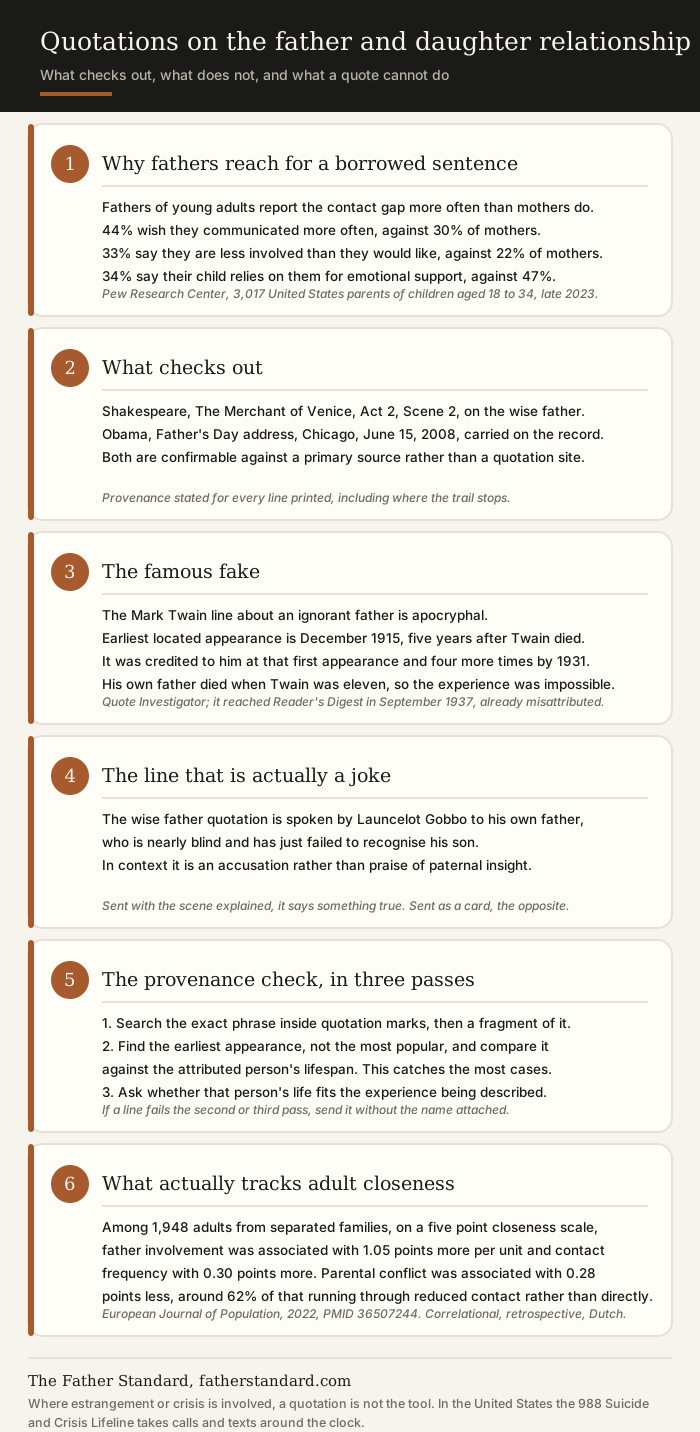
The Pew Research Center surveyed United States parents of young adults in late 2023 and found that fathers report wanting more contact than they get at markedly higher rates than mothers. Forty four percent of fathers said they wish they communicated with their young adult child more often, against thirty percent of mothers. Thirty three percent of fathers said they are less involved in their child's life than they would like to be, against twenty two percent of mothers. Sixty three percent of fathers say they are as involved as they would like to be, against seventy percent of mothers. Sixty three percent text their young adult child at least a few times a week, against eighty one percent of mothers, and the daily figures separate further, nineteen percent against forty percent (Pew Research Center, 2024).
The young adults describe the same asymmetry from their side. Thirty seven percent said their father communicates with them less often than they would like, against twenty percent who said this about their mother (Pew Research Center, 2024).
Pew measured the gap rather than what fathers do about it, so what follows is our reading rather than a finding. A quotation looks like a bid for contact with the risk taken out of it. Nobody can reject a Shakespeare line the way they can reject an unprompted sentence from you. Understanding that is the beginning of using quotations well rather than instead.
The quotations that check out
Every line below has a locatable source. Each one is followed by exactly where a reader can confirm it, and where the trail stops, this page says so rather than filling the gap with a confident guess.
It is a wise father that knows his own child.
William Shakespeare. The Merchant of Venice, Act 2, Scene 2, spoken by Launcelot Gobbo. Confirmed, and the context reverses the usual reading, which is covered in its own section below.
Any fool can have a child. That doesn't make you a father. It's the courage to raise a child that makes you a father.
Barack Obama. Father's Day address at the Apostolic Church of God, Chicago, June 15, 2008. Confirmed against the audio carried in the NPR transcript rather than against a quotation site.
When I was a boy of fourteen, my father was so ignorant I could hardly stand to have the old man around. But when I got to be twenty one, I was astonished at how much he had learned in seven years.
Credited to Mark Twain, and apocryphal. It appears nowhere in Twain's published work, and the evidence against it is strong enough to be worth its own section below.
A daughter needs a dad to be the standard against which she will judge all men.
Credited to Gregory E. Lang. Why a Daughter Needs a Dad, 2002, is a genuine and widely sold book by a real author. The exact wording that circulates could not be confirmed against the text using publicly available sources, so the sentiment is his and the precise sentence is unverified.
To a father growing old nothing is dearer than a daughter.
Credited to Euripides, untraceable. It is frequently tied to the play Helen, but by a modern publisher's cover title rather than by a cited line, and it could not be located in a standard translation using public sources.
Two of those five entries are honest failures rather than finds, which is why the provenance is printed underneath each one. Checking turns up gaps about as often as it turns up confirmations.
The most shared father quotation on the internet was not said by Mark Twain
The line about the ignorant father who learned an astonishing amount in seven years is the single most reproduced father quotation in circulation, and Twain did not write it.
The research trail is unusually clean. The earliest located appearance of the saying is dated December 1915, five years after Twain died in 1910, and it was already attributed to him at that first appearance. It does not occur in his published work. It resurfaced under his name at least four more times between 1916 and 1931 before reaching Reader's Digest in September 1937, which is roughly where its modern popularity begins (Quote Investigator).
There is also a biographical mismatch, and it is worth being careful about how much it proves, because it is weaker than it looks. Twain's father, John Marshall Clemens, died when Twain was eleven years old, while the quotation describes a relationship with a living father across the years from fourteen to twenty one. Quote Investigator raises exactly that point and then declines to rest on it, and it is right not to: Twain wrote in a fictionalised first person often enough that a mismatch with his own life settles nothing. In an 1872 dinner speech he placed himself at fourteen living with both his parents, which was not true either. So the biography is a flag rather than a verdict. What carries the case is the archive: the line surfaces five years after his death and appears nowhere in his writings, notebooks or letters.
This matters more than a trivia correction. A father sending that line to his daughter is sending a sentence whose entire authority comes from the name attached to it, and the name is wrong. If she looks it up, which takes seconds, the message she receives is not the one that was sent.
The wise father line is a joke, and knowing that improves it
"It is a wise father that knows his own child" is real Shakespeare, from The Merchant of Venice, Act 2, Scene 2. What the greeting cards leave out is the scene.
The speaker is Launcelot Gobbo. He is talking to his own father, Old Gobbo, who is nearly blind and does not recognise his son standing in front of him. Launcelot decides to string him along rather than identify himself, and says the line as part of the prank. The full exchange runs: "Nay, indeed, if you had your eyes, you might fail of the knowing me: it is a wise father that knows his own child."
So the line lands as a son telling his father, to his face and unkindly, that he does not know who his child is. The greeting card reading has it exactly backwards.
That reading is more useful than the sentimental one. Many fathers reaching for this line already know the feeling from the inside, not blind exactly, but out of practice at reading a daughter who has grown into someone new. Taken that way the line is an acknowledgement rather than a compliment, and sent with the scene explained it says something true. Sent as a card, it says the opposite of what Shakespeare wrote.
How to check any quotation before you send it
Three passes, in this order. Each one kills a different category of error.
| Pass | What to do | What it catches |
|---|---|---|
| Exact phrase | Search the line inside double quotation marks, then again with a distinctive fragment of it | Paraphrases that have drifted so far the original is a different sentence |
| Earliest date | Look for the oldest appearance rather than the most popular one, and compare it to the attributed person's lifespan | Posthumous attributions, which is the single most common failure |
| Life fit | Ask whether the attributed person could have had the experience described | Mismatches worth a second look, though a writer of fiction can describe a life he never lived, so treat this pass as a flag rather than a verdict |
If a line survives all three, send it. If it fails the second or third, either send it without the name attached or send something of your own instead. A father who says "I read this somewhere and it stuck with me" is on firmer ground than one who puts the wrong name on it and hopes she does not check.
What actually moves a father and daughter relationship
The measured work is elsewhere, and the size of the effects is worth knowing before a father decides how much weight a message can carry.
A 2022 analysis in the European Journal of Population followed 1,948 adults in the Netherlands whose parents had separated and who lived with their mother afterwards, and modelled what predicted closeness with their father decades later. Around thirty seven percent described the adult relationship as close or very close, and the mean closeness score sat at 2.9 on a five point scale. Two things predicted where a given relationship landed. Each unit of increased contact frequency during childhood was associated with 0.30 points more adult closeness, and each unit of increased father involvement with 1.05 points more. High conflict between the parents was associated with 0.28 points less, and the model puts around sixty two percent of that conflict association as running through reduced involvement and contact rather than acting directly (Spaan, van Gaalen and Kalmijn, European Journal of Population, 2022, PMID 36507244).
The shape of that result is the point. Contact and involvement did most of the work, and the damage from conflict travelled almost entirely by suppressing them. It is a study of a specific population, adults from separated Dutch families, and it is correlational rather than causal. It also relies on adults recalling their childhood contact and involvement decades later, which carries recall bias, so the numbers are a direction rather than a dosage. A 2009 overview in the American Psychological Association's Monitor on Psychology describes a similar shift of emphasis, away from the presence or absence framing and toward the quality and frequency of ordinary contact (American Psychological Association).
None of that is delivered by a quotation. All of it is delivered by the boring, repeated, unremarkable message that does not try to be an event. Our piece on what a distant father actually looks like from the other side covers the same ground from the daughter's vantage point, and the longer treatment of the father and daughter relationship sets out what the research does and does not support about repair.
What to send instead, when the quotation is not enough
A quotation says a general thing about fathers and daughters. A daughter already knows the general thing. What she does not have from anyone else is the specific.
Four openings that carry more than a borrowed line, ordered from lowest risk to highest.
| Opening | Why it works | When it is wrong |
|---|---|---|
| One concrete memory with no conclusion attached | It proves attention rather than claiming it, and it asks nothing back | Almost never, which is why it is the default |
| A question about something she is actually doing this week | It moves the exchange into the present rather than the archive | If you have asked and not listened before, it reads as a form |
| A plain statement of a fact you have noticed about her adult life | It treats her as a person rather than a role | If it slides into evaluation, which it does easily |
| An apology with no request attached to it | Of the four, it is the one most likely to reach a relationship that is genuinely damaged | If there is any expectation of a reply, it becomes a demand |
The rule underneath all four is that a message should not require a response in order to have been worth sending. That is the difference between contact and pressure, and it is the whole reason a quotation feels safe in the first place. A quote asks nothing. Keep that property and add the specificity.
Where this page stops being useful
This page cannot tell a father whether his daughter wants to hear from him. It cannot convert a well sourced quotation into a repaired relationship. The evidence above points the same way: no single message, however well chosen, does the work of a relationship by itself. The Pew figures describe United States parents of young adults in late 2023 and do not transfer cleanly to other countries or to younger children. The closeness study is Dutch, correlational, and restricted to adults from separated families where the child lived with the mother.
None of this substitutes for professional help once things have gone past what a message can reach. Estrangement is a situation for a licensed family therapist, and a quotation is not the tool for it. In the United States, the 988 Suicide and Crisis Lifeline takes calls and texts around the clock (988lifeline.org). Our piece on an estranged father covers what the literature actually supports there, and it is a different set of moves from the ones on this page.
Test yourself
Key takeaways
Last reviewed by The Father Standard Editorial Team on September 2, 2026. Our sourcing and AI-use rules are public on the editorial standards page.
FAQ
What is the most famous quotation about fathers and daughters?
By volume of circulation it is the Mark Twain line about a father who seemed ignorant at fourteen and astonishingly well informed by twenty one. Twain did not write it. Its earliest located appearance is 1915, five years after his death, and his own father died when Twain was eleven, which makes the experience the line describes impossible for him to have had.
Is "a daughter needs a dad to be the standard against which she will judge all men" a real quote?
The author and the book are real. Gregory E. Lang published Why a Daughter Needs a Dad in 2002 and it became a bestseller. The exact wording that circulates online could not be confirmed against the text using publicly available sources, so the honest description is that the sentiment is genuinely his and the precise sentence is unverified.
Did Shakespeare write anything about fathers knowing their children?
Yes. "It is a wise father that knows his own child" is from The Merchant of Venice, Act 2, Scene 2. The speaker is Launcelot Gobbo, and he says it while deliberately concealing his identity from his own nearly blind father, so in context it is a taunt rather than praise of paternal wisdom.
Why are so many father quotations misattributed?
Because quotation pages copy each other rather than sources, and a famous name attached to a good line spreads faster than an accurate one attached to an obscure author. Posthumous attribution is the most common single failure, which is why comparing the earliest known appearance of a line to the attributed person's lifespan catches most of them.
Will sending my daughter a quotation help our relationship?
On its own, very little. The measured predictors of adult closeness between fathers and children are contact frequency and involvement, not the eloquence of any individual message. In one analysis of 1,948 adults from separated families, each unit of father involvement was associated with 1.05 points more closeness on a five point scale. A quotation is a low risk way to start, and starting is worth doing, but the relationship is built by what follows it.
What should I send instead?
One concrete memory of her, with no conclusion drawn and no response required. It demonstrates attention rather than asserting it, and it is the one thing she cannot receive from anyone else. If the relationship is damaged rather than distant, an apology with no request attached to it is the only opening with real evidence behind it.
My daughter and I are estranged. Is a quotation a way back in?
No, and treating it as one can use up a rare chance to reach her without doing the harder work estrangement actually requires. Estrangement is a situation for a licensed family therapist rather than a message, and the moves that help there are different from the ones on this page. If you or she are in crisis, the 988 Suicide and Crisis Lifeline takes calls and texts around the clock in the United States.
Sources
- Pew Research Center, 2024 (pewresearch.org)
- Pew Research Center, 2024 (pewresearch.org)
- Quote Investigator (quoteinvestigator.com)
- 2022 analysis in the European Journal of Population (link.springer.com)
- Spaan, van Gaalen and Kalmijn, European Journal of Population, 2022, PMID 36507244 (pmc.ncbi.nlm.nih.gov)
- American Psychological Association (apa.org)
- 988lifeline.org (988lifeline.org)