The Estranged Father: Why the Distance Happened and How a Dad Starts Coming Back
An estranged father is a dad who no longer has meaningful contact with his child, or whose child has stepped back from him, so that the relationship has gone quiet on purpose. It is not the same as a father who died or lost custody or lives far away by circumstance. Estrangement is a distance that at least one person is choosing to keep, and it usually arrives after a long erosion rather than one loud rupture.
If you are the father in this, you already know it does not feel like a decision that got made in a single afternoon. It feels like a slow drift that hardened, a stretch of missed calls and shorter visits that at some point stopped being a rough patch and became the shape of things. If you are the adult son or daughter of an estranged father and you found this looking for a way to understand him, most of what follows still holds, read from the other side. Below is what estrangement actually is, why it tends to happen, what it costs the people inside it, and the honest first moves back that do not force the door.
What an estranged father actually is
Estrangement is the deliberate loss of contact or closeness between a father and his child, kept in place by at least one of them. That word deliberate is what separates it from every other kind of distance. A father who is deployed, hospitalized, or kept away by a court is absent, but he is not estranged, because nobody in the relationship is choosing the gap. Estrangement is different. Someone is holding the door shut, and usually both people can feel that it is being held.
It also comes in degrees rather than one flat state. Some estranged fathers have no contact at all, no calls, no replies, years of silence. Others still trade a stiff text on a birthday and nothing else, a contact so thin it carries none of the closeness it used to. It is not measured by how many words pass between them. A stiff yearly text can be as estranged as total silence, because the warmth has been switched off on purpose and both people are managing around a wound instead of a schedule.
This is a cousin of the patterns we cover elsewhere on this site, and it helps to know where the lines fall. A dad who lives somewhere else and rarely shows up is the absent father. A dad in the house who cannot be reached is the emotionally absent father. Estrangement is often where those stories end up if the distance is never repaired, the point where a child stops reaching because reaching kept costing more than it returned.
Why estrangement happens
The picture in most people's heads is a single betrayal, one unforgivable act that ended everything. That happens, but it is not the common shape. When Gilligan, Suitor and Pillemer studied estrangement across 2,013 parent and adult-child pairs, the factor that most strongly predicted a cutoff was not the violation of a serious social rule. It was value dissimilarity, a deep mismatch in what the two people believed and stood for. That study looked at mothers and their adult children, so read it as a strong nearby signal for fathers rather than a direct measurement of them. The point it makes is the useful one: estrangement tends to grow out of a widening distance in values and the tension that distance breeds, not out of one dramatic scene.
For fathers specifically, that value gap usually rides on top of years of thinner and thinner contact. Most dads sense the shortfall well before any cutoff. In a 2017 Pew survey, 63 percent of fathers said they gave too little time to their kids. A dad who was seldom reachable in the childhood arrives at the hard adolescent and adult years with less relationship banked to spend, and the drift toward a cutoff moves faster on that thin footing. The particular flashpoints vary, a divorce that turned into a loyalty war, a second marriage, an addiction, politics or religion that curdled into contempt, an old harm that was never owned, but underneath most of them is the same erosion of a bond that was already running low.
Estrangement is a process, not a verdict
The most freeing thing to understand about estrangement is that it moves. It is easy to treat a cutoff as a permanent sentence, a door that closed and locked. The research points the other way. When Gilligan, Suitor and Pillemer followed 61 mothers and their 274 adult children over 7 years, they watched relationships move into and out of estrangement across that span. And the movement was rarely triggered by one sudden event. It came from slow, nuanced shifts in contact and closeness over time. Estrangement, in other words, is less a wall and more a tide, and tides come back.
That study is about mothers, and it describes what happened rather than prescribing what a father should do, so do not read it as a promise that any particular door will reopen. What it does honestly show is that estrangement is often not the fixed, final thing it feels like from inside it. Some ties thawed. Some hardened. The direction was not set in stone. For a father who assumes the story is over, that is worth sitting with, because it means the work of coming back is not automatically futile.
What estrangement costs the father
The estranged father is often painted as the villain of his own story, and sometimes the harm that caused the cutoff was real and his. But the grief is real too, and it is worth naming plainly, because a father who cannot admit how much it hurts tends to bury it as anger, and anger is the worst possible ambassador for a reconnection. When Blake, Bland and Gilbert ran a six-session support group for 263 estranged adults, the attendees carried sadness, anger, and a sense of loss, and most of them rarely told anyone because of the shame attached to it. After the sessions, their measured psychological distress dropped from moderate to mild, and they reported feeling less alone and less ashamed.
Two things in that study matter for a father. The first is that estrangement is a genuine loss that behaves like grief, not a problem you should be able to shrug off. The second is that the shame around it keeps most people silent, and silence makes it worse. That study was about adults estranged from any family member, not fathers only, so treat it as a close parallel rather than a portrait of you exactly. What it establishes is solid ground to stand on: the pain is normal, hiding it is common, and talking to the right people measurably helps. A father who processes his own grief, ideally with support, shows up to any eventual contact as a steadier person, which is the version of him most likely to be let back in.
How an estranged father starts to come back
There is no script that reopens a door on command, and any promise that there is one should be treated as a lie. What there is, is a difference between the moves that push a child further away and the moves that make coming back feel safe. Almost every reconnection lives or dies in the same handful of choices.
| The situation | What pushes a child further away | What invites them back |
|---|---|---|
| Making contact | Frequent messages that demand a reply and a timeline | One short, warm, pressure-free opening that leaves the ball in their court |
| The old harm | Explaining why it was not that bad, or that they misremember | Owning your part plainly, with no "but" attached to the apology |
| Their reasons | Calling the estrangement unfair or a betrayal of you | Treating their reasons as real, even the ones that sting |
| The pace | Pressing for a full reconciliation now | Letting the timing belong to them, and meaning it |
| Other people | Recruiting relatives to argue your case | Keeping it between the two of you |
| If they stay silent | Escalating, guilt-tripping, or going cold in return | A steady, low, occasional signal that the door is open with no strings |
One move carries more weight than all the others: the apology without the "but." A father who says he is sorry and then explains why the child is partly to blame has really opened a negotiation, and the child hears it as exactly that. Ownership that stops cleanly, with nothing appended to soften it, is rare enough that it registers as real. If the estrangement is with a son who has gone quiet rather than fully cut off, the calm, unrattled approach in our guide on reopening the line with a withdrawn teenage son maps closely onto the early moves here, and the slow rebuild of trust we describe in why fathers and sons go silent is the same muscle. With a daughter, the dynamics in our father and daughter guide are worth reading first, because the reasons a daughter steps back are often not the ones a father assumes.
Above all, resist the urge to fix it fast. The instinct to press for a resolution is the instinct that reads, from the other side, as the same self-focus that may have caused the distance. A low, steady presence held over months, a birthday note, a short message with no ask attached, says what pressure never can: that you can be near without needing something back. That patience is the same discipline that separates a father who provides from one who is actually there, which is the whole subject of why showing up is not the same as providing.
When it is heavier than a strategy
Some estrangement sits on top of things no communication tip will touch. If the cutoff involves abuse, active addiction, or a pattern of harm, no clever reopening line touches it; the honest work is dealing with the underlying thing itself, and in some cases respecting that the door should stay closed for the child's safety. Reconnection is not always the right goal, and a father who cannot hear that is not ready for it.
The weight of estrangement also lands on the father's own mental health, and that deserves care of its own. None of this is clinical advice or crisis guidance. In the United States, help is available around the clock: call or text 988 to reach a trained counselor at the Suicide and Crisis Lifeline. A licensed therapist, ideally one who works with family estrangement, can help a father carry the grief and figure out a next step that is honest rather than desperate. Far from a detour, getting that support is often what makes a father steady enough to be worth reconnecting with.
An estranged father is not a fixed identity, and estrangement is not a verdict that got handed down for good. It is a position a relationship has moved into, built over years of thinning contact and widening distance, and the research keeps showing that these ties can move again. The way back is not a grand gesture. It is a clean apology, a door left open with no strings, and the patience to let someone walk through it on their own clock. Whether they ever do is not yours to control. What is yours: keeping that apology clean, keeping that door open, and being a man worth returning to if they look back.
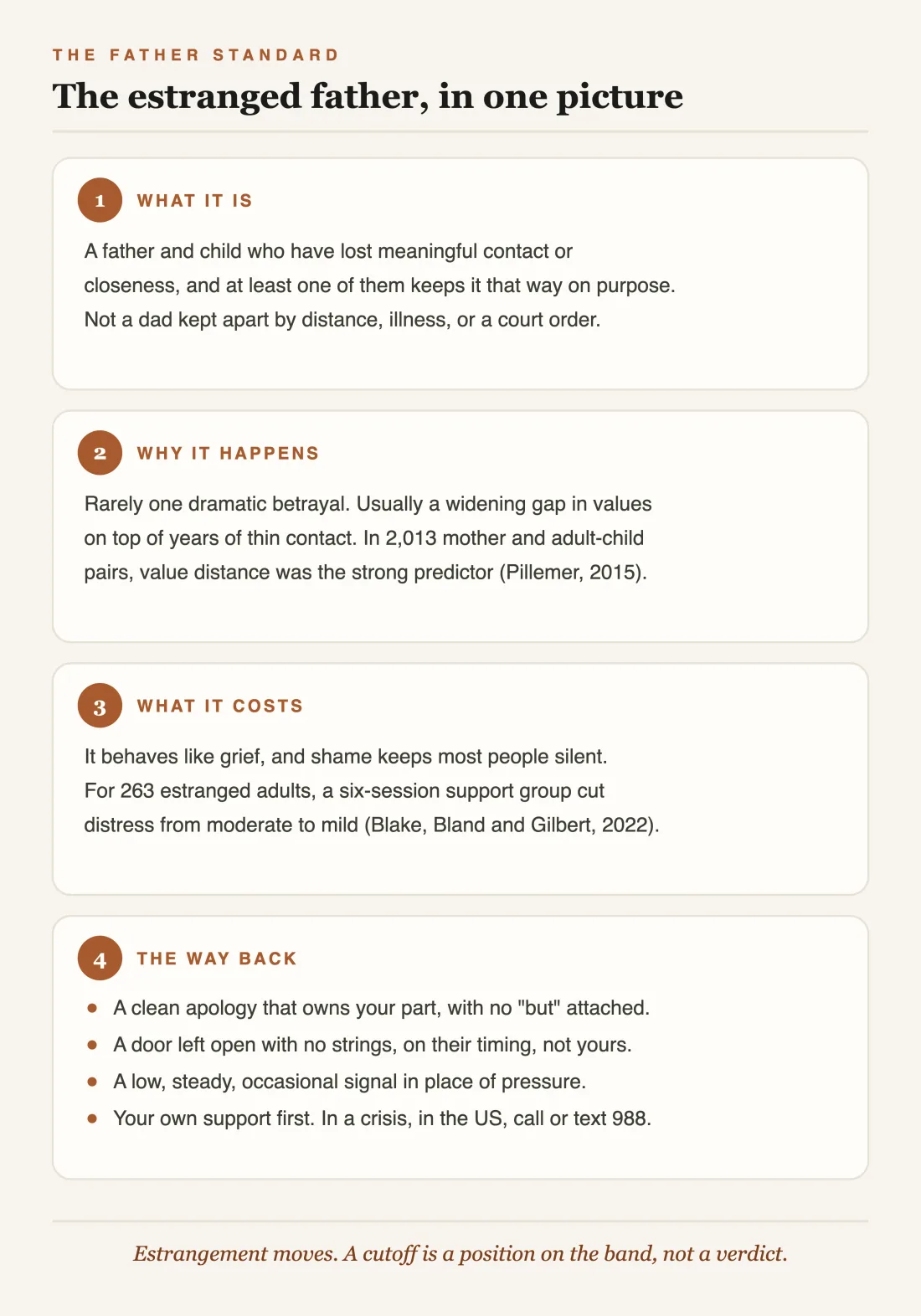
The estranged father in one picture
The whole piece compressed into a single image: what estrangement is, why it usually happens, what it costs, and the honest moves that make coming back feel safe.
Test yourself
Five questions on the core of this piece: what estrangement really is, what tends to drive it, and which moves reopen a door instead of jamming it shut. Each answer explains its reasoning, so a wrong pick teaches you as much as a right one.
Key takeaways
Last reviewed by The Father Standard Editorial Team on August 10, 2026. Our sourcing and AI-use rules are public on the editorial standards page.
FAQ
What does it mean to be an estranged father?
It means a father and his child have lost meaningful contact or closeness, and at least one of them is keeping that distance on purpose. That is what separates estrangement from other kinds of distance. A father kept away by deployment, illness, or a court order is absent but not estranged, because nobody is choosing the gap. Estrangement comes in degrees, from total silence to a thin, stiff birthday text that carries none of the old warmth. The common thread is that closeness has been switched off deliberately, and both people can usually feel it being held shut.
Why do adult children become estranged from their fathers?
Rarely because of one dramatic betrayal, though that does happen. In a study of 2,013 mother and adult-child pairs, the strongest predictor of estrangement was value dissimilarity, a deep mismatch in beliefs and what each person stands for, rather than the breaking of a big social rule. Its subjects were mothers, so treat it as a close signal for fathers rather than a direct measurement. For fathers, that value gap usually sits on top of years of thin contact, and the specific triggers vary: a divorce that became a loyalty war, a second marriage, an addiction, an old harm that was never owned, or politics and religion that hardened into contempt. Underneath most of them is a bond that was already running low on connection.
Can an estranged father and child ever reconcile?
Often, though never on demand. A 7-year study that followed mothers and their adult children found relationships moving into and out of estrangement over time, and the movement usually came from slow shifts in contact and closeness rather than one sudden event. That means estrangement is frequently a state a relationship can leave, not a permanent sentence. It does not guarantee that any particular door reopens, and some should stay closed, especially where there was abuse. But for many families the tie is more movable than it feels from inside the silence.
What is the first thing an estranged father should do?
Work on himself before he works on the relationship. Estrangement behaves like grief, and the shame around it keeps most people silent, which makes it worse. A father who processes his own loss, ideally with support or a therapist, shows up to any eventual contact as a steadier person, which is the version most likely to be let back in. When he does reach out, the first move is a short, warm, pressure-free message that owns his part with no "but" attached and leaves the timing entirely to the child. Frequent, demanding contact does the opposite of what he wants.
Why does my apology to my estranged child never work?
Usually because it is not a clean apology. A father who says he is sorry and then explains why the child is partly to blame, or why the harm was not that bad, has opened a negotiation rather than apologized, and the child hears it exactly that way. Ownership that stops cleanly, with nothing appended to soften or share the blame, is rare enough that it registers as genuine. Pair that with patience: pressing for a full reconciliation right after apologizing tends to read as the same self-focus that may have caused the distance in the first place.
Is estrangement always the father's fault?
No, and the question itself is often the wrong frame. Sometimes the harm that caused the cutoff was real and the father's to own. Sometimes the distance grew from a value gap, a messy divorce, or the influence of other people, with responsibility spread across more than one person. And sometimes a child needs distance for reasons a father may never fully agree with. Assigning total blame in either direction rarely helps. What helps is a father owning his actual part cleanly, taking the child's reasons seriously even when they sting, and getting his own support so the grief does not come out as anger.
Sources
- estrangement across 2,013 parent and adult-child pairs (pubmed.ncbi.nlm.nih.gov)
- too little time to their kids (pewresearch.org)
- 61 mothers and their 274 adult children over 7 years (pubmed.ncbi.nlm.nih.gov)
- a six-session support group for 263 estranged adults (pubmed.ncbi.nlm.nih.gov)
- Suicide and Crisis Lifeline (988lifeline.org)