The Father-Daughter Relationship, and What It Quietly Asks of You at Every Age
There is no single father-daughter relationship to get right. There is a bond that keeps changing shape as she grows, and the father she needs at each stage is a different man from the one before. You searched for the phrase because you want to matter to her, and you suspect the way you mattered when she was small does not translate to who she is now. You are right. Maybe she is nine and pulling away toward friends. Maybe she is fifteen and her door is closed more than it is open. Maybe she is thirty-two and the calls have gone quiet, and you cannot point to the year it happened.
Miss that shifting shape, and you keep offering her the closeness that worked five years ago, wondering why it lands wrong. See it, and you stop guessing.
This guide covers what the research actually credits to a present father, how the bond shifts at each age, what she needs from you that never changes, and how to reconnect when the distance has already opened.
What a present father actually shapes in a daughter
Start with what the evidence actually supports, because the culture around fatherhood runs on slogans. Single fatherhood has moved from rare to common in a single generation. Single dads headed about 8% of households with children under 18 as of 2013, up from roughly 1% in the early 1960s, and the American Psychological Association treats a father's active role as a real and distinct influence on how a child develops, not a backup to the mother.
The influence also reaches places most fathers never think to look. When researchers pooled decades of studies on father absence and daughters, a meta-analysis of 33 studies covering more than 70,000 girls found that father absence was significantly associated with earlier onset of puberty. The association is modest at the level of any single girl, closer to a population pattern than a prediction, and an earlier line of work by Ellis and colleagues traced part of it to family stress and the presence or absence of a father figure during a girl's early years. Read carefully, these are correlations across populations, not a verdict on any one family, and no honest father should hear them as blame if he was not there. What they do establish is real: a father's presence registers in a daughter's development at a level far below what a birthday card can reach. If absence itself is the harder question for you here, we take up what it actually costs and what a father can still do about it in the guide on the absent father.
The same body of work keeps pointing at two things that sit inside your control at any age, presence and the quality of the relationship, rather than perfection or a spotless history. You cannot rewrite the years you missed. You can change what the relationship is from this week forward, and that is where every ounce of your influence lives.
The relationship changes shape at every age
The reason so many fathers feel they lost their daughter somewhere is that they kept fathering the girl she used to be. The bond does not weaken as she grows; it changes what it asks of you. The father who adapts stays close. The father who repeats what once worked slowly becomes background.
In early childhood she wants your attention and your play, and closeness is nearly automatic. In the tween years, roughly nine to twelve, her world tilts toward friends and her own competence, and the father who takes that as rejection starts pulling back at the exact moment she is testing whether he will stay. Adolescence is where most fathers feel shut out, and it is precisely the stage that rewards effort the most, because a teenage daughter is not rejecting you so much as practicing independence with the safest person she has. Then comes adulthood, when the relationship becomes voluntary on both sides, and the account you built through all the earlier stages either carries the bond or does not.
| Stage | What the relationship asks of you | The mistake that opens distance |
|---|---|---|
| Early childhood | Show up for play and attention; be the reliable, delighted presence | Outsourcing the fun and the bedtime, then wondering why the bond feels thin later |
| The tween years (about 9 to 12) | Stay close while she reaches for friends; keep the door open without forcing it | Reading her new independence as rejection and withdrawing first |
| Adolescence | Be the safe, non-reactive adult she can return to; listen more than you fix | Taking the closed door personally and meeting her distance with your own |
| Adulthood | Let the relationship be voluntary; offer without demanding, show up without keeping score | Waiting for her to make all the effort, or trading closeness for being right |
If your daughter is a teenager right now, the underlying shift matches what governs teenage sons, and the moves that hold a bond steady through adolescence carry straight across: our guide to reconnecting with a teenage son covers the non-reactive posture that keeps an adolescent coming back.
What she needs from you that never changes
Underneath the shifting demands, three things hold at every age, and they are the ones fathers most often trade away for a paycheck, a solved problem, or a lecture that felt like guidance at the time.
She needs you present, not just providing. A daughter reads your attention as her worth. The paycheck, the roof, the college fund, all of it matters and none of it substitutes for the twenty unhurried minutes where she has your face and not your phone. The difference between the father who provides and the father who is actually there is the whole subject of being present, not just providing, and daughters feel that gap earlier and more sharply than most dads assume.
She needs you safe to come to. The single most valuable thing you can be to a daughter is the person whose reaction she can predict and does not fear. If bad news gets met with a lecture, an interrogation, or a flare of temper, she stops bringing you the bad news, and then she stops bringing you the news at all. Safe does not mean permissive. It means she can tell you the true thing and know the relationship will hold.
She needs you to listen before you fix. Most fathers are wired to solve, and a daughter often does not want the problem solved, she wants to be heard while she works it out. Lead with a solution and she learns that her feelings are a problem to be managed. Listen first and she learns that her inner life is worth someone's full attention, and that lesson shapes what she will later accept from other men.
Reconnecting when the distance has already opened
If you are reading this because the closeness is already gone, the path back is narrower but it is real. It does not start with a grand conversation. It starts with a small, consistent, no-strings presence that asks nothing back. You are also not alone in it: about a quarter of American children lived apart from their father by 2010, so this is common ground rather than a private failure.
Reach out without a hook. Something as plain as a photo with the words I saw this and thought of you, an old inside joke, a memory, anything that opens no demand and asks for no reply, is worth more than a long letter that asks her to account for the silence. Thinking of you today is already a complete message, and it does not need an answer to have done its work. Then do it again. A workable rhythm for the first several months is roughly once every two to four weeks, often enough that she cannot conclude you gave up again, spaced enough that it never lands as pressure. If she answers, let her pace set the new rhythm. If she does not answer at all, hold that same gentle cadence for at least six months before you reconsider the approach, never the effort. If there is real repair owed, own your part plainly and without a list of her faults attached, because an apology with conditions is not an apology she can accept. And expect the early responses to be thin. A daughter who learned that the relationship was unsafe or absent will test whether the change is durable before she risks trusting it. Your job is to be durable.
The deeper mechanics of that repair, including the trap of making a child your emotional confidant and the difference between a father who is absent and one who is merely distant, are laid out in the case for the distant father. Read it before a hard week tempts you to force the reconnection on your timeline instead of hers.
Some of the distance was not earned by anything you did. When a divorce or custody fight leaves another parent shaping what your daughter believes about you, the same principles hold, but the timeline stretches and the pull to defend yourself grows stronger. Resist correcting her account of you, even the parts you are sure are wrong, because to her a defense can sound like proof of the very thing being alleged. Let steadiness be the only argument you make, and if this is your situation, look for a therapist who works specifically with parental alienation rather than general estrangement, since the pacing and the dynamics differ. And if she has told you directly to stop contacting her, that request is the one message you honor without exception. Durable does not mean ignoring a clear no.
When it is more than distance
There is a line between a strained relationship and a situation that needs professional help, and a father should know where it is. Estrangement that has hardened over years, a daughter cutting off contact entirely, a family fracture tangled with addiction, abuse, or a mental-health crisis, none of these is repaired by a better text message. If your daughter is in danger, or you are, reach the 988 Suicide and Crisis Lifeline by call or text at any hour. Bring a licensed family therapist in early instead of waiting for things to worsen, and where the estrangement has hardened, look specifically for a clinician who specializes in adult-child estrangement, since that work is its own field. Asking for that help is not a failure of fatherhood. It is one of its more responsible forms.
None of this reduces to a single trick or a perfect weekend. It is built by showing up again next week in whatever form she needs that week, and doing it enough times that she stops bracing when you do. You cannot control who she becomes. You can decide, starting this week, what kind of father she gets to have while she becomes it.
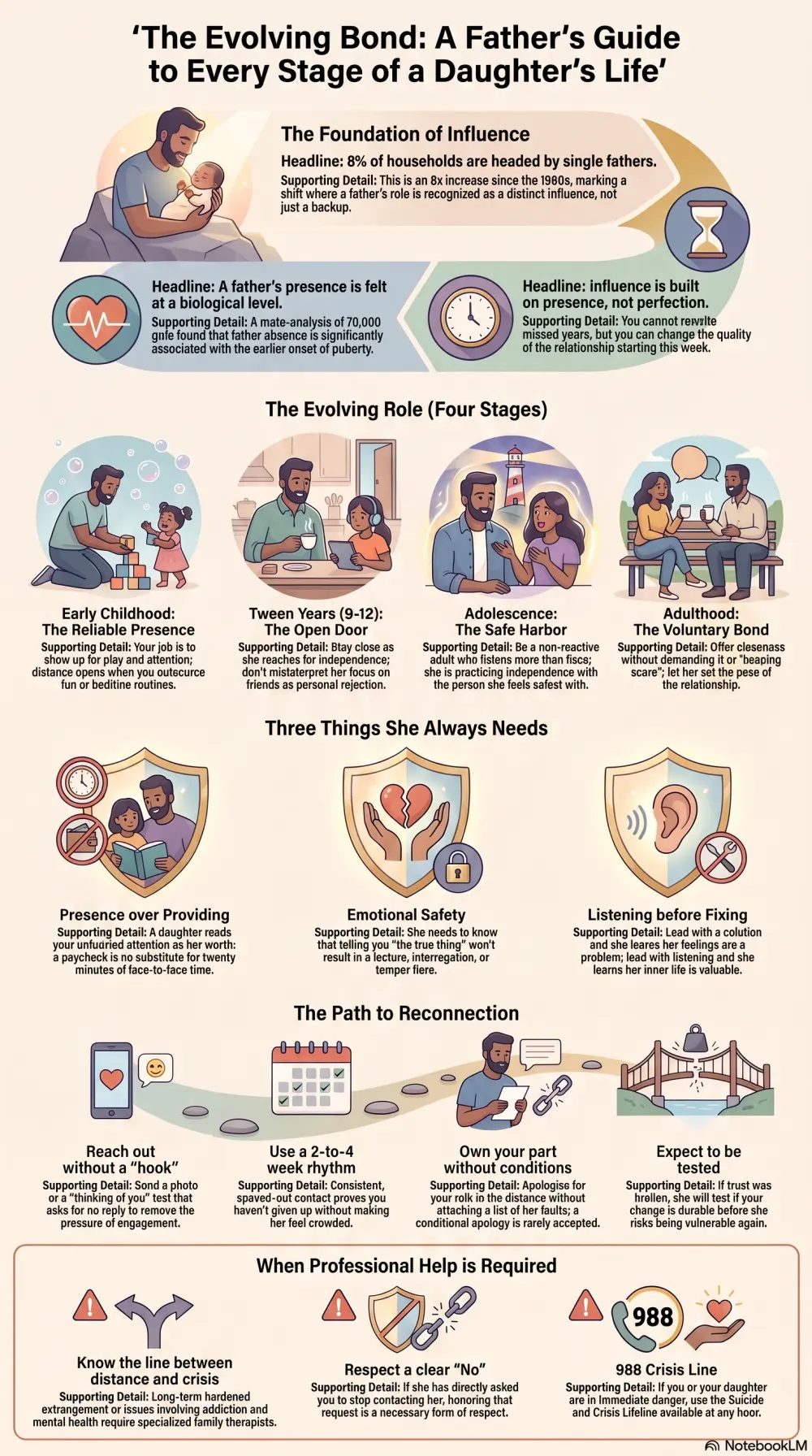
The father-daughter relationship in one picture
Everything above, condensed: what a present father shapes, how the bond changes at each age, the three things she always needs, and the line where distance becomes a matter for professionals.
Test yourself
Five questions on the father-daughter relationship across the ages. Answer honestly, then hold your answers against how your last few interactions with her actually went.
Key takeaways
Last reviewed by The Father Standard Editorial Team on August 5, 2026. Our sourcing and AI-use rules are public on the editorial standards page.
FAQ
How do I build a stronger bond with my daughter?
Start by matching what you offer to the age she is now, not the age she was when the closeness came easily. A young child needs your play and attention, a tween needs you to stay close while she reaches for friends, a teenager needs you calm and safe to come to, and an adult daughter needs a relationship that does not keep score. Underneath every stage, three things hold: be genuinely present rather than only providing, be safe to bring hard news to, and listen before you rush to fix. Those are the moves that compound. A single big gesture rarely changes a relationship; a hundred small, reliable ones do.
Why is my teenage daughter pulling away from me?
Pulling away is the job of adolescence, and she usually aims it at the safest adult she has rather than at you personally, because you are the one she trusts to still be there once the phase passes. The mistake that turns a normal season into lasting distance is matching her withdrawal with your own. Staying warm is concrete, not a mood: keep sending the small message with no question attached, show up to the game or the recital she claimed not to care whether you attended, keep her place at the table on the nights she barely speaks. Non-reactive is the other half, meeting a slammed door without slamming one back. The full posture is in reconnecting with a teenage son, and it applies just as directly to a daughter.
Can I repair the relationship with my adult daughter after years of distance?
Often yes, though it runs on her timeline rather than yours. Repair starts small, with low-stakes contact that carries no request and no guilt, sent about once every few weeks rather than forced through one dramatic conversation. Own your part of the distance plainly, without attaching a list of her faults, because a conditional apology is one she cannot accept. If months pass with no reply, know that the silence is common and is not a cue to escalate: hold the same steady, undemanding rhythm rather than sending the long wounded letter, which reads as pressure and undoes the patience. Then expect to be tested, since a daughter who learned the relationship was unsafe or absent will check whether the change lasts before she trusts it. Where the rupture is deep or bound up with addiction, abuse, or a mental-health emergency, work with a licensed therapist trained in family estrangement, and when someone's safety is at stake, the 988 Suicide and Crisis Lifeline answers calls and texts at any hour. The groundwork for that repair is in the case for the distant father.
At what age does the father-daughter relationship change the most?
Adolescence is the stage where most fathers feel the change hardest, but the turn actually starts earlier, in the tween years of roughly nine to twelve. That is when her world tilts toward friends and her own competence, and a father who reads the tilt as rejection begins pulling back at the exact moment she is testing whether he will stay. Adolescence then feels like the break because it is where a father feels most shut out, and it is also the stage that rewards effort the most, since a teenage daughter is practicing independence with the safest person she has rather than rejecting him. Adulthood brings a quieter change of its own, when the relationship becomes voluntary on both sides and the account built through the earlier stages either carries the bond or does not. The bond does not weaken as she grows. It changes what it asks of you, and the father who keeps fathering the girl she used to be is the one who slowly becomes background.
Sources
- Single dads headed about 8% of households with children under 18 as of 2013 (pewresearch.org)
- American Psychological Association treats a father's active role as a real and distinct influence on how a child develops (apa.org)
- a meta-analysis of 33 studies covering more than 70,000 girls found that father absence was significantly associated with earlier onset of puberty (pubmed.ncbi.nlm.nih.gov)
- family stress and the presence or absence of a father figure during a girl's early years (pubmed.ncbi.nlm.nih.gov)
- about a quarter of American children lived apart from their father by 2010 (pewresearch.org)