The Co-Parenting Application, and the Discipline It Cannot Buy You
A co-parenting application will not fix your co-parenting. What it can do is hand you one neutral, court-safe channel for the schedule, the appointments, and the money, plus a written record of who said what. What it cannot buy you is the thing that actually protects your children: the low-conflict discipline you run through that channel. You searched for the app because you want the fighting to stop leaking onto your kids, you want a record because memory has become a weapon, and you want one place to handle the logistics without a phone call that ends in a slammed door.
An app can give you the record and the logistics. It cannot stop the fighting for you. The software is a channel; what flows through it is your call. Here is the part that is genuinely in your hands: you can hold that low-conflict discipline on your own, even when the other parent never does.
This guide covers what a co-parenting application actually does, how to pick one without getting sold, and how to use it so it lowers the conflict your kids feel instead of becoming a new place to fight.
What a co-parenting application actually is
Fathering across two homes is ordinary. The share of American homes with minor kids run by a single father reached about 8% by 2013, several times the 1960 level, and beyond those households sit many more separated dads who split custody without running a home of their own. Divorce alone runs near 2.4 per 1,000 people a year, and plenty of co-parents were never married at all. A co-parenting application is the tool a growing share of them reach for first.
A co-parenting application is a shared, timestamped system that both separated parents log into to run the logistics of raising a child across two homes. Strip away the marketing and every serious one does four jobs: it holds a shared custody calendar, it carries written messages that cannot be quietly edited or deleted, it tracks shared expenses, and it stores a record of decisions and documents. Some add a tone filter that flags a hostile line before you send it, and some let a lawyer or therapist view the thread.
The reason the category exists is that the ordinary tools fail under stress. Text messages get deleted, screenshots get doctored, phone calls turn into arguments with no witness, and a group chat becomes a place to relitigate the marriage. A co-parenting app replaces all of that with one neutral, permanent, viewable channel. That value is real. It is also where the work starts rather than where it finishes.
Why the channel matters more than the app
Most fathers assume the harm to their kids traces back to the divorce, or to a custody split that feels unfair. The evidence lands elsewhere. When Clinical Psychology Review reviewed years of research on divorced families in 2020, the two variables that best predicted how children fared were how much the parents fought and how well each one parented. The American Academy of Pediatrics puts it more plainly, reporting that children fare better as the conflict between their parents drops, and that one of the strongest protective moves a parent can make is to keep a child clear of the adults' quarrel.
Read that against what an app does. The software does not lower conflict by existing. It lowers conflict only if you use it to move your communication somewhere written, factual, and out of your children's earshot. The American Psychological Association is blunt about the target: after a split, build a low-conflict relationship centered on the children, not a standing forum for adult grievances. A co-parenting application is a tool for building exactly that channel. It cannot make you walk through it calmly. The full operating standard behind that calm, the four rules that hold up no matter how the other parent behaves, lives in a father's standard for co-parenting after a split. Think of the app as how you execute that standard, never as a replacement for having one.
What to look for in a co-parenting app
The market is crowded, and most comparison lists are affiliate pages ranking whoever pays the most. Ignore the star ratings and judge an application on whether it enforces the discipline that lowers conflict. Four capabilities do the real work. The rest is convenience.
A tamper-proof message log is the non-negotiable one. If a message can be edited or deleted after it is sent, the record is worthless the day you need it. A shared calendar with a change history stops the "you never told me about the recital" argument from having anywhere to hide. An expense tracker with receipts moves money out of the emotional column and into an accounting one. And a tone check, where the app flags a hostile phrase before it goes out, is the feature that quietly rewrites your own behavior, because knowing a line will be flagged makes you edit it yourself.
| What to look for | Why it lowers the conflict your kids feel | Treat as a red flag |
|---|---|---|
| Tamper-proof, timestamped messages | Ends the he-said-she-said that pulls kids in as witnesses | Any app that lets either parent edit or delete sent messages |
| Shared calendar with change history | Removes the schedule ambush that turns handoffs tense | A calendar only one parent can edit or see |
| Expense log with receipts | Keeps money disputes off the phone and off the kids | Money handled only by text or verbal promise |
| Tone or language flag on messages | Makes you rewrite the barbed line before your co-parent ever reads it | No record at all, so nothing discourages the barb |
| Professional or court access on request | Lets a judge or therapist see the real pattern, not a curated screenshot | Records that cannot be exported or certified |
How to use it so it actually lowers conflict
The same application that protects your kids can become the new battlefield if you bring the old fight into it. The app does not fight for you or against you; your habits inside it decide which way it cuts. Five rules turn a co-parenting app from a weapon back into a channel.
Write every message as if a judge will read it, because one day one might. Keep it to logistics, facts, and dates. No history, no grievance, no bait. This is not just legal caution. Writing for a calm reader rehearses the father your children deserve, and the record it leaves is one you will be proud of.
Reply to the schedule and let the barb sit. When a message arrives with a hook in it, respond only to the date or the question and leave the provocation unanswered. An app makes this easier than a phone call ever could, because you can wait, breathe, and edit before you send.
Put money and the calendar in the app, and keep them there. Every expense with a receipt, every schedule change in writing. The moment logistics move back to text or a hallway conversation, they lose the record that keeps them honest, and the conflict follows them out.
Never route a message through your child. The application exists precisely so that "tell your dad the pickup moved" never has to travel through a kid. The same pediatric guidance that warns parents against running each other down within a child's earshot applies to logistics too: adult business stays between the adults.
Let the tone flag do its job. When the app warns you that a line reads as hostile, rewrite it instead of resenting the warning. Over months, the habit outlasts the software.
If your children are teenagers, the app matters less and your track record matters more, because adolescents notice the gap between how you talk about their mother and how you actually behave. The specific moves for holding the bond through those years are in our guide to reconnecting with a teenage son.
When the court orders one
In high-conflict custody cases, judges sometimes order both parents to communicate through a specific co-parenting application and nowhere else. If that happens to you, treat it as an advantage rather than a punishment. A court-ordered channel takes the ambiguity out of the situation: there is one place to communicate, one record of whether each parent is cooperating, and no argument about what was said. The parent who uses that channel cleanly, month after month, builds a documented pattern of steady, child-focused conduct. The parent who keeps trying to drag the fight back into texts and voicemails builds the opposite. You do not control which of those the other parent becomes. You fully control which one you are.
The application cannot fix a dangerous situation
A co-parenting app lowers conflict between two parents who are both safe. It does nothing about abuse, threats, or a co-parent who is a real danger to you or your child. In that situation the app's records may help your legal case, but the channel is not a shield. Get your lawyer involved, document everything, and bring in professionals early. Call the National Domestic Violence Hotline at any hour on 1-800-799-7233, or find it online at thehotline.org. Should you or your child hit a mental-health crisis, the 988 Suicide and Crisis Lifeline takes calls and texts around the clock. Put a licensed family therapist on the team now, not once things get worse. No app, and no article, is a substitute for that help. The particular damage that follows when a father makes a child his emotional confidant is spelled out in the case for the distant father, worth reading before a hard week ever tempts you there.
None of this comes down to which icon sits on your phone. Kids do not keep score of the app their parents used. What they carry into adulthood is whether the weeks felt calm or felt like a minefield. A co-parenting app is one of the better tools for making those weeks calmer, and it stays exactly that, a tool in the hands of the father who decides how to use it.
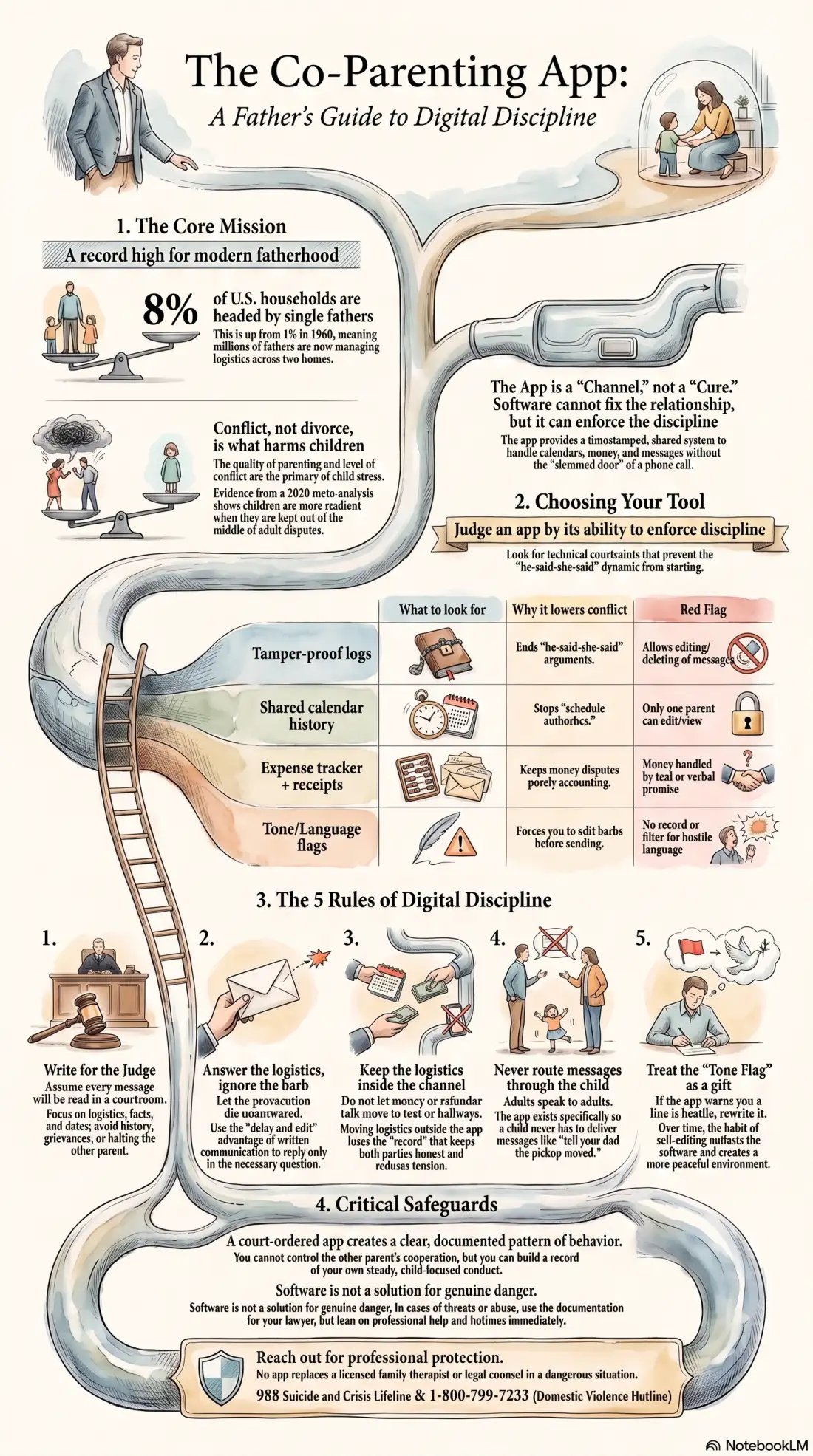
The co-parenting application in one picture
Everything above, condensed: what the software actually does, the four capabilities worth paying for, and the discipline no download can supply.
Test yourself
Five questions on choosing and running a co-parenting application. Be honest, then compare your answers to how your last tense exchange actually went.
Key takeaways
Last reviewed by The Father Standard Editorial Team on August 4, 2026. Our sourcing and AI-use rules are public on the editorial standards page.
FAQ
Do I really need a co-parenting app, or is texting fine?
Texting is fine right up until it is not, and by then the record you needed is already compromised. A co-parenting application gives you a tamper-proof, timestamped channel, so when a disagreement about who said what surfaces, there is one clean record instead of two sets of screenshots. If your co-parenting is genuinely low-conflict and cooperative, a shared calendar and a single email thread may be enough. The higher the conflict, the more a dedicated app earns its place, because it takes the arguable parts of communication and makes them un-arguable.
Which co-parenting application is the best one?
The best one is whichever enforces the four capabilities that lower conflict: a message log that cannot be edited or deleted, a shared calendar with a change history, an expense tracker with receipts, and a tone flag on outgoing messages. Widely used options built around those capabilities include OurFamilyWizard, which family courts often order in high-conflict cases, along with TalkingParents, 2Houses, and AppClose. Match any of them against your situation and the checklist above rather than chasing a star rating. High-conflict or court-involved cases lean toward the apps built for documentation, and if a judge orders a specific application, use that one. Cooperative co-parents can use something lighter. The tool matters far less than the discipline you run through it, which is the part covered in a father's standard for co-parenting.
How should I respond to a hostile co-parenting message?
Answer the logistics and leave the rest. Reply only to the date or the question in front of you and let the barb sit unanswered, which an application makes easier than a phone call ever could, because you can wait, breathe and edit before you send. Keep what you do send to logistics, facts and dates, with no history, no grievance and no bait, on the assumption that a judge may read it one day. If the app flags your line as hostile, rewrite it rather than resenting the warning. Never route any of it through your child. What carries weight is the pattern rather than any single exchange.
What happens if the court orders us to use a co-parenting app?
You use it, and you treat it as an advantage rather than a punishment. Judges order a single application in high-conflict custody cases, and what that order does is take the ambiguity out of the situation: there is one place to communicate, one record of whether each parent is cooperating, and no argument about what was said. The parent who uses that channel cleanly, month after month, builds a documented pattern of steady, child-focused conduct. The parent who keeps trying to drag the fight back into texts and voicemails builds the opposite. You do not control which of those the other parent becomes. You fully control which one you are. If the order names a specific application, use that one rather than the one you would have picked.
Can messages in a co-parenting app be used in court?
Often yes, though never automatically. Reputable co-parenting applications keep records that cannot be altered after the fact, and many can produce certified or exportable logs, but whether a given record is admitted still runs through your jurisdiction's evidence rules, so ask your attorney how to certify and submit an export. The prospect cuts two ways, which is exactly why these apps work: knowing a judge could read anything you write pushes both parents toward neutral, child-focused messages. Write every message as if it will be read aloud in a courtroom, keep it to logistics and facts, and the record that protects you also quietly improves your behavior. If your situation involves abuse or danger, that documentation supports your case but does not replace your lawyer, or, where anyone is in crisis, the 988 Suicide and Crisis Lifeline.
How do I keep records that will hold up in court?
Put everything in one channel and keep that channel clean. Pick an application whose messages are timestamped and cannot be edited or deleted after they are sent, whose calendar carries a change history, and whose expense log holds receipts, then move the schedule and the money into it and keep them there. The moment logistics travel back out to a text or a hallway conversation, they lose the record that keeps them honest. Write every message as if a judge will read it, which means logistics, facts and dates, with no history, no grievance and no bait, and when a message arrives with a hook in it, answer the date and leave the provocation unanswered. Check before you commit that the app can export or certify its logs, because records that cannot be exported or certified are a red flag. Admissibility is never automatic even so, since it runs through your jurisdiction's evidence rules, so ask your attorney how to certify and submit an export. What carries the most weight is the pattern rather than any single message: the parent who uses the channel cleanly, month after month, builds a documented record of steady, child-focused conduct. Where abuse or danger is involved, that documentation supports your case but is not a shield, so bring your lawyer in early.
Sources
- The share of American homes with minor kids run by a single father reached about 8% by 2013 (pewresearch.org)
- Divorce alone runs near 2.4 per 1,000 people a year (cdc.gov)
- Clinical Psychology Review reviewed years of research on divorced families in 2020 (pubmed.ncbi.nlm.nih.gov)
- children fare better as the conflict between their parents drops (healthychildren.org)
- a low-conflict relationship centered on the children (apa.org)