How to Reconnect With Your Teenage Son (Without a Big Talk)
There is a specific silence that lives in houses with teenage boys. You ask how school was. Fine. You ask how the game went. Good. You ask if anything is wrong. No. Three conversations, four words, and a door you could swear was open five years ago.
Most fathers respond to that silence in one of two ways. They force it, scheduling the big talk that both of you dread and neither of you survives with dignity. Or they accept it, deciding that teenagers are just like this and the relationship will resume on its own in ten years.
Both are wrong, and both are expensive. Here is what is actually happening on the other side of the one-word answers, and the small mechanics that reopen the line.
First, the reframe: the silence is developmental, not personal
A teenage boy pulling away from his parents is doing a job. Adolescence is the project of building a self that stands apart from the family, and distance from you is one of its raw materials. The withdrawal, the closed door, the allergy to questions: normal development, not necessarily evidence of a broken relationship. Pediatric guidance on talking with teens backs the approach underneath this whole article: listen without judgment and skip the lecture. The withdrawal you feel with your son is one piece of a wider shift in the job itself, from managing a child to consulting a near-adult, which plays out across the whole teenage decade.
That is the part fathers are told. Here is the part they are not: normal distance still compounds if you match it. When he steps back and you step back in response, out of respect or hurt or busyness, the gap doubles. The job is to hold your position while he does his job. Close enough to reach, far enough not to crowd.
And the stakes are not soft. Fathers themselves put this relationship at the center of who they are: in Pew Research Center's national survey, 85% of fathers said being a parent is the most or one of the most important aspects of their identity. Almost no man feels that way and wants to discover, at his son's graduation, that they have not had a real conversation in four years.
Why the big talk backfires
The big talk is the instrument of a man who solves problems at work: book the meeting, name the issue, resolve it. With a teenage boy it fails for three predictable reasons.
First, it is high-stakes by design, and high stakes are exactly what he cannot afford with you. A face-to-face conversation about the relationship asks him to perform emotional disclosure, live, to the person whose judgment weighs most. The refusal is not defiance. It is load management.
Second, it arrives on your schedule. Teenagers disclose on a delay and at strange hours. The willingness to talk shows up at eleven at night, in the car, mid-task, and almost never inside the window you reserved for it.
Third, it frames the relationship as a problem he caused. However carefully you phrase it, "we need to talk about us" lands on a sixteen year old as an accusation. Now he owes you an explanation he does not have words for. Silence is his only dignified exit.
Retire the summit. What replaces it is smaller, cheaper, and it works.
The mechanics that reopen the line
1. Feed him openers that cost nothing
One-word answers are not the absence of communication. They are the correct response to status-update questions. "How was school" is a request for a report, and reports from teenagers come in one word.
Swap in questions that are specific, low-stakes, and slightly absurd. "Rate the cafeteria food out of ten and defend the score." "Who would win, your coach or your principal, and in what sport." "Tell me one thing that made you laugh today. There is always one." These work because they can be answered without self-disclosure. You are not asking him to open up. You are demonstrating, rep after rep, that talking to you is cheap.
The feelings are not the target. The feelings arrive later, riding on rails built from nonsense conversations. That is how boys work, and frankly, how their fathers work too.
2. Go shoulder to shoulder
Eye contact is confrontation equipment. The formats where boys actually talk are parallel: the car, the gym, the grill, the garage, the walk, the game. Hands busy, eyes forward, silence allowed.
| Venue | Why it works | Your move |
|---|---|---|
| The car | Fixed duration, no eye contact, capped depth | No calls while he is in the seat, ever |
| The gym or a shoot-around | Effort covers the silences | Train together, talk between sets |
| The grill or the garage | Hands busy, shoulder to shoulder | Give him a real job, not a chore |
| His game or his feed | His territory, his expertise | Be the guest, ask the dumb question |
| Late-night kitchen | Defenses are down after eleven | Be findable, not waiting up |
The car deserves special mention. It is the single best conversation venue ever built for fathers and teenage sons: fixed duration, no exits, no eye contact, and an end point that caps how deep anything has to go. Never waste a drive by handing him silence while you take a call. Half the real conversations you will ever have with this kid happen at forty-five miles an hour, both of you looking at the road instead of at each other.
3. Enter his territory without annexing it
Somewhere in his week there is a thing he is genuinely into: a game, a sport, an artist, a build, a feed. The move is to show up in it as a guest, not an inspector. Let him be the expert. Ask the dumb question and take the mockery with grace. The point is not that you love the thing. The point is that interest in his world, offered without judgment, is the strongest signal of respect a father can send a teenage boy.
One warning: do not weaponize what you learn there. The father who turns last week's confidence into this week's lecture closes the door harder than distance ever did.
4. Hold one recurring slot, and make it boring
Reconnection is not an event. It is a standing order. Pick one recurring, low-key slot that belongs to the two of you: Saturday breakfast, the Thursday drive, the Sunday shoot-around. Protect it the way you protect revenue, and let it be unremarkable. No agenda, no check-in, no "so how are we doing."
The slot does its work through repetition. It tells him, without a single word of ceremony, that time with him is a fixed line in your week and not a gap-filler. If your calendar genuinely cannot produce one defended hour, that is the upstream problem, and it has its own playbook: Present, not just providing.
5. Treat the first disclosure like a live grenade, gently
At some point, if you run these mechanics, he will hand you something real. A worry, a girl, a failure, something he did. This moment is the entire project, and most fathers blow it in under ten seconds by doing one of three things: fixing it, judging it, or telling the story of when the same thing happened to them in 1998.
Do none of these. Say less than you want to. "That is a hard one. Walk me through it." Ask what he wants from you before assuming: sometimes he wants help, usually he wants to be heard by a man he respects. The quality of your reaction to disclosure one sets the price of disclosure two.
6. Repair fast and out loud
You will lose your temper, miss the slot, mock the wrong thing. Boys forgive a bad moment fast. What they remember is whether you owned it out loud. Say it plainly, eye to eye, no self-flagellation: "I handled that badly. That is on me."
A teenage boy who watches his father correct himself without excuses is receiving the most valuable single lesson in masculinity available anywhere, and it costs one sentence.
What progress actually looks like
Calibrate your expectations to reality, because unrealistic expectations kill this project in week three.
Progress is not him telling you his feelings. Progress is the grunt turning into a sentence. Progress is him staying in the kitchen four minutes after the food is gone. Progress is one unprompted text about something dumb, sent to you and not just to his friends. These are the offers restarting, and every one of them is him testing whether the new line is real.
The lag is real too. Depending on how far things drifted, expect weeks or months of faithful, boring presence before the account pays its first dividend. This is where fathers who run companies have an unfair advantage, because they already know what to do with a system that compounds slowly: you keep feeding it, you do not check the price daily, and you never interrupt it because this quarter felt flat.
The longest study of men's lives ever conducted keeps returning one finding: the quality of relationships is the strongest predictor of health and happiness in the long run. Your son is the longest relationship you will ever hold. The window where he is down the hall is shorter than it looks, and it is open right now, one dumb question at a time.
If the distance runs wider than one teenager, start with the mechanism itself: how good men end up strangers at home, and how it reverses.
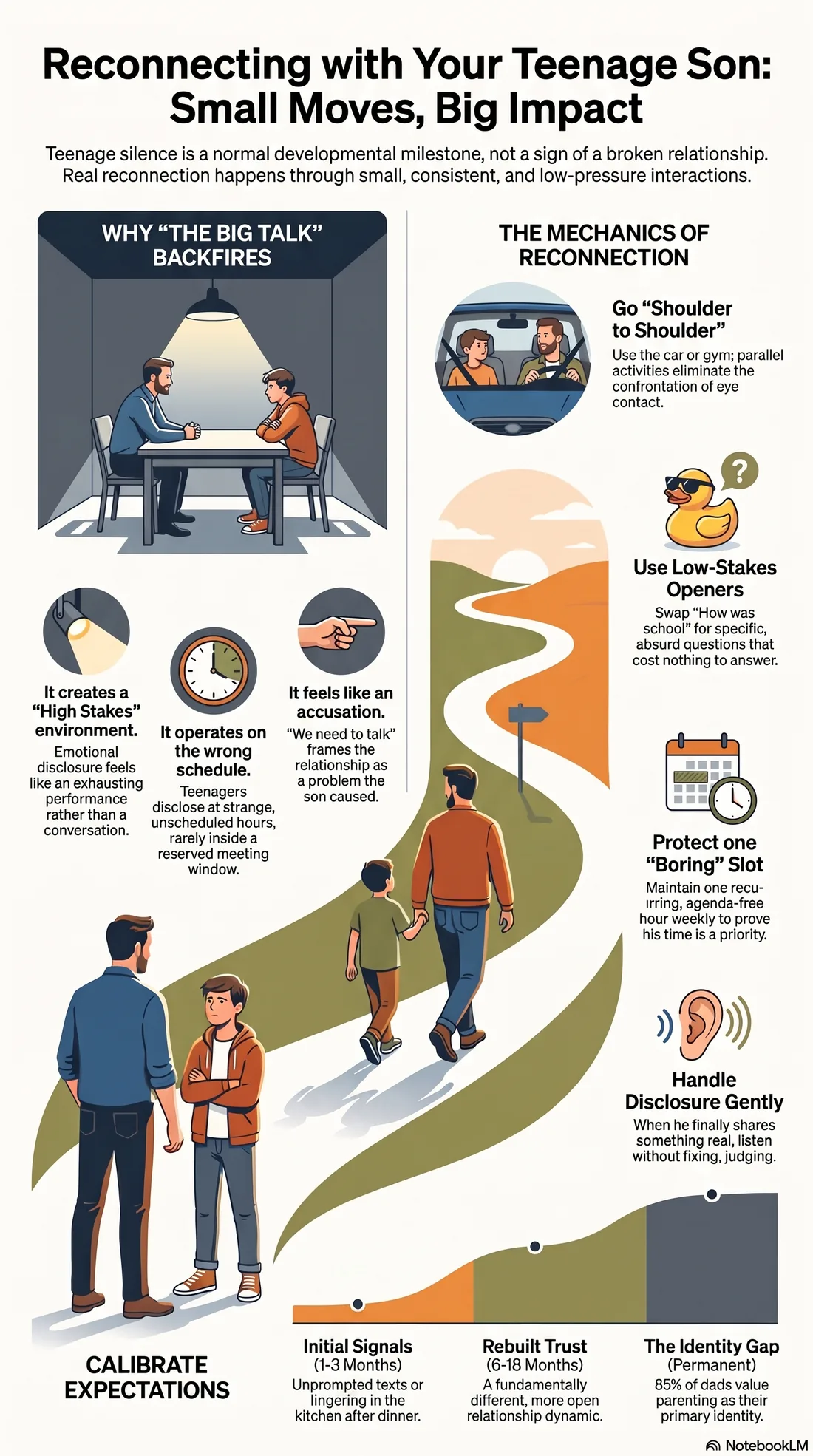
The playbook, in one picture
Everything above in one picture: why the silence happens, why the big talk fails, and the mechanics that reopen the line.
Test yourself
Five questions. Fathers who pass this understand their one-word teenager better than they think.
Key takeaways
Last reviewed by The Father Standard Editorial Team on July 28, 2026. Our sourcing and AI-use rules are public on the editorial standards page.
FAQ
How do I reconnect with my teenage son if he only gives one-word answers?
Stop asking status-update questions and start offering low-stakes, specific openers he can answer without disclosing anything. Move conversations into parallel formats like the car or the gym, hold one recurring slot per week, and let repetition do the work. One-word answers are the correct response to interrogation. Change the format and the answers change.
Should I force my teenager to spend time with the family?
Require presence at a small number of fixed anchors, like family dinner or the weekly slot, and keep the pressure low inside them. Forcing enthusiasm backfires, but abandoning structure entirely tells him the connection is optional for you too. Boring, mandatory, low-pressure anchors are what the relationship rebuilds on.
My son talks to his mother but not to me. Is that normal?
Very common, and not a verdict. Mothers often hold the disclosure channel while fathers hold a different one: activity, competence, humor. Do not compete with her channel or interrogate her for intel. Build your own line through shared activity and cheap conversation, and expect it to look different from hers. Different is not worse.
How long does it take to rebuild the relationship?
Treat these as editorial working estimates rather than measured research. The first signals, longer answers, an unprompted text, him lingering in the room, typically show up within one to three months of consistent low-pressure presence. Something that feels like a genuinely different relationship usually takes six to eighteen months. The timeline belongs to him. The consistency belongs to you.
Why does the big talk backfire with a teenage son?
The scheduled sit-down about the relationship fails for three predictable reasons. It is high-stakes by design, asking him to perform emotional disclosure live to the person whose judgment weighs most, which is exactly what he cannot afford with you. It arrives on your schedule, when teenagers actually disclose on a delay, at eleven at night or mid-task, almost never inside the window you reserved for it. And however carefully you phrase it, "we need to talk about us" lands on a sixteen year old as an accusation, leaving silence as his only dignified exit. Retire the summit and replace it with smaller, cheaper openers that cost him nothing to answer.
What activities actually reopen the line with a teenage boy?
Parallel ones. Eye contact is confrontation equipment to a teenage boy, so the formats where he actually talks are the ones where the hands are busy and the eyes are forward: the car, the gym, the grill, the garage, the walk, his game. The car is the best of them, because it has a fixed duration, no exits, no eye contact, and an end point that caps how deep anything has to go, which is why you never waste a drive by taking a call from the front seat. Add one thing he is genuinely into, entered as a guest rather than an inspector, and one recurring low-key slot that belongs to the two of you and stays deliberately unremarkable. The activity itself is not the point. The format is.
Sources
- listen without judgment and skip the lecture (healthychildren.org)
- 85% of fathers said being a parent is the most or one of the most important aspects of their identity (pewresearch.org)
- the quality of relationships is the strongest predictor of health and happiness in the long run (adultdevelopmentstudy.org)