Co-Parenting After a Split: A Father's Standard for Protecting the Kids from the Conflict
Most fathers walk into co-parenting braced for the wrong battle. They fight for time, for the schedule, for the sense that they did not get erased. That fight feels like the whole war, and it is not even the important front.
The important front is quieter. It is what your children absorb in the handoffs, in the tone of a text message their mother reads across the room, in whether Sunday night feels like a truce or a landmine. That is one of the biggest variables in how they come out the other side, and unlike the custody schedule, it is something you can influence on your own even when the other parent will not cooperate.
This is that standard. Your lawyer handles the legal strategy. Your job is to run your half of a two-household system so well that your children never have to manage the distance between their parents.
Co-parenting is now a father's job, at scale
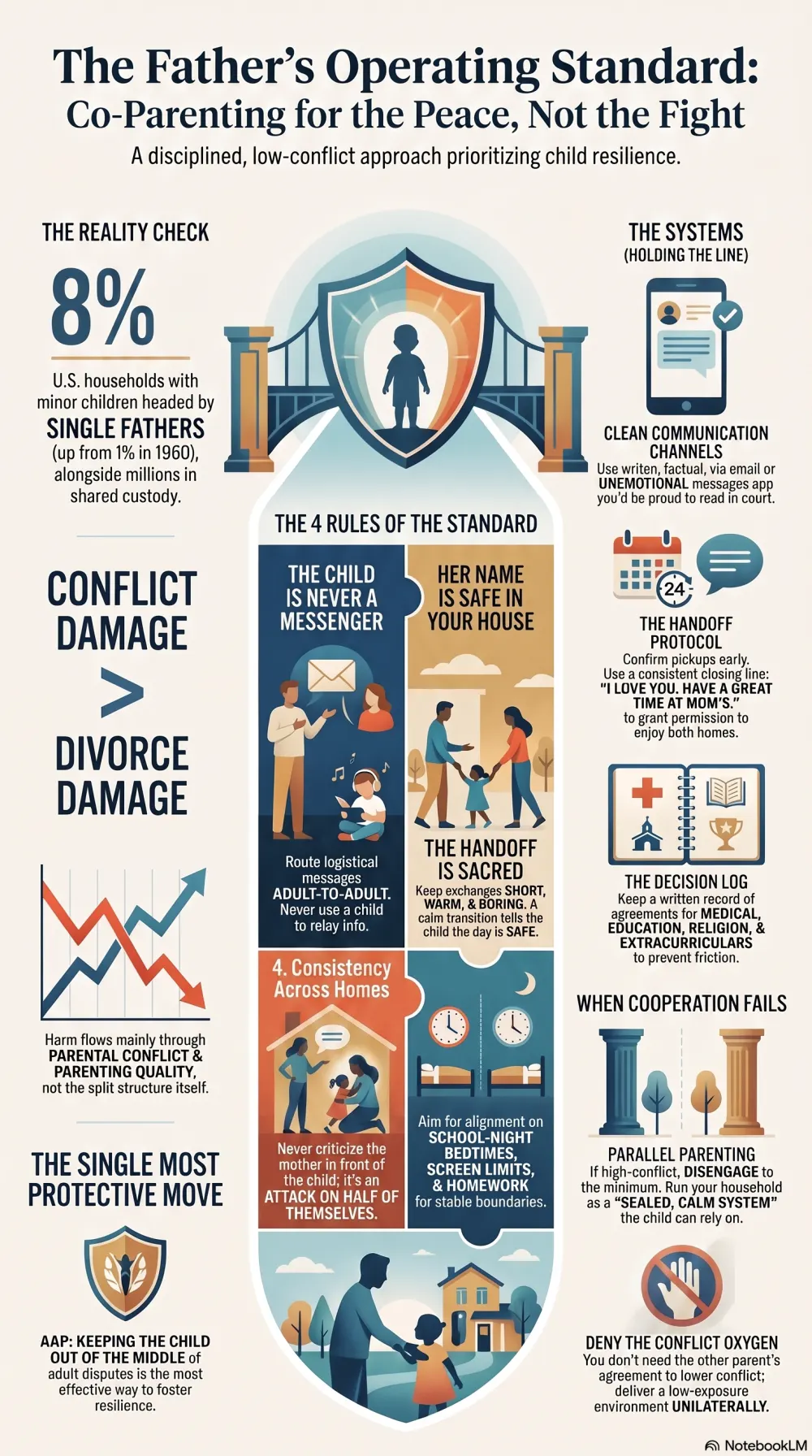
This is not a niche situation. A record 8% of U.S. households with minor children are headed by a single father, up from just over 1% in 1960, and that number sits on top of the millions of separated fathers who share custody without heading their own household. Against a national backdrop of roughly 2.4 divorces per 1,000 people each year, co-parenting has quietly become one of the central jobs of modern fatherhood. The American Psychological Association treats it as exactly that, framing the goal after a split as a healthy, low-conflict relationship organized around the children rather than around the adults' grievances.
The one fact that reorders everything
Fathers assume the damage comes from the divorce itself, or from not seeing the kids enough. The evidence points somewhere else. A 2020 meta-analysis in Clinical Psychology Review, pooling decades of data on divorced families, found that the harm to children flows mainly through two channels: the conflict between the parents and the quality of parenting each one provides. Those are the mechanisms the research keeps returning to, which is why what the children see and hear inside the arrangement carries so much weight.
The American Academy of Pediatrics says the same thing in plainer language. Its guidance on separation states that children prove more resilient and less stressed when there is less conflict between their parents, and one of the protective moves it highlights is keeping the child out of the middle of the adult dispute.
Treat that as an instruction. A court largely fixes your custody percentage. It does not fix how much conflict your kids are exposed to, and you can lower that on your own even if the other side never does. The father who understands this cares less about winning the schedule and more about keeping the house calm.
The standard, defined
A co-parenting standard is a set of rules you hold yourself to regardless of how the other parent behaves on any given day. It has to work unilaterally, because you do not control her and cannot wait for her to be reasonable before you do the right thing. Four rules carry most of the weight.
The child is never a messenger. No information travels through your kid because you do not want to talk to their mother. "Tell your mom the check is coming" is a small thing that teaches a large lesson: that your child is responsible for the tension between the adults. Route every logistical message adult to adult, even when it costs you a swallowed sentence.
Her name is safe in your house. You do not need to like her. You need to make sure your child never has to defend one parent to the other. A child hears criticism of their mother as criticism of half of themselves, which is why the AAP is explicit that parents should not criticize each other in front of the child or where the child might overhear. This is the hardest rule and the one that pays the most.
The handoff is sacred. Exchanges are where two households touch, and they are where children read the temperature. A tense, clipped handoff tells a kid the day is dangerous. Keep them short, warm, and boring. Show up on time, hand over the backpack, say something kind, leave. The boredom is the point.
Consistency across the two homes. Children do better when the rules do not swing wildly between houses. The AAP notes that consistent rules and discipline across both homes give kids the stable boundaries they need. You cannot force her house to match yours, but you can align on the few things that matter most, bedtime on school nights, screen limits, how homework gets handled, and hold your end without fail.
Build the system so feelings do not run it
Good intentions collapse under a bad week. The point of a system is that it holds when you are angry, tired, or hurt, which in the first year after a split is most of the time. Three mechanics do the holding.
Move communication to a channel you can be proud of
Route co-parenting logistics through written messages you would be comfortable reading aloud in front of a judge, because one day you might. Many fathers use a dedicated co-parenting app or a single email thread for scheduling, medical notes, and expenses. The medium is not magic. The discipline it enforces is: written, factual, unemotional, and time-stamped. When she sends something barbed, you answer the logistics and ignore the bait. Every message you keep clean is evidence, and more importantly it is a rehearsal of the man your kids need you to be.
Run a real handoff protocol
Treat the exchange like a procedure, not a mood. A workable one: confirm the next pickup in writing the day before, arrive five minutes early, keep the curbside conversation to schedule and health only, and give your child a consistent line as they leave, some version of "I love you, have a great time at Mom's, see you Thursday." That one line matters more than it sounds like it should. It gives your child explicit permission to enjoy the other house, which lifts a weight most kids of divorce carry silently. The mechanics of holding steady across a hard transition are the same ones we lay out in the working father's presence playbook.
Keep a decision log for the big four
Agree, in writing, on the handful of cross-home decisions that cause the most friction: medical, education, religion, and extracurriculars. Write down what you have settled so a future argument cannot rewrite history. Where you cannot agree, name a tiebreak process before you need it. Agreeing on how a decision gets made, while you are still calm, is what stops next week's disagreement from turning into a war.
| Situation | The standard holds | The standard breaks |
|---|---|---|
| She sends a hostile text | Answer only the logistics, in writing, calmly | Fire back, or vent to the kids about it |
| The child relays a complaint about her house | Listen, validate the feeling, stay neutral on her | Pile on, use it as evidence against her |
| A handoff runs late | Note it factually, keep your tone flat | Turn the curb into a confrontation |
| Rules differ between homes | Hold your house's rules without commentary | Tell the kid the other house is doing it wrong |
| You miss your kids badly on her nights | Feel it privately, protect their time there | Call constantly, make them manage your grief |
When the other parent will not cooperate
Sometimes the standard above meets a wall, because the other parent is high-conflict, undermining, or worse. The strategy then has a name: parallel parenting. Instead of trying to collaborate closely, you disengage to the minimum necessary, communicate only in writing about only the essentials, and run your household as a sealed, calm system the child can rely on. The goal is no longer agreement. It is starving the conflict of the child's attention. Children can do well inside parallel parenting, because what protects them was never the friendliness between their parents. It was the low exposure to fighting, and you can deliver that alone.
Hold one line even here: your child still never becomes your ally against their mother. The temptation is enormous when she is behaving badly, and it is the one move that reliably damages kids in the long run, the same wound described in the distant father playbook when a parent leans on a child for emotional support the child is not built to give.
If the situation involves abuse, threats, or a parent who is a genuine danger, this stops being a co-parenting question and becomes a safety one. Document everything, involve your lawyer, and lean on professionals. The National Domestic Violence Hotline is reachable 24/7 at 1-800-799-7233 or at thehotline.org, and if you or your child are ever in a mental-health crisis, the 988 Suicide and Crisis Lifeline is available 24/7 by call or text. A licensed family therapist should be part of the plan, not an afterthought. No article replaces that help.
Co-parenting a teenager is a different sport
The rules above hold at every age, but adolescence changes the terrain. Many teenagers start voting with their feet, negotiating the schedule themselves, and noticing hypocrisy the moment it appears. The father who spent years keeping handoffs clean and their mother's name safe has built the currency that matters most now: a teenager who does not associate his house with tension. If your kids are entering those years, the specific moves for staying connected through them are in how to reconnect with your teenage son.
The through-line across every age is the same one the research keeps returning to. Your children are not grading the custody split. They are grading how peaceful the week felt. Deliver that on your own, on the days it is hardest, and you will have done the one thing the evidence says actually helps.
Co-parenting in one picture
The whole standard on one page: the one fact that reorders everything, the four rules, and the systems that make them hold under a bad week.
Test yourself
Five questions on the co-parenting standard. Answer honestly, then check what your last hard week actually looked like.
Key takeaways
Last reviewed by The Father Standard Editorial Team on August 3, 2026. Our sourcing and AI-use rules are public on the editorial standards page.
FAQ
Does joint custody or sole custody matter more for how kids turn out?
The custody label is not where the research puts its focus. The evidence identifies conflict between the parents and the quality of each parent's care as the main channels through which children are affected after a separation, working somewhat independently of the specific custody arrangement. That is why a high-conflict setup can weigh on a child even when the time split looks fair. Fight for a fair schedule, and at the same time lower the conflict your children experience, because that is the part the evidence ties most directly to how they do.
How do I co-parent with someone who refuses to cooperate?
Switch from close collaboration to parallel parenting. Communicate only in writing, only about essentials like schedule, health, and school, and stop trying to reach agreement on everything. Run your own household as a calm, consistent, sealed system the child can count on. Children do well inside parallel parenting because what protects them is low exposure to conflict, which you can provide on your own without the other parent's help.
What actually goes in a co-parenting decision log?
The four cross-home decisions that cause the most friction: medical, education, religion, and extracurriculars. Write down what the two of you have settled on each so a future argument cannot rewrite history. Where you cannot agree, record the tiebreak process you will use, named before you need it rather than in the middle of the disagreement, because agreeing on how a decision gets made while you are both still calm is what stops next week's disagreement from turning into a war. Keep every entry factual and flat in tone, the same way a late handoff gets noted, with the logistics recorded and the commentary left out.
Should I ever tell my kids the truth about their mother's behavior?
Not as a case against her. Children hear criticism of one parent as an attack on part of themselves, and the pediatric guidance is clear that parents should not criticize each other where a child can hear. You can acknowledge a child's feelings honestly without recruiting them against their mother. The exception is genuine safety: abuse or danger belongs with your lawyer, documentation, and licensed professionals, and if anyone is in crisis, the 988 Suicide and Crisis Lifeline is available 24/7.
Does conflict between parents harm children more than the divorce itself?
The research points at the conflict, not the split. What most shapes how children adjust after a separation is the level of conflict between their parents and the quality of the parenting they receive, working largely apart from the custody arrangement itself. That is why a fair-looking schedule can still weigh on a child when the hostility stays high, and why lowering the conflict does more for them than winning the arrangement. It is also the part you can influence on your own, even when the other parent will not cooperate: reduce what your children absorb in the handoffs, the texts, and the tone, and you protect them from the variable that matters most.
Does co-parenting change when the kids become teenagers?
The four rules hold at every age, but the terrain changes. Teenagers start voting with their feet, negotiating the schedule themselves, and noticing hypocrisy the moment it appears, so an arrangement that used to be settled between two adults becomes something your child now has an opinion about and acts on. That is where years of clean handoffs and a safe tone about their mother pay out, because the currency that matters at this age is a teenager who does not associate your house with tension. What they are grading does not change either. Your children are not grading the custody split. They are grading how peaceful the week felt.
What is co-parenting?
Co-parenting is the arrangement two separated parents run when they raise the same child across two households. The American Psychological Association frames the goal as a healthy, low-conflict relationship organized around the children rather than around the adults' grievances, and that framing is the whole definition worth keeping. It is not the custody percentage and it is not a friendship with your ex. It is a two-household system, and your job is to run your half of it well enough that your children never have to manage the distance between their parents. The reason the definition matters is that it points at the right target: the 2020 Clinical Psychology Review meta-analysis found the harm to children after a split flows mainly through the conflict between the parents and the quality of parenting each one provides, working largely apart from the custody arrangement itself.
Sources
- A record 8% of U.S. households with minor children are headed by a single father (pewresearch.org)
- roughly 2.4 divorces per 1,000 people each year (cdc.gov)
- a healthy, low-conflict relationship organized around the children (apa.org)
- the conflict between the parents and the quality of parenting each one provides (pubmed.ncbi.nlm.nih.gov)
- prove more resilient and less stressed when there is less conflict between their parents (healthychildren.org)