Signs of a Bad Father Son Relationship: Which Ones Are Actually Diagnostic
The most reliable signs of a bad father son relationship are not the loud ones. Search the question and you will be handed arguments, shouting, slammed doors and long silences. Those are real, and they are also the least useful items on any such list, for a reason that has nothing to do with how serious they are. A blowup is an event. Events get remembered by both people. If the only signs you are checking are the ones you can already recall, you are auditing the part of the relationship that was never hidden from you.
The signs worth looking for are the ones that leave nothing behind to remember. The measurement literature has a name for that category, and the national survey data suggests parents read the whole instrument a good deal more generously than their grown children do.
Where to look first
Stop scanning for conflict and start scanning for absence. Ask what your son would have to bring to you that he currently takes somewhere else. Assume your own rating of this relationship is the least reliable number available to you, and go find a better one: how often he makes contact without being prompted, whether the list of things he still tells you is shrinking, and whether repair reliably follows friction. All six checks are set out below.
Then calibrate honestly. The effects in this literature are small to moderate, not deterministic. A father who reads this and concludes he has ruined a son has overread it, and so has a father who concludes none of it matters.
The rating gap is the first sign, and it is about you
Pew Research Center surveyed 3,017 United States adults with at least one child aged 18 to 34, and separately 1,495 young adults aged 18 to 34 with a living parent, fielded from October 24 to November 5, 2023. The two groups were deliberately not drawn from the same families, so this is a population-level comparison rather than a within-family one. That distinction matters and it is worth keeping: nobody here is grading their own father.
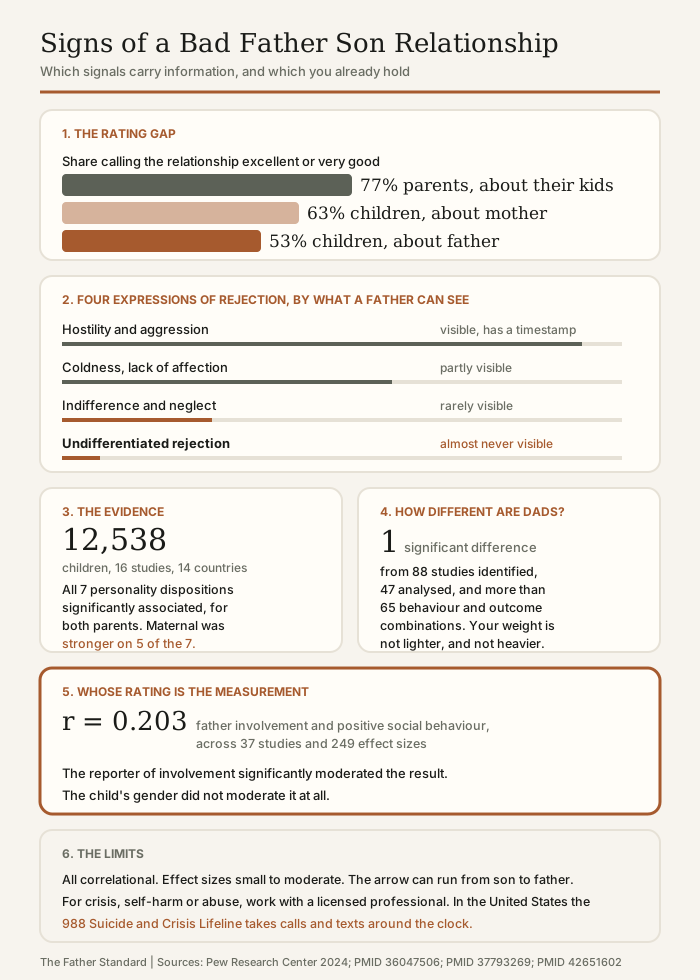
Read the two numbers next to each other anyway. Among parents, 77% describe the relationship with their young adult children as excellent or very good. Among young adults, 59% describe the relationship with their parents that way. Split by parent, young adults rate the relationship with their mother at 63% and with their father at 53%, in Pew's report on parents, young adult children and the transition to adulthood.
The practical reading is narrow, and keeping it narrow is what makes it usable. This is not a finding about your son. It is a finding about the instrument. Parents as a group rate this relationship the way the 77% figure rates it, and grown children as a group rate their fathers the way the 53% figure rates it. If your entire evidence base for the health of this relationship is your own impression of it, you are relying on the version of the instrument that reads high on average.
One more line from the same survey names the shape of it. Among young adults, 61% say their father does not rely on them for emotional support much or at all. Whatever else is happening, traffic on that road is mostly one way.
The sign that leaves no event attached to it
The organised evidence on parental rejection does not sort by dramatic incident. It sorts rejection into four expressions, and only two of them are loud.
A 2023 meta-analysis in The Journal of Genetic Psychology, covering 16 studies and 12,538 children across 14 countries, tested the fourth and quietest of those expressions: undifferentiated rejection, meaning a child's belief that a parent does not really care about him, in the absence of any specific behaviour he can point to as the cause. It is indexed as PMID 36047506. The finding was that undifferentiated rejection, from either parent, was significantly associated with all seven of the personality dispositions the theory tracks: hostility and aggression, dependence, negative self-esteem, negative self-adequacy, emotional instability, emotional unresponsiveness, and negative worldview.
| Expression of rejection | What it looks like from outside | Would a father remember it? |
|---|---|---|
| Hostility and aggression | Shouting, criticism, contempt, punishment that overshoots | Yes, it is an event with a timestamp |
| Coldness and lack of affection | Warmth withheld, physical distance, nothing offered unprompted | Sometimes, mostly as a temperament rather than an act |
| Indifference and neglect | Not being asked about, not being turned toward, plans made without him | Rarely, because the omission never became an occasion |
| Undifferentiated rejection | The son's settled sense that his father does not much care, with nothing he can name as proof | Almost never, because there is nothing to have remembered |
Look at that right-hand column on its own. It is a ranking of how visible each thing is from the father's chair, and the order is close to inverted: the expression carrying the most information is the one least likely to have been witnessed. That is the structural problem with checking for the loud signs. The loud ones are the ones you were present for.
The same paper carries a result that cuts against the framing of this entire website, and it belongs here rather than in a footnote. Maternal undifferentiated rejection was associated significantly more strongly than paternal undifferentiated rejection on five of the seven dispositions. The father's version is real, measured and significant across all seven. It is not the larger of the two.
Whose rating counts as the measurement
A 2026 three-level meta-analysis in Behavioral Sciences pooled 37 studies and 249 effect sizes on father involvement and children's social behaviour, indexed as PMID 42651602. Father involvement correlated with positive social behaviour at r = 0.203, described by the authors as moderate, and with negative social behaviour at r = -0.087, described as low.
Two of its moderator results are more useful to a father than the headline. First, the reporter of father involvement significantly moderated the size of the association, which is a technical way of saying that who you ask changes the answer you get. Second, the child's gender exerted no moderating effect at all. Whatever is operating between fathers and sons in this dataset is not a separate mechanism from what operates between fathers and daughters, which is worth knowing before treating anything here as a specifically male problem with a specifically male solution.
The reporter finding is the one to act on. It is the same lesson the rating gap teaches, arriving from a completely different direction, and together they point at a single practical instruction: you are grading an exam you also wrote. Go and find out how he would mark it.
How large the difference between mothers and fathers actually is
There is a version of this topic that treats a father's failures as uniquely damaging. The best available comparison does not support it.
A 2023 systematic review and meta-analysis in Clinical Psychology Review, conducted under PRISMA 2020 guidelines, set out to separate maternal from paternal parenting behaviours in predicting internalising problems. It identified 88 studies, analysed 47 of them and examined upward of 65 parent-behaviour and child-outcome combinations. It is indexed as PMID 37793269. Across all of that, exactly one significant maternal and paternal difference emerged: a unique role for maternal overprotection in predicting child anxiety. For everything else, the associations for mothers and for fathers were largely similar. The authors' own closing note is that fathers remain underrepresented in this literature and that stronger representation is needed before anyone draws firm conclusions about each parent's distinct role.
That result is genuinely double-edged and both edges are worth stating. Your behaviour is not weighted lighter than hers, so a father cannot treat himself as the secondary parent whose contribution rounds down. Your behaviour is also not weighted heavier, so nothing here supports the idea that a difficult father-son relationship is a category of harm apart from ordinary family difficulty. We have written separately about what a son takes from an involved father in the relationship between a father and son, and about the specific pattern where nothing is wrong and nothing is happening in the distant father.
What to check instead
Six checks, each of which returns information a father does not already hold.
The first is a traffic question. When something goes wrong in his life, how many people does he tell before he tells you, and is the number rising. The second is the unprompted contact question. Strip out every contact that was logistics, a birthday or a reply to you, and count what is left over a month. The third is the topic inventory. List the subjects that used to be discussable and are now routed around, because a shrinking list of safe topics is the quiet version of the same finding.
The fourth is the true-self question. Pew found 69% of young adults say they can be their true self with their parents all or most of the time. Ask yourself which version of himself is in the room when he is with you, and whether he relaxes when he leaves. The fifth is the repair question, and it is the one that separates a rough relationship from a bad one. After friction, who moves first, how long does it take, and does it happen at all. Relationships that survive conflict are not the ones with less conflict. They are the ones where repair reliably follows.
The sixth is to ask him, badly. Not as a summit, not as an interview, and not in a way that requires him to manage your reaction. One specific answerable question, once, in passing, and then let it sit. If asking feels too exposed to attempt, that reluctance is itself a reading. Our practical version of that conversation is set out in how to reconnect with your teenage son.
The limits, stated plainly
Everything above is correlational. None of these studies randomly assigned children to fathers, so the arrow may run the other way, and a son who is struggling for reasons of his own can make a father withdraw as easily as the reverse. Shared circumstances such as income, illness or upheaval push both sides at once. The effect sizes are small to moderate throughout, and a correlation near 0.2 is a real finding that describes a tendency across thousands of families rather than a verdict on yours.
If any of this touches genuine crisis territory, meaning self-harm, suicidal thinking, abuse or a son who has cut contact and is not safe, it stops being a relationship question and becomes a clinical one. Work with a licensed professional. In the United States the 988 Suicide and Crisis Lifeline takes calls and texts around the clock. Nothing on this page is a substitute for either.
The signs on a single page
Test yourself
Key takeaways
Last reviewed by The Father Standard Editorial Team on August 31, 2026. Our sourcing and AI-use rules are public on the editorial standards page.
FAQ
What is the single clearest sign of a bad father son relationship?
Not conflict. The clearest signal is the absence of unprompted contact combined with a shrinking list of subjects that can be raised without management. Conflict means two people are still contesting something. The measured construct that most closely matches the quiet version is undifferentiated rejection, a son's settled sense that his father does not much care, held without any specific act attached to it, and it was significantly associated with all seven personality dispositions across 16 studies and 12,538 children.
Is a father's failure worse for a son than a mother's?
The available comparison does not show that. A systematic review under PRISMA 2020 guidelines identified 88 studies and examined more than 65 parent-behaviour and child-outcome combinations, and found exactly one significant maternal and paternal difference, which concerned maternal overprotection and child anxiety. On the rejection side, maternal undifferentiated rejection was associated more strongly than paternal on five of seven dispositions. Fathers are underrepresented in this literature and the authors say so.
My son and I argue constantly. Is that a bad relationship?
Arguing constantly is a real problem and it is a different problem from the one this page describes. The diagnostic question is not how much friction there is but whether repair follows it, who moves first, and how long that takes. Frequent conflict with reliable repair is a noisy relationship. Rare conflict with no repair is a quiet one, and the quiet one is harder to see.
He is polite and we never fight. Why does this still feel wrong?
Politeness is compatible with distance and can be the form distance takes. Check the three counts rather than the tone: unprompted contact over a month with logistics removed, the number of subjects that can still be raised, and whether he tells you about a setback before or after he has told several other people. If all three are low, the tone of your conversations is not the measurement.
Does the relationship being bad now mean I have damaged him?
Correlational findings of this size do not support that conclusion. The associations run from about 0.09 to about 0.2 in the meta-analyses cited here, which describes a tendency across thousands of families rather than an outcome for one. The arrow can also run the other way, since a son struggling for his own reasons can produce withdrawal in a father.
He is an adult now. Is it too late for any of this to matter?
The rating gap data was collected on parents and children aged 18 to 34, so it describes adult relationships specifically. Among those young adults, 61% report their father does not rely on them for emotional support much or at all, which describes a road with very little traffic rather than a closed one.
What should I not do after reading this?
Do not present the findings to him. Arriving with statistics converts a relationship question into a case being argued, and it puts him in the position of responding to evidence rather than saying something true. Ask one specific question, accept the first answer without correcting it, and change something on your side before mentioning that you have.
How long before any of this shows a change?
Longer than feels reasonable, and the early signal is not warmth. It is the safe-topic list growing back by one item, or a single piece of unprompted contact that was not a reply to you. Those are small enough to miss if you are watching for a conversation instead.
Sources
- parents, young adult children and the transition to adulthood (pewresearch.org)
- PMID 36047506 (pubmed.ncbi.nlm.nih.gov)
- PMID 42651602 (pubmed.ncbi.nlm.nih.gov)
- PMID 37793269 (pubmed.ncbi.nlm.nih.gov)
- 988 Suicide and Crisis Lifeline (988lifeline.org)