Teenager Parenting: The Job Quietly Changed and Nobody Told You
Parenting a teenager is a different job than parenting a child, and most fathers are still doing the old one. The role quietly shifts from manager to consultant somewhere around thirteen, and the fathers who keep managing, keep directing, keep issuing the calls they made when the kid was eight, find the door closing on them one flat answer at a time.
You feel it before you can name it. The boy who used to run to the car now walks to it. Ask the girl what happened at school and you get the weather report. Whatever you advise lately just bounces off. Nothing dramatic happened. The job description changed underneath you, and the memo went to your teenager, not to you.
Here is the new job, what the evidence actually supports about doing it well, and the one line every father of a teenager has to find: the line between guiding and controlling.
The job changed from manager to consultant
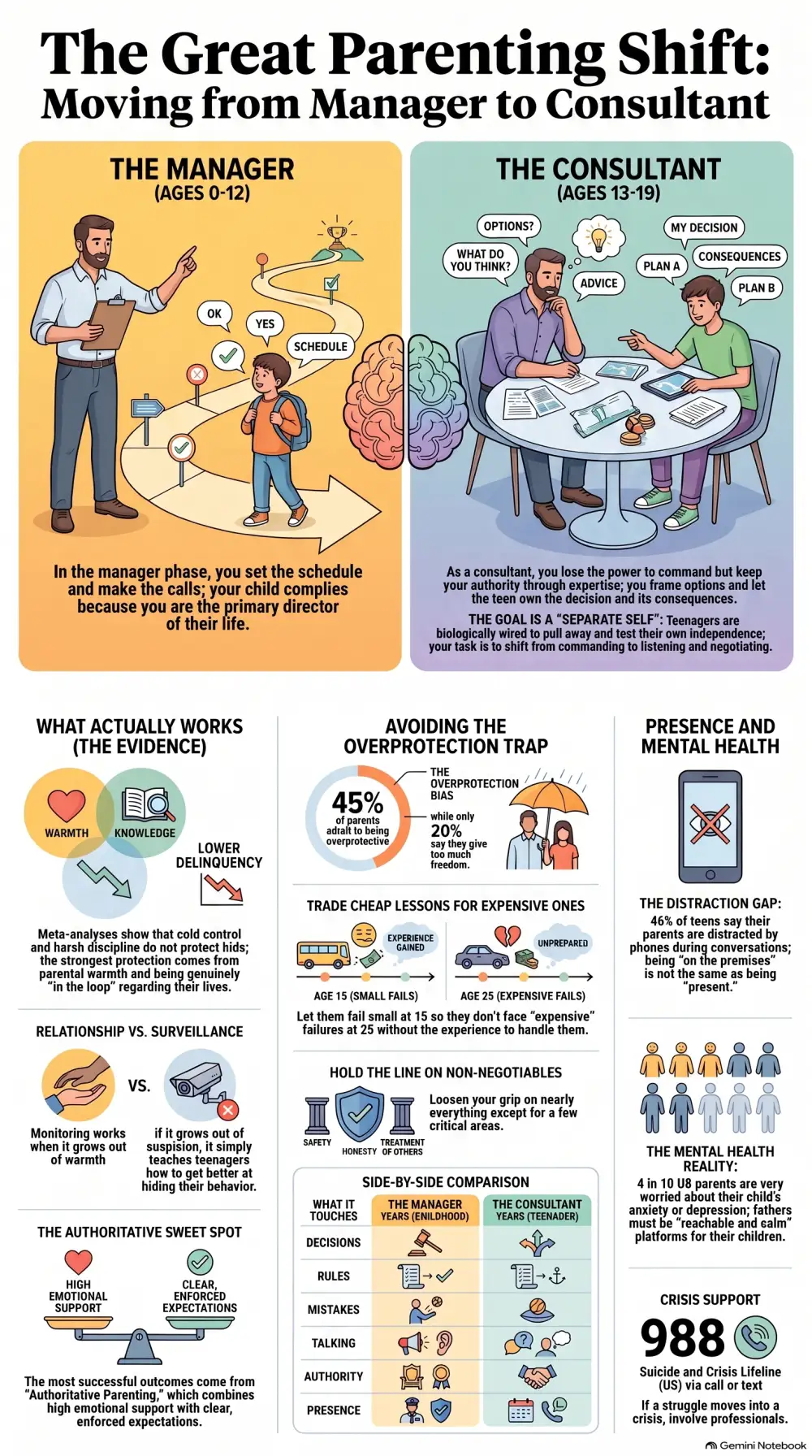
For the first decade you were a manager. You set the schedule, made the calls, held the standards, and the child mostly complied because compliance was the whole arrangement. That job is over, and clinging to it costs fathers more ground with a teenager than almost anything else they do.
The teenage years are the project of building a separate self. Your kid is supposed to pull away, argue the rules, and test whether the person they are becoming can stand on its own outside your shadow. Pediatric guidance on talking with teenagers lands on the same shift: listen more than you talk, and skip the lecture, because a lectured teenager stops hearing you. That is the consultant's posture, not the manager's.
A consultant father still holds the line on the handful of things that matter. What changes is the rest. He frames the options, says what he sees, and lets his teenager own the decision and what follows from it, inside those limits. Make that shift on purpose and you keep your influence. Refuse it and all you keep is the fighting.
What the evidence says actually works
Strip away the parenting-blog noise and one pattern keeps surfacing: warmth and structure belong together, not one at the expense of the other. The blend of high warmth with clear, enforced expectations, often called authoritative parenting, is the model developmental researchers keep pointing to for adolescents. What the hard data adds is which ingredient carries most of the weight.
The clearest signal comes from the discipline nobody markets to fathers: the delinquency literature. A large meta-analysis of 161 studies on parenting and delinquency found the strongest links ran in two directions. Rejecting parenting, neglect, hostility, harsh criticism, raised the risk most. Low parental knowledge of what a teenager was actually doing raised it too. Manipulative, guilt-based control, what researchers call psychological control, carried its own real risk, roughly as strong as monitoring's protective pull. Firm rule-setting on its own, without warmth or rejection attached, barely moved the needle either way.
Read plainly, that says something most fathers get backward. Rules are not the lever. What protects a teenager is staying warm rather than rejecting, and staying genuinely informed about their life. The informed part only works when it grows out of the warmth. Knowledge a teenager hands you because they trust you is protection. The same knowledge pried loose by suspicion just teaches them to hide better.
The overprotection trap
Fathers of teenagers tend to fail in a specific direction. Asked to describe their own bias, 45% of parents say they lean overprotective, against just 20% who admit to giving too much freedom. The instinct is love. The effect, over the teenage years, is to starve your kid of the exact thing the decade exists to build: the muscle of handling their own life. What that looks like measured, for raising a teenage daughter, is a short list of logistics rather than a change in tone.
A teenager who is never allowed to fail small, forget the homework, miss the bus, blow the money, mishandle the friendship, arrives at eighteen with an adult body and a child's experience of consequences. Your job in the consultant years is to keep the failures survivable and let them happen, not to remove every obstacle. Trade cheap lessons at fifteen for expensive ones avoided at twenty-five.
One line matters here: this applies to reversible mistakes only. Money, chores, forgotten responsibilities, minor social fallout, let those land. It does not apply to anything with permanent stakes. Driving safety, substance use, unprotected sex, physical risk, those stay non-negotiable, not lessons to learn the hard way.
Going hands-off is its own failure, the bottom corner of the grid. The move is to hold a short list of non-negotiable lines, safety, honesty, substance use, how people in your house treat each other, and loosen your grip on nearly everything else as they prove they can carry it.
The mental-health reality you cannot outsource
The teenage years now carry a weight that changes the whole job. Amid a widely reported youth mental-health crisis, four in ten US parents say they are extremely or very worried their child might struggle with anxiety or depression, the top worry on their list. For fathers this is dangerous ground, because the reflex a lot of us were raised on, toughen up and push through, was built for a different problem.
Skip the therapist act. Your job is to be reachable and calm. A father who meets a struggling teenager with panic or a lecture teaches him to stop bringing the hard stuff home. Hear him say "I have not been okay" without flinching, treat it as information instead of an emergency, and he keeps talking to you. Pediatric guidance is blunt that this is not a thing to wait out: take changes in mood or behavior seriously and treat mental health like any other health concern.
Learn the signs that go past ordinary teenage moodiness: a withdrawal from everyone rather than just you, sleep or appetite that swings hard, grades falling off a cliff, talk of being a burden or of not wanting to be here, giving prized things away, or any self-harm. Any of those warrants same-day attention, not wait-and-see. Start with your teenager's pediatrician, who can screen, refer, and coordinate faster than searching for a therapist cold, and the school counselor is another fast, free entry point.
If your teenager is in immediate danger, meaning a plan, access to a means to hurt themselves, or an attempt already made, call 911 or go to the nearest emergency room. If they can reach firearms or medications and you are worried, lock those up or remove them, because reducing access to means is one of the most protective steps a parent can take in a risky stretch. For support short of an active emergency, the 988 Suicide and Crisis Lifeline connects you to a counselor by call or text, 24 hours a day in the US. None of this makes you the clinician. This is general information rather than clinical advice, and your steadiness is the platform other help stands on, never the whole building.
Presence still beats management, even now
There is a temptation, once a kid is capable and independent, to downshift into logistics: rides, money, rules, the occasional inspection. But a teenager reads the difference between a father who is around and a father who is merely on the premises. Nearly half of teens, 46%, say a parent is at least sometimes distracted by their phone when they are trying to talk to them, and teenagers notice the message in that: this call, this feed, this email, ranks above me.
Presence in the teenage years is quieter than it was. It looks like this: findable at eleven at night when disclosures actually happen, phone in the glovebox on the drive, showing up to the thing that matters to them even when it does not matter to you. The father who trades presence for provision is running a false economy, and it has its own reckoning, which we take apart in being present, not just providing.
The job, decade over decade
The clearest way to see the shift is side by side. The values stay the same. The methods invert.
| What it touches | The manager years (childhood) | The consultant years (teenager) |
|---|---|---|
| Decisions | You make the call | You frame the options, they choose |
| Rules | Many, fixed, enforced | Few, non-negotiable, the rest negotiable |
| Mistakes | You prevent them | You let the small ones land and land safely |
| Talking | You instruct | You listen first, advise second, briefly |
| Authority | Position and compliance | Trust and the relationship |
| Your presence | Supervision | Availability, on their schedule |
None of this softens the standard. The standard stays exactly as high. What changes is delivery, from something you impose to something you model until they own it. A teenager will not adopt a value because you enforced it. They adopt it because they watched you live it while they were deciding who to be.
When the distance has already opened
If you are reading this because the pulling-away has already hardened into real silence, the consultant framing still holds, but you have repair to do first. A teenage son who has gone quiet is not usually a verdict, and the line reopens through format rather than confrontation, which we walk through in how to reconnect with your teenage son. If the distance is wider and older than one adolescent, the mechanism itself is worth understanding, because good men drift into becoming strangers at home in small increments, and it reverses the same way it formed.
The teenage decade is short and it does not repeat. The kid down the hall is running the last few years of daily proximity you will ever get by default. You do not get a vote on whether the manager's era ends. You do get a vote on whether you show up on purpose for what comes next.
Teenager parenting in one picture
Everything above in one view: the shift in the job, the warm-and-firm target, the overprotection trap, and the lines that actually hold.
Test yourself
Five scenario questions drawn from the framework above: the manager-versus-consultant line, the warm-and-firm quadrant, and the overprotection trap. Each answer explains the reasoning, so a wrong guess is worth more than a right one.
Key takeaways
Last reviewed by The Father Standard Editorial Team on August 7, 2026. Our sourcing and AI-use rules are public on the editorial standards page.
FAQ
What is the hardest part of parenting a teenager?
The hardest part is letting go of the manager's job. It shows up in specific moments: the curfew debate, the grade that slipped, the friend you do not like. The manager hands down the ruling. The consultant says what he sees, names the risk he is worried about, and asks what the teenager is going to do about it before deciding whether a hard boundary is even needed. You keep the safety line. You stop owning every decision behind it.
What kind of parenting works best for teenagers?
The blend developmental researchers call authoritative, high warmth with clear, enforced expectations, has the best track record for adolescents. A 161-study meta-analysis on parenting and delinquency sharpened which part matters most: rejection and hostility raised risk the hardest, low knowledge of a teenager's life raised it too, and manipulative guilt-based control carried its own real risk. Firm rules on their own barely moved anything. The lesson for a father is that warmth is what earns the information, and the information is the protection.
How much freedom should I give my teenager?
More than feels comfortable, inside a short list of non-negotiables: safety, honesty, substance use, and how people in the house get treated. Everything outside that list should loosen as your teenager shows they can carry it, on a timeline you set together rather than one you impose. Reversible mistakes, money, chores, minor social fallout, are cheap tuition at fifteen. Keep the permanent-stakes items, driving, substances, physical safety, firmly non-negotiable.
My teenager seems anxious or down. What should I do as a father?
Be reachable and calm, and treat it seriously instead of trying to toughen it out. Watch for signs past ordinary moodiness: withdrawal from everyone, hard swings in sleep or appetite, grades collapsing, talk of hopelessness or being a burden, or any self-harm, and act the same day rather than waiting. Start with the pediatrician or school counselor. If there is immediate danger, a plan or an attempt, call 911 or go to the emergency room, and reduce access to firearms and medications at home. The 988 Suicide and Crisis Lifeline is available by call or text, 24 hours a day in the US. Your steadiness matters, but it cannot replace a licensed professional once things reach crisis.
How do I stay close to my teenager when they are pulling away?
Trade supervision for availability. Pulling away is normal developmental work, not proof of rejection, so hold your position instead of matching the distance. Be findable when disclosures actually happen, usually late and off-schedule, put the phone down when they talk, and show up to what matters to them. Nearly half of teens say a parent is at least sometimes distracted by a phone mid-conversation, and they read the ranking in it. If the silence has already hardened, the line reopens through shared activity and format rather than a confrontation.
How should I handle my teenager's own screen and social media use?
Treat it like every other teenage decision: consultant, not surveillance. Spyware and secret monitoring signal distrust, and the same evidence on knowledge holds here, information pried loose by suspicion backfires. Set a few household agreements together instead, chargers out of bedrooms overnight, no phones at the dinner table, and keep talking about what they run into online rather than tracking every tap. The goal is a teenager who tells you when something online goes wrong, which only happens if you are not the man who overreacts when they do.
How is parenting a teenager different from parenting a child?
It is a different job, not a harder version of the same one. Somewhere around thirteen the role shifts from manager to consultant, and the father who keeps directing, who keeps issuing the calls he made when the kid was eight, finds the door closing one flat answer at a time. A younger child needs a manager who decides. A teenager is building a self that stands apart from the family and needs a consultant who holds the safety line, says what he sees, and hands more of the decision back. The whole task turns on one line: the line between guiding and controlling.
Sources
- listen more than you talk, and skip the lecture (healthychildren.org)
- meta-analysis of 161 studies on parenting and delinquency (pubmed.ncbi.nlm.nih.gov)
- 45% of parents say they lean overprotective, against just 20% who admit to giving too much freedom (pewresearch.org)
- take changes in mood or behavior seriously and treat mental health like any other health concern (healthychildren.org)
- 46%, say a parent is at least sometimes distracted by their phone (pewresearch.org)