Absent Father Poetry: What the Poems Keep Saying, and What a Father Should Hear
Absent father poetry is written almost entirely by the children. That is the first thing worth knowing about it, and it is the thing that makes it useful to a father. These poems are a record of the absence from the only side that experienced it, kept by people who could not say any of it out loud at the time.
People arrive at this search for different reasons, and plenty of them are not fathers at all. A large share are the children, grown or not, looking for words that match what they lived. If that is you, the honest thing we can do is point you to the real poets rather than at ourselves, and the section below on published poems is written for you first.
This page is written for the father's side of it. Either you found something your kid wrote and it knocked the wind out of you, or you are trying to work out what the years of your own absence actually looked like from the other chair. Both are reasonable reasons to read poems. Neither is served by a list of inspirational quotes.
So this page does something narrower. It sets out the five images that recur across this body of work, decade after decade, in the poems of published writers and in the ones posted anonymously at two in the morning. Then it says what each image is actually reporting, because these poems are far more specific than they first appear, and the specificity is the information.
Why there is so much of it
The volume tracks a household change, not a literary fashion. In 1968 about 7.6 million American children, roughly 11 percent, lived with their mother only. By 2020 that figure was 15.3 million, about 21 percent, according to the Census Bureau's analysis of Current Population Survey data. But the trend line only explains part of why a genre exists at all.
Living arrangements are not the same thing as a father's presence. Plenty of children in two-parent homes write these poems too, because a father can be in the house every night and still be the one described in Hayden's poem below, present and unreachable, which this site treats as its own category in the emotionally absent father.
The other part is that the material has nowhere else to go. A nine-year-old cannot tell his mother he has been checking the driveway. A twenty-six-year-old cannot open a conversation with her father by describing the specific Christmas. The poem is where it goes when there is no available listener, and that is why the poems are so consistent across people who have never met.
The five images that keep coming back
Read enough of this work and the repetition becomes almost uncanny. The same handful of objects and scenes appear across completely unconnected writers. Not because the writers are copying each other. Because absence produces a small, specific set of experiences, and those experiences have obvious physical correlates.
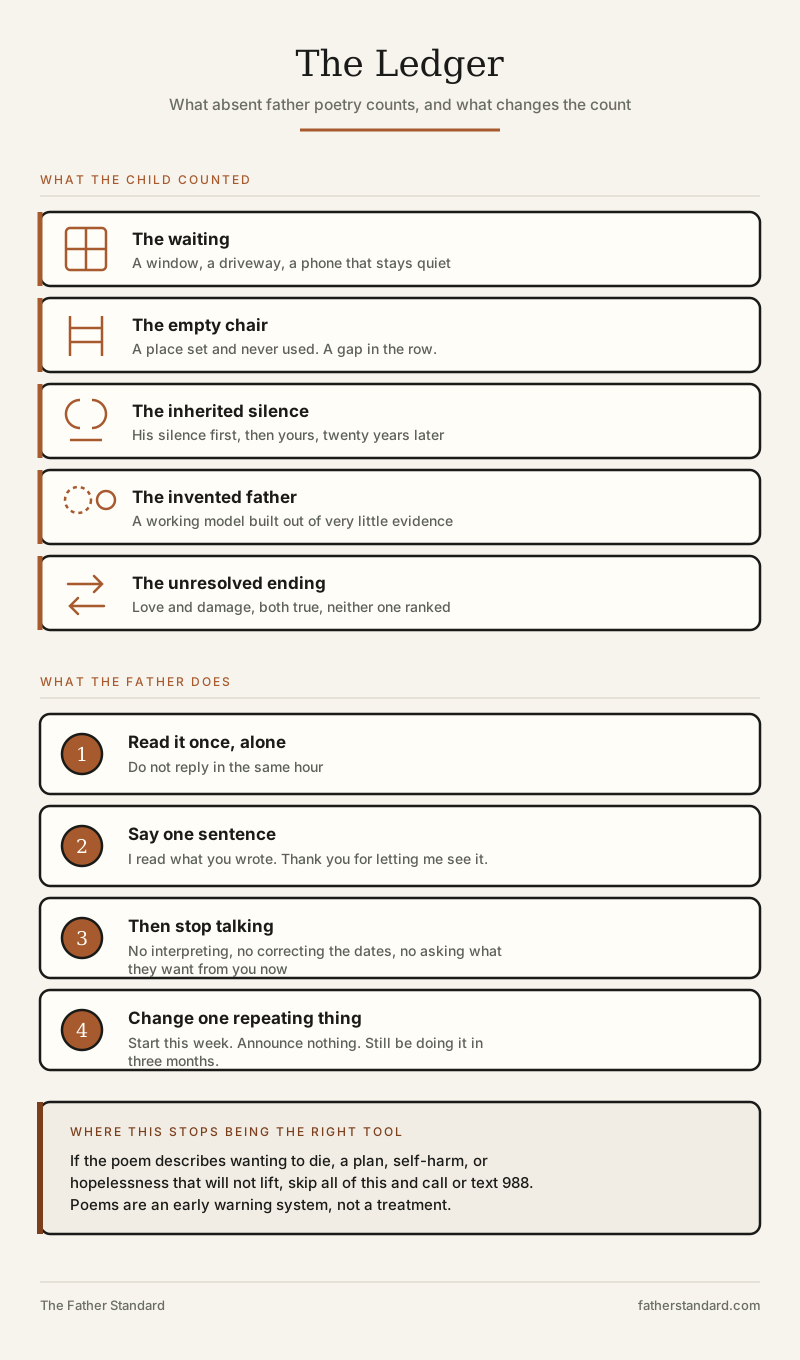
The waiting. A window, a driveway, a doorway, a phone that does not ring. Usually with a time attached. Not "I missed him" but "I sat on the step until the streetlight came on."
The empty chair. The place set and not used. The concert with a gap in the row. The absence made visible by furniture, which is the most common single device in the genre.
The inherited silence. The poem that turns out to be about the writer's own mouth, not the father's. The realization, usually arriving in adulthood, that a father who said nothing raised a child who says nothing.
The invented version. Poems addressed to a man who does not exist. Sometimes better than the real father, sometimes worse, always more coherent. Children build a working model out of very little evidence, and the model gets carried for decades.
The ambivalence that refuses to resolve. The last stanza that will not land on either forgiveness or condemnation. This is the mark of the honest ones, and it is the single most misread feature of the whole genre.
| The recurring image | What it is actually reporting | What it asks of a father |
|---|---|---|
| The window, the driveway, the phone that does not ring | Time spent in active expectation. The waiting was work, and it happened on a schedule the child could recite. | Reliability over intensity. A predictable small thing beats an unpredictable large one, every time. |
| The empty chair, the gap in the row | Attendance was counted, publicly, in front of other people. The child knew who else noticed. | Show up to the boring ones. The audience for your absence is larger than you think. |
| The inherited silence | The child learned that feelings are not spoken in this family, and carried that rule into their own adult relationships. | Go first. Your kid will not open a conversation you have never once opened. |
| The invented father | The child had insufficient data and built a model anyway. That model, not you, is what they have been arguing with. | Supply real information. Specific, unheroic, unedited facts about yourself dissolve an invention faster than any apology. |
| The unresolved ending | Both things are true at once. Love and damage are not in a queue waiting to be ranked. | Stop asking to be sorted. Do not treat the ambivalence as a negotiation you can win. |
That last row is where most fathers go wrong, so it is worth spelling out. A poem that ends unresolved is not a poem that is still deciding. It is a finished report on a permanent condition. When a father reads one and hears "she has not forgiven me yet", he tends to start campaigning for a verdict, and the campaigning is itself the thing that makes the distance worse. The correct reading of an unresolved ending is that the ambivalence is the destination, and a relationship can be built on top of it. We have written about how that repair actually proceeds in the estranged father and about the shape of the damage itself in the absent father.
Published poems worth reading first
Before writing anything, read the two that most of this genre is descended from. We are not reproducing them here, because they are under copyright and the poets and their publishers are owed that. Both are freely readable at the Academy of American Poets.
My Papa's Waltz by Theodore Roethke, first published in 1942, is the founding text of the unresolved ending. Sixteen lines, a father and a small son moving around a kitchen, and eighty years of readers arguing about whether it is a happy memory or a terrifying one. It is both. That is the point, and that is why it will not stop being taught.
Those Winter Sundays by Robert Hayden, published in 1962, is the other pole. A father who provided relentlessly and expressed nothing, and an adult child who understands too late what the provision cost. If you have ever told yourself that working was the same thing as loving them, this is the poem written by the son of a man who believed that. It is fourteen lines long. Read it before you read anything else on this page again.
The distinction between those two poems maps onto a distinction this site returns to constantly. Roethke's father is present and frightening. Hayden's is present and unreachable, which is its own category of absence, and the one we cover in the emotionally absent father.
Three poems written for this page
The following were written by our editorial team to illustrate the five images set out above. They are compositions built from the recurring motifs in the genre. They are not anyone's biography, they are not a reader submission, and they are not a member of our team describing their own childhood. We are saying that plainly because a poem that reads like testimony should never be allowed to pass as testimony.
If you want the real thing, read the published poets linked above, then read what your own child actually wrote.
I. The Step, a composite poem, not a real person's story
Six thirty was the number I had.
Not a promise, a number,
which is a different thing
and I knew the difference by then.
The streetlight came on at eight.
I made that the rule.
Not because you said so,
because something had to say so.
You came in April. You were kind.
You asked what I had been doing
and I said nothing,
which was the only lie I told you.
II. Provision, a composite poem, not a real person's story
You paid for the roof.
Nobody has ever said otherwise,
least of all me,
least of all now.
I am saying I learned the house
from the sound of you leaving it,
and that a boy can be warm
and still be counting.
There is a version of you
I put together out of the receipts.
He was a good man.
I would have liked to meet him.
III. What I Did Not Inherit, a composite poem, not a real person's story
My wife asks what I am thinking
and I hear your answer come out of me,
word for word,
in your voice, at your volume, which was none.
So this is the estate.
Not the watch. Not the name.
A locked room I was given the key to
and never once told was a room.
I am learning to say the small things.
It is going badly.
It is going.
Does writing it down actually help
Yes, modestly, and the modesty is the part a father is most likely to skip past. There is a real evidence base, and a father who forwards his kid a journaling app after reading this has misunderstood what it shows.
There is a real evidence base and it is modest. A 2026 systematic review and meta-analysis of poetry-based interventions in mental health in Psychiatry Research pooled fifteen studies and found poetry therapy associated with reductions in post-traumatic stress symptoms and improvements in depression, anxiety and stress, with effect sizes in the moderate to large range. The same authors were blunt about the limits. Most of the trials were small, at risk of bias, and methodologically varied, and their conclusion was that poetry-based work should not be recommended beyond an adjunctive role until better randomized trials exist. Effects on resilience were not statistically significant at all, and for perceived pain they found no reliable benefit, in results affected by small-study effects.
The picture for young people specifically is smaller again. A meta-analytic review of expressive writing interventions for adolescents published in Clinical Psychology Review pooled 21 studies of writers aged 10 to 18 and found an overall effect size of 0.127. Positive in direction, and small. The authors described the evidence as promising but not decisive, and they flagged something a parent should not skip past: the standard protocol may need modifying to reduce potential detrimental effects. Writing about a wound is not automatically therapeutic. Sometimes it reopens it.
The broader literature on disclosure lands in the same place. Frattaroli's meta-analysis of 146 randomized studies of experimental disclosure in Psychological Bulletin found an average effect size of .075, which is real and small.
The practical reading of all three is this. The poem is a good sign, because the material found a channel. Treat it as information about where things stand, not as proof your child is fine and not as a treatment in itself.
The evidence in one view
Three bodies of research, what each one found, and the limit its own authors put on it.
If your own child wrote one
Before anything else. If the poem describes wanting to die, a plan, self-harm, or hopelessness that will not lift, skip what follows and go to the section below on clinical risk, or call or text 988 now.
The reflex is to respond to the poem. Resist it. A poem is not a message addressed to you, even when it uses the word you, and treating it as inbound correspondence is how fathers turn a rare piece of honesty into a closed door.
Four things hold up.
Acknowledge that you read it, in one sentence, without interpreting it. "I read what you wrote. Thank you for letting me see it." Then stop talking. The urge to explain the years is enormous and the explanation is the thing that will cost you.
Do not correct the facts. Some of it will be wrong. The chronology will be off, the reason you missed the thing will be misremembered, the version of you in stanza three will be a stranger. Correcting any of it tells your child that the emotional report is on trial, and they will not file another one. There is a time for supplying real information about yourself, and it is not inside the first conversation about a poem.
Do not ask what they want from you. It sounds generous and it lands as a bill. They usually do not know, and the question hands them the work of managing your discomfort.
Change one repeating thing, this week, and tell nobody you are doing it. The single most credible response to a poem about your absence is an unannounced pattern that does not break. That is the whole argument of present, not just providing, and it is what the waiting poems are asking for.
Where poetry stops being the right tool
Some of this material sits next to genuine clinical risk, and a page about poems should say so rather than leave it implied.
If a poem your child wrote describes wanting to die, a plan, self-harm, or a level of hopelessness that does not lift, the correct response is not a conversation about the poem. It is contact with a licensed professional, and if there is any immediate concern, the 988 Suicide and Crisis Lifeline is available in the United States by call or text, twenty four hours a day, for the person in crisis or for a parent worried about someone else.
The same applies to your own end of it. The review of rigorous studies on the causal effects of father absence found the evidence strongest and most consistent for high school graduation, social and emotional adjustment, and adult mental health, which means the thing being written about in these poems is the same thing that shows up in the outcome data years later. Poems work as an early warning system for that, not as treatment, and reading one should sometimes end with a phone call to a clinician rather than a phone call to your kid.
The standard
A father who reads his child's poem and hears an accusation has read it wrong. A father who reads it and hears a verdict he can appeal has read it worse.
What is actually in these poems, across decades and thousands of unconnected writers, is a set of measurements. Someone kept count. They counted the evenings, the empty seats, the times you did not say the thing. They are showing you the ledger, which is an act of trust that most children never extend to the parent who ran up the balance.
The only response that has ever worked is to stop arguing with the ledger and start changing what goes into it, quietly, from this week forward.
The whole thing in one picture
The five images the poems keep counting, the four move response, and the point at which this stops being a job for poetry.
Test yourself
Five questions on who actually writes these poems, what each recurring image is reporting, and what the research on writing does and does not support. Each answer explains the reasoning, so a wrong guess is the more useful outcome.
Key takeaways
Last reviewed by The Father Standard Editorial Team on August 17, 2026. Our sourcing and AI-use rules are public on the editorial standards page.
FAQ
What is absent father poetry?
It is the body of poems about a father's absence, written overwhelmingly by the children rather than the fathers, spanning published literary work and anonymous online writing that independently land on the same handful of images. The label is broader than it sounds. A meaningful share of these poems come from households where the father was there every night, because a man can be present at every dinner and still be the subject of an absence poem if he never spoke, never showed up emotionally, or was unreachable in the ways that counted to the child. The genre tracks a missing father, not a missing address.
Why do so many poems about absent fathers sound alike?
Because a child has no vocabulary for an abstraction like abandonment, so the feeling attaches itself to whatever object happened to be in the room, a window, a driveway, an empty chair, a phone that stayed quiet. Writers who have never met converge on the same objects because the objects are doing the emotional work the child could not yet name. That also gives a father a practical test on his own child's poem. If it names a specific object or a specific hour rather than a general accusation, it is reporting something that was measured and remembered, not a mood that will pass by Thursday.
What are the best known poems about absent or distant fathers?
Two dominate the field, and they describe two different fathers, so start with the one that matches your own situation. If your absence looked like unpredictability, read Theodore Roethke's "My Papa's Waltz" from 1942, where the same memory reads as warmth or as fear depending on the line you stop at, and both readings hold. If your absence looked like showing up every single day while saying almost nothing, read Robert Hayden's "Those Winter Sundays" from 1962, where the provision is understood only after it is too late to thank anyone for it. Read both at the Academy of American Poets rather than in a reposted excerpt, since both remain under copyright and the reposts routinely garble the line breaks that carry the meaning.
Does writing poetry about an absent father actually help?
Modestly, and the caveat matters more than the yes. Across both the poetry research and the wider expressive-writing research the effects come out real but small, and the word the authors keep reaching for is adjunctive, meaning it belongs alongside professional care rather than instead of it. Two practical consequences follow for a father. Writing about a wound is not automatically soothing and can reopen it, which is why the adolescent researchers argued the standard protocol needs adapting for younger writers rather than handed to them unchanged. And a poem arriving is not evidence that the processing is finished, so it is never a reason to decide your child no longer needs a clinician.
My child wrote a poem about my absence. What should I say?
There is a right order and most fathers get it backwards. Read it once, alone, and do not respond the same hour. Then say only that you read it and that you are glad they let you see it, and let the silence after that sentence do its work. What you leave out is the whole discipline. No reading of what it means, no correction of the dates and details that are wrong, no question about what they need from you now, because each of those hands your child the job of managing you at the exact moment they stopped performing. The part that counts is not spoken at all. Choose one thing you have been unreliable about, change it starting this week, say nothing about having changed it, and still be doing it in three months.
Should I write a poem back to my child?
Almost never as a first move, and never as a substitute for changed behavior. A poem back reads as a bid to be judged on eloquence rather than on conduct, and it puts your child in the position of having to evaluate your feelings about their feelings. Writing privately for yourself is a different matter and can be genuinely clarifying about what you actually did and avoided. Keep that draft in a drawer, act on what it shows you, and let the visible response be the thing you do every Tuesday rather than the thing you wrote once.
Why do these poems never end with forgiveness?
Because forgiveness would require the child to settle on one version of the father, and most of these children were raised by two at once, the real man and the invented one assembled out of missing evidence. An ending that resolved cleanly would have to discard one of those, and the honest poems decline to. What reads as evasion to a father hoping for closure is the most accurate line in the piece. Treating it as a ruling still open, and pressing for the better outcome, is the surest way to prove to your child that you still have not read what they wrote.
Sources
- Census Bureau's analysis of Current Population Survey data (census.gov)
- My Papa's Waltz (poets.org)
- Those Winter Sundays (poets.org)
- systematic review and meta-analysis of poetry-based interventions in mental health (pubmed.ncbi.nlm.nih.gov)
- meta-analytic review of expressive writing interventions for adolescents (pubmed.ncbi.nlm.nih.gov)
- meta-analysis of 146 randomized studies of experimental disclosure (pubmed.ncbi.nlm.nih.gov)
- 988 Suicide and Crisis Lifeline (988lifeline.org)
- the causal effects of father absence (pubmed.ncbi.nlm.nih.gov)