The Absent Father, What His Absence Actually Costs, and What He Can Still Do
An absent father is not always the one who walked out. He can be in the house every night, at the table for dinner, present in every photograph, and still be gone from his child's life in the way that counts. The word points at two different men, the father who left and the father who stayed in body but not in attention, and both leave a mark. Below is what the evidence really pins on a father's absence, how much of that holds up once you account for everything else going wrong in these homes, and what a father can still do about it starting this week.
If you are here because you already suspect you have been absent, in either sense, that suspicion is the useful part. Most absent fathers are not villains. They are men who got pulled away by work, by a divorce, by their own fathers' example, by a slow drift they never chose on any single day. The distance is real either way, and so is the road back.
What "absent father" actually means
The phrase covers two situations that feel very different from the inside but land in a similar place for a child. The first is physical absence, the father who does not live with his child. This is common and getting more common. More than one in four fathers with children 18 or younger now live apart from at least some of them, a share that has risen over recent decades. Living apart does not have to mean absent in the deeper sense, and many nonresident dads stay closely involved, but the same data show the pull of drift is strong: only about one in five fathers who live apart see their children more than once a week.
A father who lives apart is also no longer unusual: single-father homes have grown to roughly 8% of households with kids, from close to 1% six decades earlier, so a father can keep a different address and still be the one his child counts on. Plenty of men do exactly that now.
The second is emotional absence, the father who is physically present and psychologically gone. He provides, he shows up to the house, and his child still cannot reach him. That version rarely gets named as absence because nothing looks wrong from outside, which is exactly what makes it durable. The line between that father and a merely busy one is the whole subject of the case for the distant father, and it is worth reading if you are not sure which describes you.
Both versions share the thing that matters to a child, which is not your address and not your income. It is whether your attention is reliably available. Your child was never tallying the hours or the dollars. What registered was whether you looked up when they spoke, and whether you could be reached when they needed you.
What a father's absence is actually linked to
Here the honest answer matters more than the loud one, because the culture around father absence runs on both guilt and denial, and neither is true. For years the research was fair to criticize: most of it compared kids with absent fathers to kids without and called the difference an effect, ignoring that the families differ in a dozen other ways before anyone leaves. Newer work took that criticism seriously.
A landmark review pooled the studies that used rigorous designs built to isolate cause, including sibling comparisons, natural experiments, and statistical matching. Its assessment is that father absence does have real negative effects on children's well-being, though the size of those effects is smaller than the raw comparisons suggest. The evidence is strongest and most consistent for three outcomes: finishing high school, a child's social and emotional adjustment, and mental health in adulthood. It is weaker and more mixed for others, such as cognitive test scores. Read that carefully, because it cuts both ways. Absence is not harmless, and the effect is not the catastrophe the slogans imply. It is a real risk shift across a population, smaller than the raw comparisons suggest, and never a sentence on any single child.
This is the frame that lets an absent father act instead of freeze. The American Psychological Association describes a father's involvement as its own force in a child's growth, not a stand-in for the mother. That is the useful half of the picture. A father showing up is a real and positive input in its own right, which is reason to believe your renewed presence can still register now. Nothing in the evidence says the door is locked.
Being in the house is not the same as being there
A father can meet every visible marker of presence and still be absent to his child. He pays the bills, he sits at the table, he attends the game with his eyes on his phone, and he believes he is present because he is in the room. The child reads it differently. The child reads attention, and attention is the one thing a screen, a long commute, or a mind stuck at work quietly steals.
This is the trap that catches good, hardworking fathers hardest, because their absence wears the costume of responsibility. Providing feels like fathering, and it is part of fathering, but it is not the part a child later remembers as love. What separates the dad who pays for everything from the dad a child can actually reach is the whole subject of being present, not just providing, and most fathers badly underestimate how early and how sharply a child feels that gap.
The fix is not more hours. It is undivided hours. Twenty minutes where your child has your face and not the top of your head, repeated often enough to be trusted, outweighs a full weekend spent in the same house with your attention somewhere else. A child never grades you on the clock. A child grades you on whether you could be reached.
The shapes absence takes
Absence is not one thing, and the way back depends on which shape it took. A father who was pushed to the edges by a custody arrangement needs a different plan from one who checked out at the dinner table, even though both children felt a father who was not fully there.
| Shape of absence | How the child usually experiences it | The first move back |
|---|---|---|
| Physically gone after a split | A father who exists on a schedule, easy to feel as optional | Become reliably present within whatever access you have, so contact stops feeling conditional |
| Present but on the phone or at work in his head | A father in the room who cannot be reached | Protect short, undivided blocks of attention and defend them like an appointment |
| Pulled away by conflict with the other parent | A father whose story is being told by someone else | Stay steady and non-defensive, and refuse to argue your case through the child |
| Absent by his own father's example | A father repeating a script he never examined | Name the pattern out loud and choose the opposite deliberately, one interaction at a time |
| Gone for years, near-total estrangement | A father who became a stranger | Small, no-strings contact that asks nothing back, held patiently over months |
If the absence you are looking at is with a daughter, the bond carries its own particular weight and changes shape as she grows, which the father-daughter relationship guide maps age by age. If it is with a teenage son who has gone quiet, the withdrawal is often developmental rather than a verdict, and reconnecting with a teenage son lays out the calm, unrattled stance that keeps a pulling-away kid within reach.
What an absent father can still do
The way back is narrower than the path you had before you left, but it exists, and it does not open with a big conversation. It opens with proof, delivered in small pieces, that you have become someone who shows up.
The first contact should carry nothing. No question that needs answering, no guilt, no summary of the years. A forwarded photo, a line about a shared memory, one sentence that lets them know you were thinking of them and expects no reply at all, moves the needle further than a page-long letter demanding they explain the silence. Send it, wait, and send another later. After a long gap, a cadence of roughly one light touch every two to four weeks tends to work: frequent enough to read as commitment, sparse enough that it never feels like a campaign. The moment they answer, hand the tempo to them.
All of that assumes you can reach the child directly, which is true for an older teenager or an adult child with their own phone. A younger child usually cannot be texted, and the only door often runs through the other parent. There the same reliability gets proven differently: by being early and steady for every scheduled visit, by keeping your word on the small logistics, and by being easy rather than combative with the parent who holds the calendar, because to a young child a father who shows up exactly when he said he would is the entire argument. If you have no access at all, no order in place or contact flatly refused, the answer is not to force your way to the child but to build the lawful channel. Ask about family mediation, pursue a parenting-time or custody order, keep a dated record of every attempt you make to stay in contact, and ask a family-law professional whether supervised or graduated visitation is a realistic first step. A documented, lawful effort to be present is itself part of becoming present.
When you own your part, own it clean. State the wrong you did, then stop talking. The instinct to add context, to point out the parts they have wrong, to balance the ledger, is the instinct that turns an apology into an argument, and your child will hear the balancing, not the sorry. Match the apology to the contact you actually have, too. A first text is not the place for the heavy repair; carry the real one until there is enough contact to say it by voice or face to face, where a child can hear that you mean it. You are not trying to win the history. You are trying to become safe to know today.
The early replies will be thin, and that is the point of them. A child who learned a father does not stick around will run a quiet test of whether this version lasts before they spend any trust on it. A one-word text, a plan that falls through, a long silence, these are the test, not the verdict. Passing it takes only one thing, which is that you keep going until the new pattern outweighs the old one in their memory.
There is no fixed date on which you are allowed to give up, because the aim is not to win a reply by a deadline. The aim is to hold a door open that your child can walk through whenever they are ready, which might be months away and might be years. Hold it lightly enough that it does not curdle into self-punishment. Keep your own life full, lean on your own people, and if the silence starts to hollow you out, put your own therapist in the middle of it. A father who burns himself down while he waits is no more reachable than the one who walked away.
Some of the distance was handed to you rather than earned. When a divorce or custody fight has shaped what your child believes about you, hold the same steady line, but expect the clock to run slower and the urge to defend yourself to run hotter. Do not correct their version of you, even the parts that are flatly untrue, because a child can hear a defense as confirmation. Let consistency make your case for you. How you carry the split is itself a shield for the child, which is the whole point of a father's standard for co-parenting after a split.
When it is more than distance
Some ruptures sit past the reach of anything a father can do alone, and part of returning well is recognizing when you have hit one. A years-deep estrangement, a child who has severed contact outright, a home knotted up with addiction, violence, or a psychiatric emergency, none of these gets mended by a warmer message. When anyone's safety is on the line, treat it as the emergency it is: in the United States the 988 Suicide and Crisis Lifeline takes calls and texts around the clock, and readers elsewhere should use their country's emergency number or crisis line. If a child is being harmed, phone local emergency services or a child-protection agency straight away rather than sitting with it. Short of an emergency, pull a licensed family therapist in early instead of waiting for the situation to rot, and for a hardened estrangement seek out a clinician whose specialty is exactly that, because it is a distinct discipline. Reaching for that help is not proof you failed at fathering. It is one of the more grown-up moves a father has.
One hard limit sits over every piece of the reconnection advice above: it applies only where contact is lawful and safe. If a court order, a no-contact order, or a protective order is in place, that order outranks anything on this page and must be honored to the letter. If the estrangement grew out of your own abuse or violence, or an adult child has clearly told you to stop, the responsible move is to stop initiating and to do the repair work with a professional, not through more contact the child did not ask for.
No perfect weekend and no one big talk settles this. You built the distance one skipped moment at a time, and you close it the same way, one kept word after another, until the kept ones outweigh the broken ones in your child's memory. You cannot get back the years you were not there. You can decide, starting this week, that your child gets a present father from here forward, and that decision is entirely yours to make.
The absent father in one picture
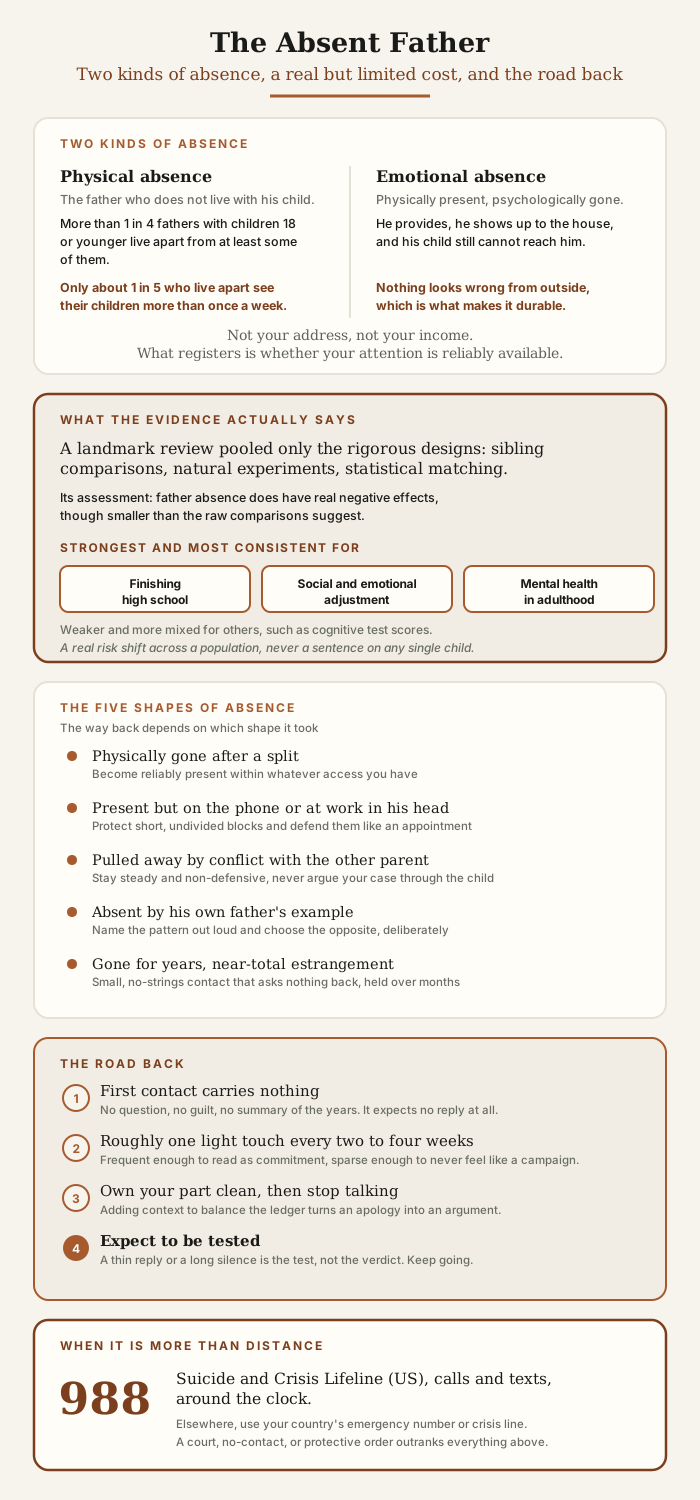
The whole argument in one image: the two kinds of absence, the real but limited cost the evidence supports, the shapes absence takes, and the road a father can still walk back.
Test yourself
Five quick questions to check what you took from this, less a test than a mirror. Answer honestly, then set each answer against how your last few weeks with your child actually went.
Key takeaways
Last reviewed by The Father Standard Editorial Team on August 6, 2026. Our sourcing and AI-use rules are public on the editorial standards page.
FAQ
What is an absent father, and what does the term mean?
The term covers two situations. One is physical absence, a father who does not live with his child, which is now common rather than rare. The other is emotional absence, a father who lives in the house but is not reachable, present in body and gone in attention. Both are real, and a child feels them in a similar place, because what registers for a child is not your address or your paycheck but whether your attention can be counted on. A father who is home every night with his mind permanently at work can be more absent, to the child, than one who lives apart but shows up fully during the time he has.
What are the different types of absent fathers?
The split between physically gone and emotionally gone is the coarse version. In practice absence arrives in about five shapes, and the shape matters because the first move back is different for each one. A father who is physically gone after a split exists for his child on a schedule, which is easy to feel as optional, so his first move is to become reliably present inside whatever access he already has. A father who is in the room but on the phone or still at work in his head is a father who cannot be reached, so his first move is to protect short undivided blocks of attention and defend them like an appointment. A father pulled away by conflict with the other parent has his story told by someone else, so his job is to stay steady and non-defensive and refuse to argue his case through the child. A father who is absent by his own father's example is repeating a script he never examined, and it breaks by naming the pattern out loud and choosing the opposite deliberately, one interaction at a time. A father gone for years into near-total estrangement has become a stranger, so the only thing that works is small, no-strings contact that asks nothing back, held patiently over months. Working out which shape you are in tells you which single thing to start with.
What are the effects of growing up with an absent father?
The careful answer is that father absence carries real but limited risks, not a guaranteed outcome. The strongest research, using designs built to separate cause from the other ways these families differ, finds the clearest effects on finishing high school, a child's social and emotional adjustment, and mental health in adulthood, with weaker and more mixed effects elsewhere. The size of these effects is smaller than simple comparisons suggest. In plain terms, absence shifts the odds across a population, it does not decide any single child's life, and no honest reading of the evidence supports either the doom or the denial the topic usually attracts.
How can an absent father reconnect with his child?
Begin light and expect nothing back. A brief message with no demand and no guilt, sent about once every few weeks after a long gap, tells your child you are steady without cornering them into a reply. If the child is young and reachable only through the other parent, prove the same steadiness by being on time for every scheduled visit and easy to deal with over the logistics. Own your share of the break plainly, with no ledger of their faults attached, and save the heavy apology for a moment with enough contact to carry it. Then let yourself be tested, because a child who learned a father does not stick around will wait to see whether this lasts, which means the thin early replies are the trial and not the verdict. If the break involves addiction, violence, or a psychiatric emergency, bring in a clinician who specializes in family estrangement, keep any court or no-contact order above every suggestion here, and when safety is at stake dial your country's emergency line or, in the US, 988. The mechanics of that repair are worked out in the case for the distant father.
Does an absent father ruin a child's life?
No, and the honest reading of the evidence sits between the doom and the denial the question usually attracts. The strongest research, using designs built to separate cause from the other ways these families differ, finds that father absence carries real but limited risks rather than a fixed outcome. It raises the odds of specific difficulties, chiefly finishing high school, social and emotional adjustment, and mental health in adulthood, and the size of those effects is smaller than simple comparisons suggest. Absence shifts the odds across a whole population, it does not decide any single child's life. Because the outcome was never sealed, a father who closes the distance later is still doing work that counts.
Sources
- More than one in four fathers with children 18 or younger now live apart from at least some of them (pewresearch.org)
- single-father homes have grown to roughly 8% of households with kids, from close to 1% six decades earlier (pewresearch.org)
- Its assessment is that father absence does have real negative effects on children's well-being, though the size of those effects is smaller than the raw comparisons suggest (pubmed.ncbi.nlm.nih.gov)
- American Psychological Association describes a father's involvement as its own force in a child's growth (apa.org)