The Emotionally Absent Father: The Dad Who Is There and Not There
An emotionally absent father is a dad who is physically present and emotionally unreachable. He lives in the house, pays for the shoes, sits at the table, shows up to the game, and his child still cannot get to him. Nothing looks broken from the outside, which is exactly why the pattern can run for years without a name. The child is not missing a father who left. The child is missing the one who is right there and cannot be reached.
If you clicked on this because you suspect the description fits you, that hunch is worth keeping. Most emotionally absent fathers are not cold men. They are men who were never taught the language, who run on work stress and autopilot, who are repeating the exact father they had. Below is how to recognize it, where it comes from, what a child actually takes from it, and the concrete way back.
What an emotionally absent father actually is
The word absent points at two very different men. One is the father who is physically gone, who lives at another address or walked out entirely. The other is the father who never left the building and is gone anyway. We cover the first man, and the overlap between them, in the absent father. This piece is only about the second: the dad whose body is in the house and whose attention is somewhere the child cannot follow.
Emotional absence is hard to name because it fails no visible test. He is sober, calm, and sitting right there at the table. He provides, and providing looks so much like fathering that both the father and the child can mistake one for the other for a decade. What lands for a child is not the address or the paycheck. It is whether your attention shows up when they reach for it, and emotional absence is the slow, quiet no.
That no rarely arrives as a decision. It arrives as a pattern of small moments where a child served something up, a feeling, a story, a question, and got a fix, a lecture, or the top of your head instead of your face. Enough of those and the child stops serving. The house goes calm. Everyone calls it peace. It is closer to two people who have quietly agreed to stop reaching, and the father who is drifting into the distant father usually cannot feel it happening from the inside.
How to tell if you are one
Emotional absence hides behind good behavior, so the honest check is not whether you love your kids. Of course you do. The check is whether that love is reaching them in a form they can feel. A few patterns give it away.
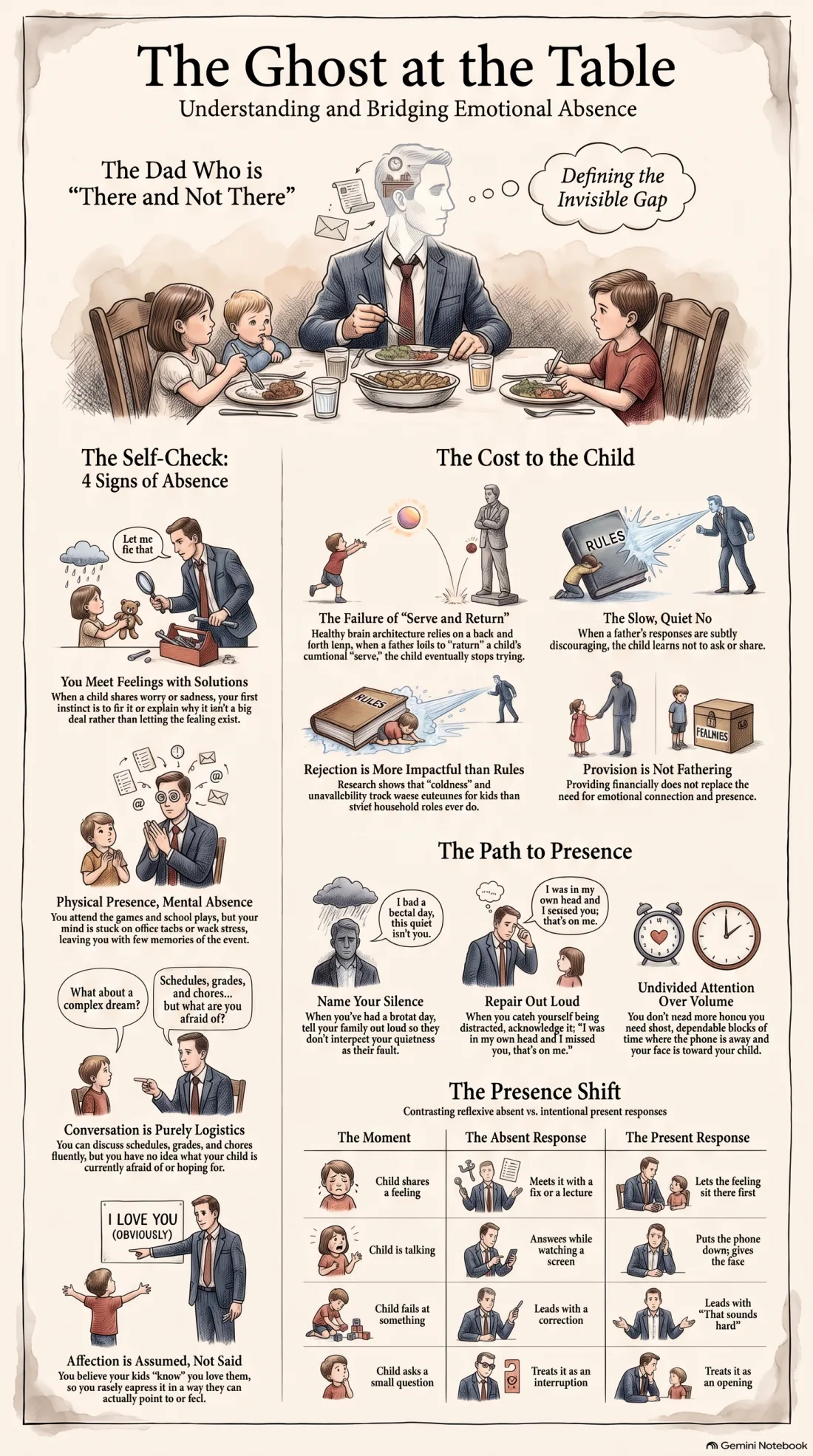
You meet feelings with solutions. Your child brings you something soft, worry, sadness, excitement, and your first move is to fix it, correct it, or explain why it is not a big deal. The feeling never gets to just exist in front of you.
You are physically there and mentally at work. You attend the events and remember almost none of them, because your body was in the stands and your mind was on the thing waiting at the office.
Affection is assumed rather than said. You figure your kids know you love them, so you rarely say it or show it in a way they can point to. The knowing stays theoretical.
Your own bad days go dark and silent. When work or life presses on you, you withdraw into a quiet the whole house learns to tiptoe around, and a young child reads that silence as something they caused.
Conversation is logistics. You talk about schedules, grades, and chores fluently, and you have almost no idea what your child is actually afraid of, hoping for, or into this month.
None of these makes you a bad man. Each of them is a place where the connection is dropping, and the first repair is simply seeing it without flinching away.
Where emotional absence comes from
Emotional absence is usually inherited, not chosen. A large share of men grew up with a father who equated feeling with weakness and provision with love, so they learned to father the way they were fathered, running silence as if it were strength. You cannot easily give a child a fluency you were never taught yourself, and most men were handed the vocabulary of results and never the vocabulary of feeling.
Work is the second engine. A father under real financial pressure often tells himself that grinding is the loving thing, that the hours are for the family, and he is not entirely wrong. Most dads already feel the shortfall: nearly two thirds of fathers told Pew in a 2017 survey that they spend too little time with their kids. The trap is that the same hours that pay for the childhood can quietly consume the father who was supposed to be in it. Providing becomes the whole identity, and the gap between paying for a child and being reachable to one is what our guide on why providing is not the same as showing up is built around.
Stress and screens finish the job. A tired man home from a hard day reaches for the phone the way another man reaches for a drink, and the glow becomes a small door he steps through to leave the room without leaving his chair. The child, who cannot compete with the door, learns to stop knocking.
What it does to a child
The careful read matters more here than the loud one, because the conversation around this swings between guilt and flat denial. Emotional absence is a real risk, not a curse, and the evidence keeps pointing at warmth and reachability as the levers that actually move a child's outcomes.
When researchers pooled 161 studies for a meta-analysis of parenting and delinquency, the parenting factors most strongly tied to poor outcomes were rejection and hostility, manipulative pressure, and poor monitoring, a parent who had lost track of a child's daily life. That study measured active coldness and disengagement, not quiet unavailability as such, so emotional absence is not the same thing it looked at. It is a plausible cousin: a child who cannot reach a parent may end up reading the silence in a similar way, though that extension is the Editorial Team's, not a finding of the study. Turn the telescope around and the associations point the same way: a review of 24 longitudinal studies of engaged fathering linked hands-on involvement, the doing-things-together kind rather than the sharing-an-address kind, with steadier behavior in boys and broader gains in development. Both bodies of work report associations rather than proof of cause, and both point warm, engaged attention out as the thread that matters most, more than money or discipline.
The mechanism has a name in developmental science. The Center on the Developing Child at Harvard describes serve and return, the responsive back-and-forth between a child and a caring adult, as a building block of healthy brain architecture. A child serves, a coo, a question, a held-up drawing, and a present adult returns it, and that loop, repeated many times over a childhood, is how a child learns they can affect the people they love. An emotionally absent father is a father whose returns keep failing to land. The child keeps serving into a room that does not answer, and eventually stops.
The studies above track behavior, school, and development rather than the inner life, so the next part is the Editorial Team's read rather than a research finding. A son who grew up reaching for a father he could not reach often becomes a man who struggles to name what he feels, having watched feeling get swallowed at home. A daughter can absorb that same distance as her baseline for what closeness is supposed to feel like. We follow the son's version in our guide on why fathers and sons go quiet, and the daughter's in our father-and-daughter guide. Whatever the child, the research effect is a nudge to the odds across a whole population, never a verdict on your particular child, and never anything a father who re-engages cannot start to move.
What emotional presence actually looks like
Becoming emotionally present is not a personality transplant, and it does not require you to turn into a man who cries at commercials. It is a set of small, repeatable moves that change what happens in the ordinary moments. The gap is almost always in the same handful of places.
| The moment | What emotional absence does | What emotional presence does |
|---|---|---|
| Your child brings a feeling | Meets it with a fix or a lecture | Lets the feeling sit there before solving anything |
| Your child is talking | Answers while half-watching a screen | Puts the phone down and gives the face |
| Your child fails at something | Leads with the correction | Leads with a plain "that sounds hard" |
| You had a brutal day | Goes quiet and unreachable at home | Names it out loud so no one reads the silence as their fault |
| Your child asks a small question | Treats it as an interruption | Treats it as an opening |
| Affection | Assumes it is understood | Says it plainly, on an ordinary day |
That first habit carries more weight than the rest, since it decides whether your child brings you anything at all. The AAP's guidance on talking with teenagers puts the same idea plainly, urging parents to listen without judgment or reaction and treating what you say as less important than that you are actually hearing it. The point holds at any age. A kid who gets fixed every time they feel something learns to stop feeling out loud. A kid who gets heard learns that you are safe to reach.
How to become reachable again
The way back does not open with a speech. It opens with a change in the small moments, proven often enough that your child comes to trust it.
Start by letting your own guard down before you ask your child to. In the Editorial Team's read, warmth in a home tends to run downhill from the parent, and a child usually opens up about as far as the father models, which is why you go first. Name one small real thing you feel, admit something you handled badly, say the affection out loud instead of assuming it was received. Each time you do, you hand your child permission to do the same.
Protect undivided attention over volume. You do not need more hours, you need a few that are actually yours to give, with the phone in another room and your face pointed at the person in front of you. A short, repeating, dependable block of real attention beats a whole weekend under the same roof with your mind three miles away.
Let feelings exist before you fix them. When your child brings something soft, resist the reflex to solve, correct, or minimize it. Reflect it back first, "that sounds like it really got to you," and let the moment breathe. The fixing can come later, if it is even wanted.
Repair out loud when you miss. You will still go absent on hard days, because the old pattern is deep. What separates a present father from an absent one is not that he never checks out. It is that he comes back and says so: "I was in my own head last night and I missed you, that is on me." A child who watches a father rupture and repair learns that connection survives being dropped, which is one of the most durable things you can teach.
If the child here is an adolescent who has already gone silent, the reopening runs on its own clock, since a teenager backing away is more often growing up than passing sentence. The calm, unrattled moves that keep a teenage kid within reach are laid out in our guide on reopening the line with a withdrawn teenage son.
When the distance is deeper than a habit
Some of this reaches past what small moments can fix. If your own emotional shutdown is rooted in depression, unprocessed trauma, or an addiction you use to leave the room, no listening tip will touch the source, and the grown-up move is to treat it as the health issue it is. A therapist is not an admission of failure as a father. It can be one of the surer ways back to being reachable for your kids.
If the emotional gap has already calcified into estrangement, a kid or grown child who has stepped back or cut you off, warmth and an honest ownership of your part are still the starting point, but the timing belongs to them, and leaning in usually backfires. That is a heavy thing to carry, and it can wear on your own mental health, which deserves care of its own. Nothing here is clinical or crisis guidance. Anyone in crisis in the US can reach a trained counselor at any hour by calling or texting 988, the Suicide and Crisis Lifeline, and a therapist who specializes in family estrangement can help you shoulder it and find a next step that is honest.
The emotionally absent father is not a fixed identity. It is a pattern of dropped returns, built one distracted moment at a time, and it reverses the same way it set in. You catch one feeling instead of solving it. You say one honest thing out loud. You give one ordinary evening your actual eyes instead of the back of your phone. No single moment fixes this, and then you do it again tomorrow anyway.
The emotionally absent father in one picture
The whole piece compressed into a single image: what emotional absence is, how to catch it in yourself, what it costs a child, and the moves that make you reachable again.
Test yourself
A quick five-question check on the ideas here: presence against provision, catching a feeling against fixing it, and the sequence a repair follows. Every answer walks through the why, so missing one teaches as much as getting it right.
Key takeaways
Last reviewed by The Father Standard Editorial Team on August 9, 2026. Our sourcing and AI-use rules are public on the editorial standards page.
FAQ
What is an emotionally absent father?
An emotionally absent father is physically present but psychologically unreachable: in the house, providing, showing up to events, and still impossible for his child to actually reach. What separates it from an ordinary bad week is that the unavailability is chronic rather than occasional, so it stops reading as a problem and just becomes the weather of the house. What a child feels is not a missing address or paycheck but a missing attention, the sense that reaching for their father rarely gets a reach back.
How do I know if I am an emotionally absent father?
The tell is not whether you love your kids but whether that love reaches them in a form they can feel. Common patterns: you meet feelings with fixes or lectures, you attend events with your mind at work, you assume your affection is understood rather than saying it, you go silent on hard days, and your talk is nearly all logistics. If you want one early sign to watch, it is whether your child still brings you soft things at all, worry, excitement, a small hurt, because that is the first thing to disappear when a father goes unreachable. None of this makes you a villain. It just shows you where the wire has come loose, and seeing it honestly is the first repair.
What does an emotionally absent father do to a child?
It shifts the odds rather than sealing a fate. A large meta-analysis on parenting and delinquency found rejection, hostility, manipulative pressure, and poor monitoring among the strongest parenting links to poor outcomes. That work looked at active coldness rather than quiet unavailability, so treat the connection to emotional absence as a reasonable extension, not a direct finding. Developmental science frames healthy growth as built on serve and return, the responsive back-and-forth between a child and a caring adult, and an emotionally absent father is one whose returns keep failing to land. The pattern tends to compound, because the longer the returns are missed, the more a child stops serving, which is why re-engaging sooner is easier than later, though a re-engaged father can start changing it at any age.
What is the difference between an absent father and an emotionally absent father?
A physically absent father does not live with his child, or has left the picture entirely. An emotionally absent father never went anywhere: he is under the same roof every night and still out of reach in attention. The two feel very different from the inside yet arrive in a similar place for the child, because what counts is not your location but whether your attention can be trusted to be there. A dad who keeps a separate address but is genuinely present during his hours can register as closer, to a child, than one who sleeps at home nightly with his head stuck at the office.
Can an emotionally absent father change?
Yes, and it does not require a personality transplant. Emotional presence is a set of small, repeatable moves: putting the phone down and giving your face, letting a feeling exist before you fix it, saying affection out loud on ordinary days, and repairing openly when you check out. Since a child tends to open up about as far as a parent models, the move that changes the most is to go first, naming a real feeling or owning a mistake before asking anything back. The repair itself teaches something a smooth performance cannot: a kid who watches a father drop the thread and pick it back up learns that connection survives being dropped.
Why am I emotionally shut down with my own kids?
Usually because you were never taught otherwise. Many men grew up with a father who treated feeling as weakness and provision as love, so they father the way they were fathered and run silence as strength. Work pressure adds to it, since long hours can feel like the loving choice while quietly consuming the father who was meant to be in the childhood, and stress plus screens finish the job by giving a tired man an easy door out of the room. If the shutdown runs deeper, into depression, trauma, or addiction, that is a health issue worth taking to a professional, because no communication tip reaches a source like that.
Sources
- Pew in a 2017 survey (pewresearch.org)
- 161 studies for a meta-analysis of parenting and delinquency (pubmed.ncbi.nlm.nih.gov)
- 24 longitudinal studies of engaged fathering (pubmed.ncbi.nlm.nih.gov)
- Center on the Developing Child at Harvard describes serve and return (developingchild.harvard.edu)
- listen without judgment or reaction (healthychildren.org)