Absent Father Statistics: The Real Numbers and the Viral List That Falls Apart
The most widely circulated absent father statistics are not real ones. A list that has been going round for roughly thirty years claims that 63% of youth suicides come from fatherless homes, along with 85% of children with behavioral disorders, 71% of high school dropouts and 90% of runaways, and it carries the names of federal agencies beside each figure. Those agencies do not publish those numbers, and the structure of what they do collect makes it close to impossible that they ever could.
The real absent father statistics are less dramatic and considerably more useful, because they come with dates, sample sizes, and honest error bars. A father trying to work out what his own absence has cost, or what closing it might be worth, is better served by the smaller true number than the enormous false one.
One note before the numbers, since this page discusses youth suicide statistics. If any of this touches a real situation in your family right now rather than a question about data, the 988 Suicide and Crisis Lifeline takes calls and texts around the clock in the US, and 911 covers immediate danger. The fuller version of that note sits at the end of this article.
What follows is the sourced prevalence data, what the careful outcome research found once it stopped using the sloppy method, why the viral list cannot be right, and a filter for reading any father-absence statistic you meet from here on.
How many children actually grow up without a father in the home
This is the one part of the topic where the numbers are solid, because the Census Bureau counts households every year and publishes the series.
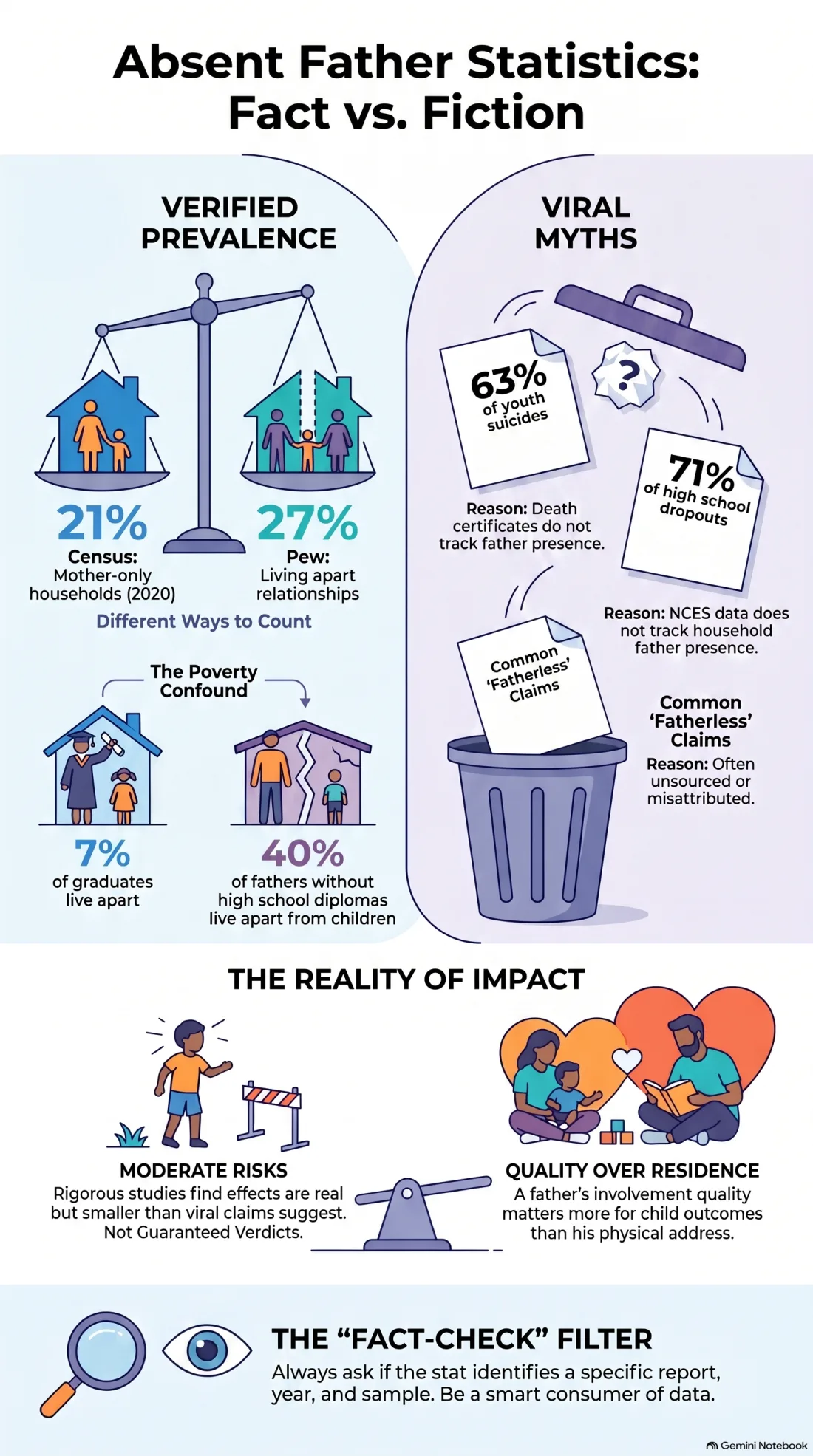
In 1968, about 60.0 million US children under 18, or 85%, lived with two parents. By 2020 that had fallen to 51.3 million children, or 70%. Over the same period the number living with their mother only went from 7.6 million, 11% of children, to 15.3 million, 21%. Children living with their father only went from 0.8 million, about 1%, to 3.3 million, 4.5%, which is a more than fourfold rise on a small base. Children living with no parent at all, usually with grandparents or other relatives, went from about 2.0 million, 3%, to about 3.0 million, 4%.
A different way of cutting it, counting from the father's side rather than the household's, gives a larger figure. Pew Research Center's analysis of the National Survey of Family Growth found that in 1960 only 11% of US children lived apart from their fathers, and by 2010 that share had risen to 27%. More than one in four fathers with children under 18 lived apart from at least some of them, split between 11% living apart from some of their children and 16% living apart from all of them.
Those two framings disagree because they are counting different things. The Census figure is a snapshot of who is in the house on the night of the survey. The Pew figure counts a father as living apart even when he sees his children regularly under a shared custody arrangement. Neither is wrong. Quoting one as though it were the other is how a great deal of confusion in this area starts.
The father-absence rate is also not evenly spread. In the same Pew analysis, Black fathers were more than twice as likely as white fathers to live apart from their children, 44% against 21%, with Hispanic fathers at 35%. Education tracked even harder: 40% of fathers who never completed high school lived apart from their children, against 7% of fathers who graduated from college. That gradient matters enormously for the next section, because it means father absence arrives bundled with poverty, and any statistic that fails to separate the two is measuring both and crediting one.
Single fatherhood has grown alongside it. Pew found that a record 8% of households with minor children were headed by a single father, up from just over 1% in 1960, with the count rising roughly ninefold from under 300,000 to more than 2.6 million by 2011. In 1960 about 14% of single-parent households were headed by fathers. By that analysis it was 24%.
The viral list, and what happens when you check it
Now the list. Some version of it appears on church bulletins, fatherhood charity websites, campaign literature and a great many social media posts. The wording drifts but the shape holds: a column of very large percentages, each one attributed to a US federal agency or a national association.
Three things go wrong when you check it.
The attributions do not survive contact with the agencies named. The bodies credited on these lists publish extensive statistics, and no traceable report, table or year has surfaced for these particular figures despite decades of the claim circulating.
The data collection required does not exist. Take the suicide figure. US mortality statistics are compiled from death certificates. A death certificate records the decedent's age, sex, marital status and cause of death. It does not record whether that person's father lived in the household while they were growing up. There is no national field for it, so there is no national percentage to publish. The same problem applies to the runaway and behavioral-disorder figures. The claim demands a variable the system does not collect.
The arithmetic clashes with the prevalence data. Roughly a fifth of US children live with their mother only. A claim that 85% or 90% of a given bad outcome comes out of that fifth is a claim about an effect size far beyond anything the outcome research has ever measured, as the next section makes plain.
One number from the list is worth pulling out on its own, because it can be checked directly against published federal data. The claim about high school dropouts is usually rendered as 71% of dropouts coming from fatherless homes. The National Center for Education Statistics reports that the status dropout rate for 16 to 24 year olds was 5.3% in 2022, covering about 2.1 million people, down from 7.0% in 2012. NCES publishes that rate broken out by race, ethnicity, disability status and other characteristics. Household father presence is not among them. The 71% figure is not a refinement of the federal data. It is unattached to it.
What the careful research actually found
Discarding the viral list does not mean father absence has no measurable effect. It has one. It is smaller than the list claims and better evidenced than the list ever was.
The problem researchers had to solve first is the one flagged above. Father absence does not arrive alone. It travels with lower household income, lower parental education, residential instability, and often with conflict that preceded the separation. A simple comparison of children with and without a resident father credits all of that to the absence.
A review in the Annual Review of Sociology gathered the studies that tried to strip those confounds out, using lagged dependent variable models, growth curve models, individual and sibling fixed effects, natural experiments and propensity score matching. Sibling fixed effects are the intuitive one: compare two children in the same family who experienced a father's departure at different ages, which holds the family's genetics, neighborhood and much of its income constant.
The conclusion was carefully bounded. Studies using the more rigorous designs continued to find negative effects of father absence on children's wellbeing, and the magnitude of those effects was smaller than what the traditional cross-sectional comparisons produced. The evidence was described as strongest and most consistent for high school graduation, children's social and emotional adjustment, and adult mental health.
Read that twice, because both halves matter. The effect did not vanish when the method got honest. It also did not stay anywhere near the size the crude comparisons suggested. The truthful summary for a father is that his absence is a real risk factor of moderate size operating on some outcomes more than others, not a verdict on his child.
The other thing the research is clear about is that presence in the house is not the variable that carries the weight. A father can be resident and uninvolved, which is why the emotionally absent father is a distinct and separately researched problem from the father who left. The American Psychological Association's overview of fatherhood research, writing about fathers after divorce, states that it is not the frequency of contact between father and child but rather the quality of the visits that contributes to the child's wellbeing. That page dates to 2009, so treat it as an established summary of the field rather than current data. Any statistic built on household composition alone is measuring an address, not a relationship. For the household these counts describe most often, our page on raising a son as a single mom works through what the better-designed studies attribute the measured gap to. The son-specific effects, and the timing that makes them easier to act on than most articles admit, are set out in absent father effects on sons.
The statistics table
The figures a father is most likely to encounter, sorted by whether they hold.
The right-hand column names what backs each verdict, so you can see which calls rest on published data and which are editorial judgment.
| The statistic | Verdict | What backs the verdict |
|---|---|---|
| 21% of US children live with their mother only | Real | Census Bureau Current Population Survey, 2020. About 15.3 million children |
| 27% of US children live apart from their fathers | Real, different measure | Pew analysis of the National Survey of Family Growth, 2010. Counts non-resident fathers, so it runs higher than the Census household snapshot |
| 4.5% of US children live with their father only | Real | Census Bureau, 2020. About 3.3 million, more than quadrupled since 1968 |
| 63% of youth suicides are from fatherless homes | Discard | No traceable publication from the agency credited. US death certificates do not record father presence in the childhood household, so no such national percentage exists to publish |
| 85% of children with behavioral disorders come from fatherless homes | Discard | Same failure. No traceable source, and no national dataset links clinical behavioral diagnoses to childhood household father presence |
| 71% of high school dropouts come from fatherless homes | Discard | NCES publishes the dropout rate, 5.3% in 2022, broken out by several characteristics. Father presence is not one of them. The figure is unattached to the federal data it is credited to |
| 90% of runaway children are from fatherless homes | Discard | No traceable source. Runaway counts are not compiled with a childhood father-presence variable |
| Father absence has a real but moderate effect on outcomes | Supported | Annual Review of Sociology review of studies using fixed effects, natural experiments and propensity matching. Effects persist, smaller than crude comparisons suggest, strongest for high school graduation, social-emotional adjustment and adult mental health |
| Father absence is confounded with poverty and education | Supported | Pew found 40% of fathers who never finished high school live apart from their children, against 7% of college graduates. The confound is measured, not hypothetical |
| Involvement quality matters more than residence | Supported in direction | APA summary of the field emphasizes quality of involvement. Editorial judgment on the comparison, since presence and quality are rarely tested against each other head to head |
Why the fake numbers are worse than useless for a father
The viral list is not a harmless exaggeration in service of a good cause. The damage it does lands hardest on the fathers it claims to speak for.
A father reading that 85% of behavioral disorders trace to homes like the one his kids are in is reading what sounds like a verdict already handed down on children he cares about. It converts a risk factor into a completed outcome. That is the emotional move that makes a distant father give up entirely, on the reasoning that the damage is already done and showing up now would be theatre. The real research says something close to the opposite: a moderate risk factor, operating on some outcomes, in a system where involvement quality carries independent weight.
The fake numbers also poison the argument. Every inflated statistic handed to someone who checks it becomes a reason to dismiss the entire subject, including the parts that are well evidenced. Father absence has a genuine, measured, replicated association with worse outcomes on several dimensions. That case does not need help. Padding it with unsourced percentages is the surest way to get the real finding thrown out alongside the invented ones.
And they misdirect the response. If 90% of a problem sits in father absence, the intervention is to restore fathers to households. If the true picture is a moderate effect tangled with poverty, low parental education and instability, then income support, housing stability and access to a non-resident father all move the needle, and a father who cannot return to the house still has substantial work available to him. The overstated statistic argues for the one lever. The honest statistic argues for several, including the ones a separated father can actually pull.
How to read any father absence statistic
A short filter, worth running before repeating a number.
Ask who collected it and when. A statistic with an agency name attached but no report, table or year is a rumor wearing a uniform. Anything from the 1990s describing family structure is describing a country with a different distribution from the one in the Census series above.
Ask what was compared. Children with and without a resident father, straight up, tells you very little. Look for the words fixed effects, natural experiment, propensity score, sibling comparison, or any acknowledgement that income and education were held constant.
Ask whether it measures the household or the relationship. Census-style counts measure who slept in the house. They do not measure whether the father was in the child's life, which is the variable most fathers actually want to know about.
Ask what the effect size is, not just the direction. Real is not the same as large. A finding can be replicated, statistically solid, and still describe a shift in odds rather than a determined outcome.
Ask whether the arithmetic can hold. If a claimed percentage of some bad outcome vastly exceeds the share of children in the group it is credited to, the claim requires an effect size nobody has ever measured.
Run those five and the viral list falls over at the first question. The Census and Pew figures pass all five, which is precisely why they are less exciting.
If what you are really trying to work out is not the national picture but your own position, the statistics stop being the useful tool. What an absent father's absence actually costs, and what he can still do about it, is a question about one child rather than a distribution, and the answer runs through what you do next rather than what happened. The same applies if the distance in your case was never about an address at all, in which case being present rather than merely providing is the more exact frame.
Everything above is general information written for fathers. It is not clinical guidance and it is not a crisis resource. If a child or young person is at risk of harm, or has said anything about not wanting to be alive, the 988 Suicide and Crisis Lifeline takes calls and texts around the clock in the US, 911 covers immediate danger, and a licensed professional needs to be involved. No article can assess a family it has never met, and that includes this one.
Save this
A single-page version of the numbers above, for printing, saving, or handing to someone who has just quoted the viral list at you.
Test yourself
Five situations to sort: telling a household count from a relationship measure, spotting the confound hiding inside a simple comparison, and judging when a statistic is describing a risk factor rather than a settled outcome. Each answer lays out the reasoning, which makes a wrong guess the more useful result.
Key takeaways
Last reviewed on August 15, 2026 by The Father Standard Editorial Team. How we select sources, and how we use AI, is documented in full on our editorial standards page.
FAQ
What percentage of children grow up without a father?
It depends on which question you are asking. Counting households, the Census Bureau found that in 2020 about 21% of US children under 18 lived with their mother only, roughly 15.3 million, with a further 4% living with no parent at all. Counting from the father's side, Pew Research Center's analysis of the National Survey of Family Growth put the share of children living apart from their fathers at 27% in 2010, up from 11% in 1960. The Pew figure runs higher because it counts a father as living apart even when he sees his children regularly under shared custody. A father who wants the number that describes his own situation should be clear which of the two he means, because they are roughly six percentage points apart and describe different things.
Is it true that 63% of youth suicides come from fatherless homes?
No. That figure has circulated for decades attributed to a US federal agency, and it does not appear in that agency's published statistics. The structural reason is straightforward: US mortality data is compiled from death certificates, which record a decedent's age, sex, marital status and cause of death, and carry no field for whether a father lived in the household during that person's childhood. There is no national dataset from which such a percentage could be calculated. Youth suicide is a real and serious problem with real risk factors, and it is not well served by a number nobody can source. If you are worried about a specific young person rather than a statistic, the 988 Suicide and Crisis Lifeline takes calls and texts around the clock in the US, and 911 covers immediate danger.
Do absent father statistics prove that father absence causes bad outcomes?
The prevalence statistics do not, and were never designed to. They count who lives where. The causal question was addressed separately by a body of research using sibling fixed effects, natural experiments, propensity score matching and similar designs to strip out the confounds. A review of that work in the Annual Review of Sociology concluded that negative effects of father absence persisted under the more rigorous designs, though smaller than the crude cross-sectional comparisons implied, with the strongest and most consistent evidence for high school graduation, social and emotional adjustment, and adult mental health. So there is a real effect, it is moderate rather than overwhelming, and it does not apply equally to every outcome.
Why do the viral fatherless home statistics keep spreading if they are wrong?
Three things keep them alive. Being pre-attributed to authoritative-sounding agencies discourages anyone from checking, since the work looks already done. A big round number is far more shareable than a 5.3% dropout rate. And the conclusion they support is one many people already hold for independent reasons, which is reliably the condition under which fact-checking fails. The cost is that when someone finally does check, the genuine and well-evidenced findings about father involvement get discarded in the same motion.
What is the most reliable source for absent father statistics?
For prevalence in the US, the Census Bureau's Current Population Survey is the primary series, published annually with a long historical run back to the 1960s. Pew Research Center's analyses of the National Survey of Family Growth cover the non-resident father angle the Census household count misses. For outcomes rather than counts, look for peer-reviewed work that names its identification strategy, and treat review articles in established journals as more reliable than any single study. The general rule is that a usable statistic comes with an institution, a year, a sample and a method. If any of those four are missing, so is the statistic.
Does living apart from your children mean you are an absent father?
Not by the research, and not by any measure worth using. The household statistics count addresses because addresses are what a census can count, not because residence is the variable that matters most. The American Psychological Association's overview of the field, discussing fathers after divorce, puts the weight on the quality of contact rather than its frequency, and the same logic runs the other direction: a father can sleep in the house every night and be functionally absent from his children's lives. If the phrase describes your situation, the more precise question is how much real contact and real attention your children get from you, which is a number only you can produce and the one you can actually change.
How much do absent father statistics differ by race and income?
Substantially, and this is the single most important caveat on the whole topic. Pew found that Black fathers were more than twice as likely as white fathers to live apart from their children, 44% against 21%, with Hispanic fathers at 35%. The education gradient was steeper still: 40% of fathers who never completed high school lived apart from their children, against 7% of fathers who graduated from college. Because father absence clusters this hard with low income and low parental education, any statistic comparing children with and without a resident father without controlling for those factors is measuring poverty and attributing it to fatherhood. That confound is the reason the careful studies exist and the reason their effect sizes came out smaller.
Sources
- 51.3 million children, or 70% (census.gov)
- in 1960 only 11% of US children lived apart from their fathers, and by 2010 that share had risen to 27% (pewresearch.org)
- a record 8% of households with minor children were headed by a single father (pewresearch.org)
- the status dropout rate for 16 to 24 year olds was 5.3% in 2022, covering about 2.1 million people (nces.ed.gov)
- lagged dependent variable models, growth curve models, individual and sibling fixed effects, natural experiments and propensity score matching (pubmed.ncbi.nlm.nih.gov)
- it is not the frequency of contact between father and child but rather the quality of the visits that contributes to the child's wellbeing (apa.org)