Raising a Son as a Single Mom: The Father Absence Research Measures Resources More Than the Missing Man
If you are raising a son on your own, the honest summary of the research is narrower and less frightening than the version that circulates online, and it is also not nothing. Studies using more rigorous designs still find negative effects of father absence, but smaller ones than the raw comparisons suggest, and concentrated in a few specific outcomes rather than spread across everything. One large cohort study went further and found that the measurable gap ran through reduced economic and parental resources rather than through the absence itself.
That distinction is not a consolation prize. It changes what you are supposed to do on a Tuesday. A gap that runs through resources and through the adults around a child is a description of what is short in a household, and what is short can be added to. A gap caused by the bare fact of a missing man could not be.
This page is about ordinary difficulty, not emergency. If what you are living through has moved past hard into crisis, whether that is your son's state of mind or your own, 988lifeline.org takes calls and texts around the clock in the United States, and a licensed clinician is the right next step rather than an article. The American Psychological Association's own guidance on single parenting ends at the same place: if the household is still overwhelmed after the practical fixes, that is a referral, not a failure.
What the frightening version gets wrong, and where it is right
The version of this research that reaches you through social media is usually a cross-sectional comparison: children in father absent homes are compared with children in father present homes, and the difference is reported as the effect of the father being gone. The problem with that comparison is that the two groups differ in many ways at once. Household income differs. Housing stability differs. The number of adult hands available in a week differs. Maternal stress differs. So does everything those things are attached to.
For about two decades researchers have been attacking that problem with better comparisons. Some compare siblings raised inside the same household. Some use events that separated a father from his children for reasons that had nothing to do with the family. The point of all of them is to stop the comparison from quietly measuring everything else that differs between one kind of home and another.
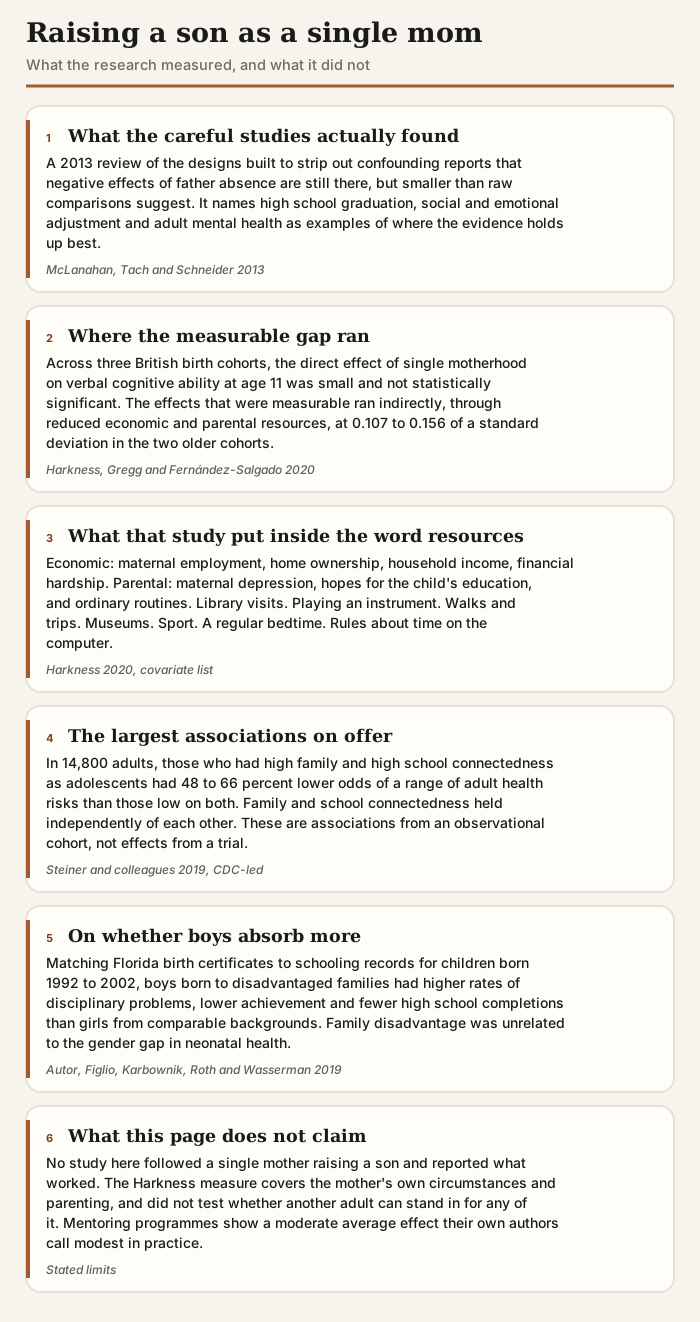
Sara McLanahan, Laura Tach and Daniel Schneider reviewed that whole body of work in the Annual Review of Sociology in 2013. Their conclusion is the one to hold onto, in both directions. Studies using the more rigorous designs continue to find negative effects of father absence on children's wellbeing, so the effect is not an artifact. But the magnitude is smaller than what the traditional cross-sectional designs report. And the evidence is strongest and most consistent for outcomes such as high school graduation, children's social and emotional adjustment, and adult mental health. Those are the review's own examples of where the effect holds up best, offered as examples rather than as a closed list.
Even as examples, that is a far more specific claim than the ambient one. They are also, as it happens, things that respond to what happens in a household.
The study that located where the gap runs
The most useful single finding for a mother raising a son alone comes from a 2020 paper in Child Development by Susan Harkness, Paul Gregg and Mariña Fernández-Salgado. They tracked verbal cognitive ability at age eleven across three British birth cohorts, children born in 1958, in 1970 and in 2000, with sample sizes of 10,675, 8,933 and 9,989. Then they ran a mediation analysis to ask not just whether there was a gap but what the gap was made of.
The direct effects of single motherhood were small and statistically insignificant. The indirect effects, the ones operating through reduced economic and parental resources, were the ones associated with lower attainment, in the range of 0.107 to 0.156 of a standard deviation for the two older cohorts. A standard deviation is the unit researchers use to compare scores across large groups. Under the conventional benchmarks Jacob Cohen set out in 1988, which are still the ones most of this literature uses, an effect around 0.2 counts as small, so these sit below even that line.
Read that carefully, because it is easy to read too strongly in either direction. A small and insignificant direct effect is an absence of evidence in these samples, not proof that single motherhood has no direct effect at all. What the study does establish positively is that the gap it could measure travelled through a specific route: money and parental resources. That is a claim about mechanism, and mechanism is the part you can intervene on.
Two limits worth stating plainly. This study measured verbal cognitive ability at age eleven, not the full range of outcomes, and it studied British cohorts, so the resource story is embedded in a particular welfare system. It also studied single motherhood in general rather than sons specifically.
| What people usually hear | What the research actually reports |
|---|---|
| Father absence causes worse outcomes | Rigorous designs find real but smaller effects than raw comparisons |
| The effects are everywhere | Strongest for a few named outcomes, given as examples |
| The cause is the missing man | One cohort study found the measurable gap ran through resources |
| Boys are doomed without a father | No study here tested that claim |
Whether sons are more sensitive than daughters
This is the question underneath the search, so here is the straight answer. The review evidence above does not break its three headline outcomes down by the child's sex, so it cannot settle the question. A different study was built for exactly this question, and it can.
David Autor, David Figlio, Krzysztof Karbownik, Jeffrey Roth and Melanie Wasserman matched Florida birth certificates to schooling records for children born between 1992 and 2002. Their finding, published in the American Economic Journal: Applied Economics in 2019, is blunt. Boys born to disadvantaged families had higher rates of disciplinary problems, lower achievement scores and fewer high school completions than girls from comparable backgrounds.
Two features of that result matter more than the headline. The differential held up when the authors compared children within the same schools, within the same neighbourhoods, and across siblings inside the same families, which is what separates it from the cruder comparisons. And they report that family disadvantage is unrelated to the gender gap in neonatal health, which points at the environment after birth rather than at something a boy arrives with.
Read precisely, this is not a finding about father absence, and it is not a finding about your son's sex acting on its own. It says that when a family is under disadvantage, boys absorb more of it than their sisters do. That puts the weight back onto the disadvantage, which is the thing this page has been pointing at from the start. If you want this question written from the father's side, our page on raising a son covers what was actually recorded about how fathers behave differently with sons.
The variable with the largest measured association, and it is not gendered
If you want one thing to spend your limited energy on, the candidate with the largest numbers attached to it in this literature is connectedness.
Riley Steiner and colleagues, in a study led from the Centers for Disease Control and Prevention, analysed data from 14,800 participants in the National Longitudinal Study of Adolescent to Adult Health, published in Pediatrics in 2019. They looked at family connectedness and school connectedness in adolescence, then at self reported health risks and experiences in adulthood: emotional distress, suicidal thoughts and attempts, violence victimisation and perpetration, intimate partner violence, sexual risk, and prescription and illicit drug misuse.
Family connectedness had protective associations for emotional distress, every violence indicator including intimate partner violence, multiple sex partners, sexually transmitted infection diagnosis, and both substance use measures. School connectedness had its own independent protective associations across a similar list. People high on both, compared with people low on both, had 48 to 66 percent lower odds across those outcomes.
These are associations from an observational cohort rather than effects from a trial, and the paper describes them that way. But the size of them, and the fact that family connectedness held independently of school connectedness, is the closest thing this evidence base offers to a lever.
Connectedness in this research means the child's sense of being cared for and of belonging. Nothing in the measurement requires two parents, and nothing in it requires a man. The CDC's own summary of school connectedness makes the same point about the school half of it: the mechanism is a child feeling that adults care about them as individuals.
About other men, honestly
Mothers raising sons are told constantly to find their son a male role model. The research on formal versions of this is real, and it is more modest than the advice implies.
Elizabeth Raposa and colleagues published a meta analysis in the Journal of Youth and Adolescence in 2019 covering 70 outcome studies of one to one youth mentoring programmes, 25,286 young people, average age twelve. Mentoring produced a statistically significant effect across youth outcomes, in what the authors classify as the medium or moderate range by the standards used for universal prevention programmes.
Two things in their moderation analysis are directly relevant here. Programmes serving a larger proportion of male youth produced larger effect sizes, and so did programmes deploying a greater percentage of male mentors. That is a programme level pattern rather than a finding about your son and one particular man, and it cannot be read as a promise about an individual match.
The authors' own summing up is the sentence to carry: the findings provide some support for the efficacy of mentoring while emphasising the need to remain realistic about the modest impact of these programmes as currently implemented. A good coach is worth having, and the evidence never claimed one could stand in for the household.
| Source | What it measured | What it found |
|---|---|---|
| McLanahan 2013 | Causal designs on father absence | Real effects, smaller than headline |
| Harkness 2020 | Verbal ability, 3 UK cohorts | Gap ran through resources |
| Steiner 2019 | Connectedness, 14,800 adults | 48 to 66 percent lower odds |
| Raposa 2019 | 70 mentoring studies | Moderate effect, modest in practice |
| Autor 2019 | Florida births matched to school | Boys absorb more family disadvantage |
What this actually changes about your week
The research above points at three things rather than at a personality you are supposed to acquire.
The first is resources, because that is where the one mediation study found the gap travelling, and it is worth being exact about what that study put inside the word. Its economic measures were maternal employment, home ownership, household income and reported financial hardship. Its parental resources measure was narrower and more specific than the phrase sounds: whether the mother showed signs of depression, what she hoped her child would do in education, and a short list of ordinary activities and routines, going to the library, playing an instrument, walks and trips with a parent, museums, sport, a regular bedtime, rules about time on the computer.
That list is more useful than a general instruction to spend more time, because it is concrete and most of it is cheap. It also puts your own mental health inside the mechanism rather than outside it, which is a reason to treat it as part of the work rather than as something to get to later.
The second is connectedness, and the specific claim in the Steiner data is that the family and school halves of it acted independently. Your son's sense of belonging at school is not a substitute for his sense of belonging at home, and neither one cancels the other. Both were separately worth having.
The third is the thing this site keeps arriving at from every direction: what fathering requires is a set of functions rather than a person holding a title. Our page on how to be a better father is written for men and its central finding does not depend on the reader being one. If you are performing those functions alone, you are performing them, and no study in this article measured legal or biological status as the variable that mattered.
Where this page stops
Cut this article back to its evidence and five studies remain, none of them built to answer a question typed into a search bar. The McLanahan paper is a review, so it inherits the limits of everything inside it. The Harkness cohorts are British, and the outcome is a single cognitive measure taken at a single age. The Steiner findings are associations from an observational cohort, and they rest on adults reporting on their own adolescence. The Raposa meta analysis covers formal programmes rather than the informal help most mothers actually have, and its own authors describe the real world impact of those programmes, as currently implemented, as modest. The Autor paper is about family disadvantage in general rather than father absence in particular, and it follows one Florida cohort.
None of these studies followed a single mother raising a son and reported what worked. That study, framed that way, is not what this literature contains, and any page that tells you otherwise is describing something it has not read. What the literature supports is narrower: the gap is real, it is smaller than you have been told, at least one careful attempt to locate it found it running through resources, and the largest associations on offer attach to a variable that has no sex attached to it.
For the wider argument about how badly the popular numbers in this area are reported, our page on absent father statistics takes the most circulated list apart claim by claim.
Raising a son as a single mom in one picture
Test yourself
Key takeaways
Last reviewed by The Father Standard Editorial Team on September 9, 2026. Our sourcing and AI-use rules are public on the editorial standards page.
FAQ
Will my son be worse off because his father is not here?
On average, children in father absent homes do worse on some outcomes, and the more rigorous studies still find that after stripping out confounding. The honest version of that sentence is narrower than the one that circulates. The effects were smaller than the raw comparisons suggest, and they clustered in a few places rather than spreading across everything a father's absence gets blamed for. An average is also not a forecast for one boy, and one cohort study that asked what the gap was made of found it running through economic and parental resources rather than through the absence itself.
Does a boy need a father figure to turn out well?
No study in this article tested that claim, and it is worth noticing that the claim is usually asserted rather than measured. What has been measured is that formal mentoring programmes produce a moderate average effect, larger in programmes with more male mentors and more male participants, and that the researchers who found this describe the real world impact of such programmes as modest. A good man in your son's life is worth having. The evidence does not support treating one as the deciding variable.
What is the single most useful thing I can do?
If you go by the size of the measured associations, it is connectedness, which carries the largest numbers in this article. What matters for an ordinary Tuesday is that the family half and the school half were counted separately and each held on its own. A good run at school does not settle what happens at home, and a hard week at home is not cancelled by a good teacher. Build both where you can. Nothing in how connectedness was measured requires two parents, and nothing in it requires a man.
Is my son more affected by this than a daughter would be?
The main review cited here does not break its findings down by the child's sex, so it cannot answer that, and this page will not pretend otherwise. The literature that most directly examines a boy specific sensitivity to family disadvantage sits in economics rather than in the medical literature. The honest position is that it is a reason to pay attention rather than an established fact about your son.
Should I keep his father involved if he wants contact?
That is a decision about safety and about the specific man, and no general page can make it for you. What this evidence base offers is a caution against assuming the answer either way, because the outcome research here measured presence and absence rather than the quality of what contact contains. Where safety is a question at all, that question comes first and it belongs with people who can assess your actual situation.
Does it help to explain his father's absence to him?
The studies in this article did not test disclosure or how it is handled, so any answer would be beyond what they support. What the connectedness research does establish is that a child's sense of being cared for and of belonging is strongly associated with better adult outcomes, which is an argument for whatever version of the conversation leaves him feeling closer to you rather than managed. Our page on absent fathers covers the adult children's side of how these conversations land.
Am I doing this alone if there is no man in the house?
The research cannot fully answer that, and it is worth saying where it stops. The mediation study measured the mother's own circumstances and her own parenting: her employment, income and housing, her mental health, her hopes for the child, and routines like bedtime, sport and trips to the library. It did not test whether a grandparent, an aunt, a teacher or a coach can stand in for any of that, so this page will not claim that it does. What sits alongside it is the connectedness research, where what registered was a child's sense that adults cared about them as individuals, and nothing in that measure specified which adults or how many.
Does any of this mean the father absence research is wrong?
No, and this page would be less useful if it said so. The 2013 review is explicit that studies using more rigorous designs continue to find negative effects. What changed with the better designs is the size of those effects and how specific they are. Treating the research as either a life sentence or a myth both get it wrong. It is a real, modest, partly mediated effect, and the mediated part is the part that responds to what you do.
Sources
- 988lifeline.org (988lifeline.org)
- single parenting (apa.org)
- Annual Review of Sociology (ncbi.nlm.nih.gov)
- Child Development (ncbi.nlm.nih.gov)
- American Economic Journal: Applied Economics (doi.org)
- Pediatrics (pubmed.ncbi.nlm.nih.gov)
- school connectedness (cdc.gov)
- Journal of Youth and Adolescence (pubmed.ncbi.nlm.nih.gov)