Adopting a Stepchild With an Absent Father: The Court Test and the Relationship Test Are Different Questions
Adopting a stepchild whose biological father is absent requires that his parental rights end first, either because he consents or because a court terminates them involuntarily. Absence in the everyday sense does not do that by itself. A court has to make a finding, on clear and convincing evidence, that the statutory grounds are met, and in most states an older child has to agree to the adoption as well.
That is the legal question. There is a second question underneath it that families usually assume the adoption will answer, and the research answers it differently. What predicts a good stepfather-child relationship is not the absent father's exit. It is the relationship the child already has with their mother.
This page is not legal advice and cannot be. Adoption is governed by state statute rather than federal law, the grounds differ by jurisdiction, and the facts of one family rarely map onto another. A licensed family law attorney in your state is the correct next step. If what you are living through has moved past a legal problem into a crisis, 988lifeline.org takes calls and texts around the clock in the United States, and a licensed clinician is the right referral rather than an article.
What a parent is actually asking
Two different problems get filed under this one search, and they call for different evidence. Whether the adoption can happen is a statutory question about one man's rights in one state. Whether it should happen, and what it will change for the child, is a question about a relationship, and the research on that second question does not say what most families expect going in.
The statutory question is the one that generates the phone calls and the filing fees. The relational one decides whether anything in the house is actually better afterwards, and it is answered somewhere other than a courtroom.
What a court has to find before the adoption can proceed
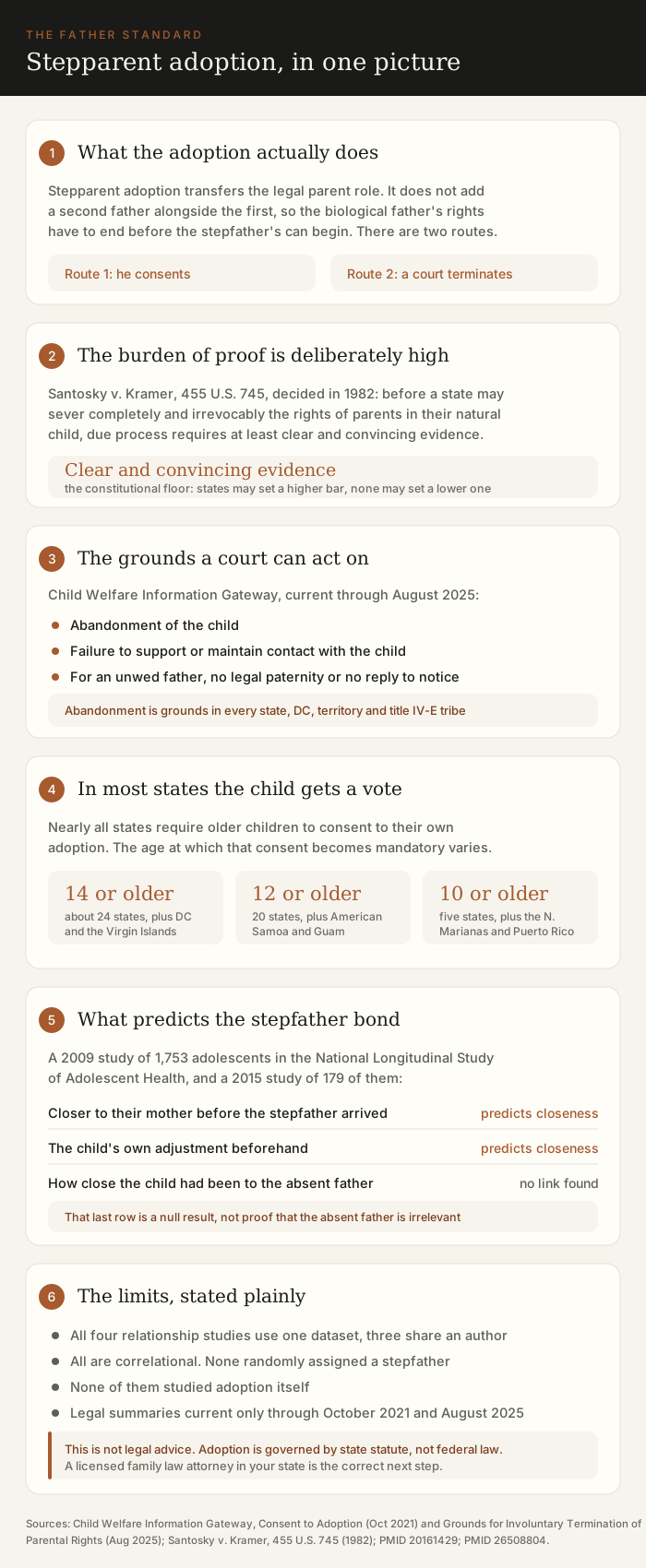
Stepparent adoption is not additive. It does not give a child a second father alongside the first. It transfers the legal role, which means the biological father's rights have to end before the stepfather's can begin.
The Children's Bureau publication Consent to Adoption, current through October 2021, states that in all states the birth mother and the birth father, if he has properly established paternity, hold the primary right of consent to the adoption of their minor child. There are two routes past that.
He consents. This is faster, cheaper and far less adversarial. Some absent fathers sign willingly, and some sign when the alternative is a contested hearing about their own conduct.
A court terminates his rights involuntarily. The same publication notes that in all states a court may find parental consent unnecessary in specific circumstances, including where the parent has abandoned the child, has failed to support the child, or has failed to establish a significant relationship with the child. It adds that an unwed father's consent may not be needed if he has failed to establish legal paternity, is found to have abandoned or neglected the child, is found unfit, or fails to respond to notice of an adoption proceeding.
The threshold for that second route is deliberately high. In Santosky v. Kramer, 455 U.S. 745, the Supreme Court held in 1982 that before a state may sever completely and irrevocably the rights of parents in their natural child, due process requires the state to support its allegations by at least clear and convincing evidence. States may set a higher bar. None may set a lower one.
The Children's Bureau publication Grounds for Involuntary Termination of Parental Rights, current through August 2025, lists abandonment and failure to support or maintain contact with the child among the most common statutory grounds, and states that all states, the District of Columbia, all territories and all title IV-E tribes recognise abandonment as grounds for termination.
Absence in ordinary language and abandonment in statute are not the same thing
This is where stepparent adoptions can stall, and it is worth being blunt about it. A father who has not visited in four years feels abandoned to everyone in the household. Whether that meets a statutory definition is a separate matter decided on a record.
| What families describe | What a court is weighing |
|---|---|
| He is never around | Documented periods with no contact |
| He never helps financially | Support ordered, and what was paid |
| He has no relationship with her | Whether a significant relationship exists |
| He would not fight it | Whether he was properly served notice |
| Everyone knows he is gone | Clear and convincing evidence on the record |
The right-hand column is what gets proven. The left-hand column is what gets felt. Both are real, and only one of them ends a legal parent-child relationship.
Two procedural traps recur. The first is paternity. If the biological father never established legal paternity, his position is weaker, and the Children's Bureau notes that in states operating a putative father registry an unmarried birth father who fails to register in the prescribed manner and time may lose the right to object to or consent to the adoption. The second is notice. A father who cannot be found still has to be served, usually by publication, and that step is frequently what sets the timeline rather than the merits.
The child usually gets a vote, and it is a real one
The child's opinion is not incidental here. In most of the country it is a legal gate.
The Children's Bureau reports that nearly all states, the District of Columbia and the territories require that older children consent to their own adoption. The thresholds break down like this.
| Age of the child | Where consent is required |
|---|---|
| 14 or older | About 24 states, DC, Virgin Islands |
| 12 or older | 20 states, American Samoa, Guam |
| 10 or older | Five states, Northern Marianas, Puerto Rico |
For a family with a teenager, that reframes the whole exercise. The adoption is not something done to a fifteen-year-old. It is something a fifteen-year-old signs, and a teenager who is ambivalent about erasing a father he still thinks about is entitled to be ambivalent in a courtroom. Our page on how to reconnect with your teenage son covers what that ambivalence usually is, and it is rarely loyalty to the absent man in the way adults read it.
What the research says the adoption will and will not change
Here the evidence stops being legal and starts being uncomfortable, because it does not support the story most families tell themselves about why they are filing.
The stepfather bond does not appear to be built out of the absent father's absence. A 2009 study in the Journal of Marriage and the Family by Valarie King, Stepfamily Formation: Implications for Adolescent Ties to Mothers, Nonresident Fathers, and Stepfathers, volume 71, pages 954 to 968, followed 1,753 adolescents in the National Longitudinal Study of Adolescent Health who lived with a single mother at the first wave, and who remained single, cohabited or married by the second wave about a year later. Close ties to married stepfathers were more likely to develop when the adolescent had been closer to their mother before the stepfather arrived. Prior ties to the nonresident father were unrelated to stepfather-stepchild ties.
That second finding is a null result, and it should be read as one. It means this study did not detect a relationship between the two things. It is not positive proof that the absent father is irrelevant to how the bond forms. The useful version of the claim is narrower and still worth having: in this sample, knowing how close a child had been to their nonresident father told you nothing useful about how close they would become to a stepfather.
What did predict the bond was measured before the stepfather appeared. A 2015 study in the same journal by Valarie King, Paul Amato and Rachel Lindstrom, Stepfather-Adolescent Relationship Quality During the First Year of Transitioning to a Stepfamily, volume 77, pages 1179 to 1189, modelled 179 adolescents from the same national dataset. Both the quality of the mother-adolescent relationship and the adolescent's own adjustment before the stepfamily formed were significantly associated with the perceived quality of the stepfather tie in the first year.
Keeping the biological father in the picture is not a cost. A 2018 study in the American Psychological Association's Journal of Family Psychology by Todd Jensen and Melissa Lippold, Patterns of stepfamily relationship quality and adolescents' short-term and long-term adjustment, volume 32, pages 1130 to 1141, identified patterns across mother-child, stepfather-child, nonresident father-child and stepcouple relationships. Youth adjustment over time was best in two patterns: a residence-centered pattern of high-quality relationships among the mother, child and stepcouple, and an inclusive pattern of high-quality relationships across all dyads including the nonresident father. Both did better than an unhappy-couple pattern or a parent-child disconnection pattern.
Read carefully, that only shows that a good relationship with a nonresident father sits inside one of the two best outcomes rather than competing with the household. It does not argue for preserving contact with every absent father. The pattern that predicted poor adjustment was disconnection, and a low-quality stepcouple relationship.
The bond is not guaranteed to hold either. A 2016 study by Valarie King and Rachel Lindstrom, Continuity and Change in Stepfather-Stepchild Closeness Between Adolescence and Early Adulthood, volume 78, pages 730 to 743, tracked 881 youth in stably married stepfamilies into adulthood and found considerable variability, with a sizable minority remaining close. The legal permanence of an adoption and the emotional permanence of the relationship are separate things, and only one of them is decided in court.
What this actually implies for the decision
Adoption is the right instrument for legal problems. Inheritance, medical consent, school authority, a surname the child wants, and the end of a custody claim that can be revived at any time. These are real, they matter, and nothing else delivers them.
It is a poor instrument for relational problems. On this evidence the stepfather-child bond is predicted by the mother-child relationship and by the child's adjustment beforehand. None of these studies tested legal status or adoption itself. What they did find is no link between how close a child had been to their nonresident father and how close they became to a stepfather. Filing in order to make a strained relationship close is buying the wrong thing.
The child's stage decides most of the practicalities. Under ten the child rarely has a vote and the case is largely about the father's record. From twelve upward the child is a party to it in most states, and their view has to be genuinely heard rather than coached.
Do not run the case as a referendum on the absent man. Our page on the absent father covers what children actually carry about a father who left, and the pattern is closer to unanswered questions than to hatred. A courtroom narrative that is entirely true can still be the version of events the child resents hearing repeated. Our page on what being present actually requires works through the version of the same distinction that applies inside the household.
The honest limits
Four of the sources behind this page are correlational studies and two are federal statute summaries. Neither type of source can carry the full weight some readers will want to put on it.
Every one of the relationship studies uses the National Longitudinal Study of Adolescent to Adult Health, so they share a sampling frame and are not four independent tests. Three of the four share an author. The convergence is real and it is narrower than four separate confirmations would be.
All four are correlational. None randomly assigned a stepfather, and none could. They describe which families end up close, not what makes a family close.
None of the studies is about adoption. They are about stepfamily formation and stepfather-child ties. Applying them to the adoption decision is a reasonable inference, and it is an inference, since no study here compared adopted stepchildren against non-adopted ones.
The legal material is a national overview and is dated. The consent summary is current through October 2021 and the termination summary through August 2025. States amend these statutes often. Nothing above substitutes for reading the current statute in your own state with an attorney.
Stepparent adoption with an absent father in one picture
Test yourself
Key takeaways
Last reviewed by The Father Standard Editorial Team on September 8, 2026. Our sourcing and AI-use rules are public on the editorial standards page.
FAQ
Can I adopt my stepchild if the biological father is absent but has not agreed?
Yes, if a court terminates his rights first. Absence alone does not do it. A judge has to find that statutory grounds are met, and under Santosky v. Kramer the state must prove its allegations by at least clear and convincing evidence before severing parental rights. Abandonment is recognised as a ground in every state, the District of Columbia, all territories and all title IV-E tribes, but what counts as abandonment is defined by state statute and decided on the record.
How long does a father have to be gone before it counts as abandonment?
There is no single national answer, and any article giving you one number is guessing. Abandonment is defined state by state, and courts typically look at contact and support together rather than elapsed time alone. This is the single most jurisdiction-specific part of the process and the clearest reason to ask an attorney licensed in your state rather than to rely on a general page.
Does my stepchild have to agree to the adoption?
In most of the country, past a certain age, yes. About 24 states plus the District of Columbia and the Virgin Islands require consent from a child aged 14 or older. Twenty states plus American Samoa and Guam set the threshold at 12, and five states plus the Northern Marianas and Puerto Rico set it at 10. For a teenager this makes the adoption something they sign rather than something arranged around them.
Will adopting my stepchild make our relationship closer?
The evidence does not support expecting that. In a 2015 study of adolescents entering stepfamilies, the quality of the stepfather-adolescent tie in the first year was predicted by the mother-adolescent relationship and by the adolescent's adjustment beforehand. Adoption resolves legal questions that nothing else can resolve. It is not the mechanism that builds the bond.
Should I keep the biological father in my stepchild's life if he wants contact?
That is a decision about safety and about the individual man, not one a general page can make. What the research offers is this: in a 2018 analysis of stepfamily relationship patterns, the two patterns associated with the best youth adjustment were a residence-centered one and an inclusive one that included a good relationship with the nonresident father. Contact with him is not automatically a cost to the household. The patterns associated with poor adjustment were disconnection and a low-quality couple relationship.
What happens to child support if the adoption goes through?
An adoption ends the biological father's legal parent-child relationship, which generally ends his ongoing support obligation going forward, and the stepparent takes on that obligation instead. Arrears already owed are treated differently in different states. This is one of the most common surprises in the process and one of the most jurisdiction-specific, so confirm it with an attorney before filing rather than after.
Does my stepchild's surname change automatically?
Not automatically in every state, and it is usually requested as part of the adoption petition rather than granted by default. Where the child is old enough to consent to the adoption, their view on the name generally carries weight too. Ask for it explicitly if it matters to your family, since raising it after the decree is a separate and slower process.
Is a stepfather who does not adopt a lesser father?
Nothing in this evidence base says so. The studies here measure relationship quality and youth adjustment, and none of them measured legal status as the variable that mattered. A stepfather without a decree can hold the residence-centered pattern that predicted the best long-term adjustment. Our page on how to be a better father applies to that role without alteration.
Sources
- 988lifeline.org (988lifeline.org)
- Consent to Adoption (childwelfare.gov)
- Santosky v. Kramer (law.cornell.edu)
- Grounds for Involuntary Termination of Parental Rights (childwelfare.gov)
- Stepfamily Formation: Implications for Adolescent Ties to Mothers, Nonresident Fathers, and Stepfathers (europepmc.org)
- Stepfather-Adolescent Relationship Quality During the First Year of Transitioning to a Stepfamily (europepmc.org)
- Patterns of stepfamily relationship quality and adolescents' short-term and long-term adjustment (europepmc.org)
- Continuity and Change in Stepfather-Stepchild Closeness Between Adolescence and Early Adulthood (europepmc.org)