How to Be a Better Father: Why More Effort Is Not the Answer, and What Is
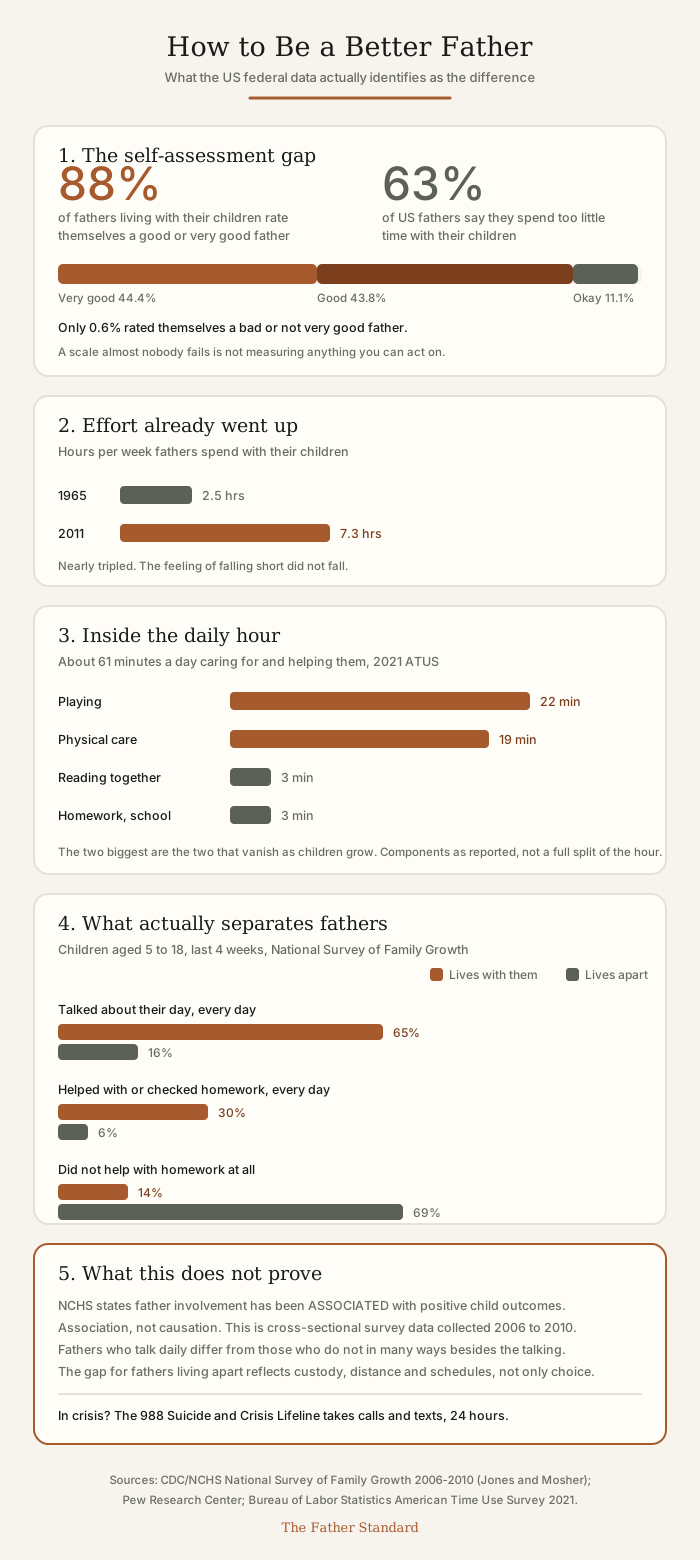
Most answers to how to be a better father are built on an assumption that the federal data does not support: that the father asking is not trying hard enough. He almost certainly is. American fathers have nearly tripled their time with their children since the 1960s, from 2.5 hours a week in 1965 to 7.3 hours a week in 2011, according to Pew Research Center's analysis of how mothers and fathers spend their time, which draws on historical time diary data and the American Time Use Survey. Effort went up and stayed up. If effort alone were the variable, this question would have stopped being asked two generations ago.
It has not stopped being asked, and the reason is visible in the same data. Fathers are giving more of their time than their own fathers did, and a majority of them still say it is not enough. That is not a character problem. It is a measurement problem, and it has a fix.
The short answer
Stop grading yourself on effort and volume, because you are already near the ceiling on both and the score is not improving. Grade yourself on frequency instead. The federal survey that measures father involvement does not measure how hard a man tries or how much he loves his children. It counts how often he did a small number of specific, unremarkable things in the last four weeks. That is the axis where fathers actually differ from each other, and it is the axis you can change on a Tuesday.
The self-assessment gap, and why it matters
Two well-sourced numbers sit oddly next to each other.
The first comes from the National Survey of Family Growth, reported by Jones and Mosher for the National Center for Health Statistics in Fathers' Involvement With Their Children: United States, 2006-2010. Asked to rate how good a job they were doing as a father, fathers living with one or more of their children answered like this: 44.4% said a very good job, 43.8% said a good job, 11.1% said an okay job, and 0.6% said not a very good job or a bad job. Round it and 88% of resident fathers place themselves in the top two boxes. Six in a thousand place themselves in the bottom one.
The second comes from Pew Research Center, which found that 63% of US fathers say they spend too little time with their children, against 36% who say they spend the right amount.
Hold those together. Roughly nine in ten fathers think they are doing well. Roughly six in ten think they are not giving enough time. Both cannot be a straightforward reading of reality, and the useful conclusion is not that fathers are deluded. Self-rating and time-accounting are measuring two different things, and neither of them is measuring the thing a child actually experiences.
This is the same trap we have written about in dad guilt: the internal feeling of falling short is a poor instrument, and turning it up does not improve the output. A father who feels worse is not thereby a better father. He is a worse-feeling father with the same calendar.
What the involvement survey actually counts
The NCHS report is worth understanding because of how narrow it is. It surveyed a nationally representative sample of 10,403 men aged 15 to 44. Its father-involvement measures rest on 2,200 fathers of children under 5 and 3,166 fathers of children aged 5 to 18, the latter split into 2,091 who lived with those children and 1,075 who lived apart from them.
For school-aged children it asked how often, in the last four weeks, the father did each of a short list of things: talked with the children about things that happened during their day, ate meals with them, took them to or from activities, and helped with homework or checked that homework had been done.
That is the whole instrument. No question about how much he loves them. No question about how hard the year was. It counts repetitions of four ordinary acts, and it is the closest thing the United States has to an official definition of an involved father.
The report is careful about what this establishes, and so are we. Its own framing is that increased father involvement "has been associated with a range of positive outcomes for the children." Associated. This is observational survey data, it cannot separate a father's involvement from everything else that travels with it, and no honest reading of it lets anyone promise that adding a behaviour causes an outcome. What it does establish is where fathers differ from one another, which is a different and more usable fact.
| In the last 4 weeks, fathers of children aged 5 to 18 | Lived with the children | Lived apart from them |
|---|---|---|
| Talked with them about their day, every day | 65% | 16% |
| Did not talk with them about their day at all | 1.1% | 37% |
| Helped with or checked homework, every day | 30% | 6.0% |
| Did not help with homework at all | 14% | 69% |
Two things fall out of that table.
The first is that daily conversation is close to universal among resident fathers and close to absent among fathers living apart. Only 1.1% of resident fathers had not talked to their school-aged children at all in four weeks, against 37% of fathers living apart. Proximity is doing enormous work. If you live with your children, the single most common involvement behaviour in the country is already happening in your house, most likely without you counting it.
The second is that even among resident fathers, the numbers are not ceilings. Thirty percent helped with or checked homework every day. The rest did it less often than daily, and 14% did not do it once in the entire month. There is real, measured spread here, and it runs between habits that got established and habits that did not, rather than between good men and bad men.
Where the daily hour actually goes
Pew's key facts about dads in the US, drawing on the 2021 American Time Use Survey, breaks the day down further. Fathers with children under 18 in the household spend on average 1.02 hours a day caring for and helping them, which is about 61 minutes. Inside that hour: 0.36 hours playing with them, about 22 minutes, 0.32 hours on physical care such as dressing, bathing and getting them ready, about 19 minutes, 0.05 hours reading to and with them, about 3 minutes, and 0.05 hours on education-related activities such as homework help, about another 3 minutes.
Read that against the involvement survey and a pattern shows up. The two activities that take the most minutes, play and physical care, are the two that scale down hard as children get older. A fourteen year old does not need bathing and will not be played with. The two activities that barely register in minutes, reading together and school involvement, are the ones that still have a form at fourteen.
So a father whose contact leans almost entirely on the first two categories can be doing an hour a day, sincerely, and still watch that foundation narrow each year, for the plain reason that it was built on the part of the day that was always going to shrink. Whether that narrowing is what later surfaces as the pattern described in the distant father, where good men end up strangers at home without a single identifiable moment where it went wrong, is not something this data can confirm. It counts acts, not closeness.
What to actually change
Four things follow from the data above. None of them require more hours. If the question is narrower than fatherhood in general, how to be a better father to your daughter and how to be a better father to your son work the same four behaviours against a thinner evidence base.
Convert your presence into a countable act. The involvement survey counts frequency, and frequency is a habit rather than an intention. Pick one of its four behaviours, the one you currently do least, and attach it to something that already happens daily. If you drive them anywhere, that is your conversation. If you eat at home, that is your meal. Family routines do the heavy lifting here precisely because they remove the decision.
Stop treating the homework check as academic. Talking is already near universal among resident fathers, at 65% daily with only 1.1% never. Homework checking is not: 30% daily, 14% not once in the month, and most of the rest somewhere in between. Of the two behaviours this page has numbers for, that is the one with room left in it. Checking is not tutoring. It is a two minute demonstration that you know what is going on in their week.
Protect the talking, not the outings. Taking children to and from activities is real involvement and it is also the one most easily outsourced to a schedule. Talking about their day is the one that survives when they stop needing lifts.
Do not confuse a bad feeling with a diagnosis. Sixty three percent of fathers report giving too little time. If that number were tracking real neglect, the country would look very different. Treat the feeling as a prompt to check the frequency of your four behaviours, and then stop. The instrument for improvement is a calendar, not a conscience, which is where our case for presence over provision starts.
What the evidence will not tell you
It will not tell you that doing these things causes your child to turn out well. The NCHS report says involvement is associated with positive outcomes, and association is where the evidence stops. Fathers who talk with their children daily differ from fathers who do not in many ways besides the talking.
It will not tell you what to do about a relationship that is already broken. Frequency advice assumes contact. If there is no contact, that is a different problem with a different answer.
It will not tell you that the fathers living apart in that table are failing. Thirty seven percent not talking in four weeks is a statistic that contains custody orders, distance, work schedules and obstruction, not just choice.
If the difficulty here is not routine but genuine estrangement, family crisis, or your own mental health, this page is not the right tool. In the United States, the 988 Suicide and Crisis Lifeline is available by call or text at 988, and a licensed family therapist is the appropriate next step for a rupture rather than a habit.
The whole thing on one page
Last reviewed by The Father Standard Editorial Team on August 28, 2026. Our sourcing and AI-use rules are public on the editorial standards page.
FAQ
How do I know if I am a good father?
Not from your own rating. As the self-assessment section above sets out, almost every resident father places himself in the top two boxes, so that scale cannot separate anyone from anyone and cannot tell you where you stand. Use the federal involvement question instead, because it is answerable: in the last four weeks, how often did you talk with them about their day, eat with them, take them places, and check their homework. If you cannot answer that from memory, that is itself the finding. Count for a fortnight before you grade yourself on anything.
Am I spending enough time with my children?
Probably more than your father did, and that is not the question that will help you. American fathers went from 2.5 hours a week with their children in 1965 to 7.3 hours a week in 2011, and 63% of them still say they give too little time. The volume has roughly tripled while the sense of falling short has stayed. That pattern suggests total hours is not the variable that resolves the feeling.
What do involved fathers actually do differently?
They repeat a small number of ordinary things more often, and that is close to the whole of it. Worth noticing what the federal survey never asks: how much a man loves his children, how hard his year was, or how good a father he is trying to be. It asks how many times in four weeks he did four specific things, and the table above is where fathers actually separate from one another. Frequency is the measured difference. Effort and affection are not measured at all, which is worth knowing before you keep grading yourself on them.
Does spending more time with my kids make them turn out better?
The evidence does not support a causal claim that strong. The NCHS report states that increased father involvement has been associated with a range of positive outcomes for children, and association is the correct word. This is cross-sectional survey data. Fathers who are highly involved differ from less involved fathers in income, work schedule, living arrangement and much else, and no survey of this design can separate those. Treat involvement as worth doing on its own terms rather than as a lever on an outcome.
I only get an hour a day with my kids. Is that enough?
An hour a day is close to the American average, so quantity is not where your problem is. The chart above shows where that hour goes, and the short version is that most of it sits in two activities that stop being available as children grow. The practical move is substitution rather than addition. As play and physical care fall away on their own, put the reclaimed minutes into the two that still have a recognisable form at fifteen, which are talking about the day and staying attached to school. The hour stays the same length. What it is made of changes.
How often should a father check his child's homework?
There is no evidence-based correct frequency, only a measured distribution to place yourself in. Among American fathers living with their school-aged children, 30 percent helped with or checked homework every day in the last four weeks and 14 percent did not do it once. Among fathers living apart the same figures are 6.0 percent and 69 percent. Time-use data puts education-related help at about 3 minutes of the average father's day, so daily does not mean long. Treat the daily figure as a benchmark rather than a dose that produces an outcome, because the survey is observational.
I live apart from my children. What does the data say about me?
That the obstacle is structural before it is personal. The survey sorts fathers only by whether the child lives in his household, not by how much he cares or how hard he is trying, and the table above shows how far apart those two groups sit on the daily behaviours. Read that gap as what it largely is: custody arrangements, distance, work rosters and sometimes obstruction. The useful consequence is that almost nothing in a non-resident father's week arrives by proximity. A father living in the house picks up the daily conversation partly by accident of being there when it happens. Living apart, every one of those contacts has to be placed in a calendar on purpose, or it does not occur.
Is feeling guilty a sign I need to do more?
It is a poor instrument. Nearly two thirds of American fathers report giving too little time, a rate high enough that it is telling you more about a shared modern expectation than about your individual household. Use it as a trigger to audit frequency, then act on the audit rather than the feeling.
Sources
- how mothers and fathers spend their time (pewresearch.org)
- Fathers' Involvement With Their Children: United States, 2006-2010 (cdc.gov)
- 63% of US fathers say they spend too little time with their children (pewresearch.org)
- key facts about dads in the US (pewresearch.org)