Dad Guilt: What It Is Actually Measuring, and Why Feeling Worse Never Made a Better Father
Dad guilt is the felt distance between the father you were told to be and the father your week actually produced. It is a gap measurement, not a verdict on your character. It tells you something needs checking. It never tells you what.
That distinction matters more than it sounds, because most fathers treat the feeling as a verdict and respond accordingly. They carry it. They apologise to nobody in particular. They lie in bed running the tape of the thing they missed. None of that closes a gap. It is possible to feel terrible about your fathering every single night for a year and end the year having changed nothing your kid could point to.
This page is about what the guilt is made of, why the amount of it you feel is a poor guide to how you are doing, and what converts it into something that shows up in a child's actual week.
What dad guilt actually is
Guilt is a comparison. It requires two things: a standard, and a reading of your own conduct against it. Remove either one and the feeling cannot exist. A father who holds no standard for himself feels nothing. A father who has no idea what he actually did all week feels nothing either, which is why the busiest men are sometimes the calmest, right up until a quiet Sunday hands them the reading.
So when the feeling arrives, two separate things are being asserted at once. First, that a standard exists. Second, that you fell below it. Fathers almost always accept both without inspecting either, and that is the error. The standard is frequently wrong. Sometimes it is not even yours.
A useful test: write down, in one sentence, the specific thing you feel guilty about. Not "I am not around enough." Something a camera could have recorded. "I was on my phone during dinner four nights out of five." "I have not been to a single one of his Saturday games this season." If you cannot produce that sentence, you are not carrying guilt about a behaviour. You are carrying a mood about an identity, and behaviour change will not touch it.
The company you are in, and the reason
The feeling is close to universal among fathers, and the reason it is so much more common in fathers than mothers is not what most men assume.
Pew Research Center surveyed US parents in 2017 and found that most dads say they spend too little time with their children. Sixty three percent said too little, against 36 percent who said they spent the right amount. Among mothers the figures nearly invert: 53 percent said the right amount, and 35 percent said too little.
Asked why, dads who said too little named work obligations most often, at 62 percent. A further 20 percent said the main reason was that they do not live with their children full time, which tracks with the finding in the same body of work that about one in four fathers of children 17 or younger lives apart from at least one of them.
Two useful things sit inside that data. The first is that the feeling is not evidence of an unusual failing. It is the majority position. The second is that the most common cause named by fathers is a structural one, and structural causes do not respond to feeling bad about them. Nobody has ever guilted their way out of a shift pattern.
Worth holding alongside it: the same organisation's key facts about dads in the US found large shares of fathers reporting that being a parent is enjoyable, 81 percent, and rewarding, 79 percent, all or most of the time. The guilt and the enjoyment are not competing accounts of the same life. They coexist in the same men, in the same week.
Guilt is a broken instrument
Here is the finding that should change how you read your own feeling.
Researchers at Utrecht University and the University of Twente ran a study on work-family guilt and internalised gender stereotypes, published in the British Journal of Social Psychology in 2023. In the first study, 135 mothers and 116 fathers were given a hypothetical situation in which work interfered with family, and asked how guilty they would feel. Fathers' implicit gender stereotypes were measured separately with a gender-career association task.
The result: the stronger a father's implicit stereotype that work is the man's lane, the less guilt he reported. Mothers on average reported more guilt than fathers, and for mothers that link to implicit stereotypes did not hold in the same study.
Read that carefully, because it is doing something specific. It is not saying fathers with strong provider beliefs are worse fathers. It is saying the volume of guilt a father feels is partly a readout of what he believes his job is, not of what he did. Two men can miss the same bedtime. The one who believes the bedtime was his to make feels it. The one who believes bedtime was never his department does not. Their sons had the same evening.
That is what makes guilt a poor instrument. It reads your beliefs about your role, not your child's actual experience. A low reading does not prove you are doing fine, and a high one does not prove you are failing. Either reading can be badly wrong, in either direction.
One caveat the study itself carries: the fathers' guilt in study one was measured against a fictitious scenario, not a real week. That is a real limitation and we are not going to paper over it. The direction of the finding is still the useful part.
Where the gap is actually coming from
If guilt is a gap measurement, the next question is what the gap is made of. A large cross-country study gives a precise answer, though it is measuring a neighbouring condition rather than guilt itself.
Roskam, Mikolajczak and a large international team studied parental burnout across 36 countries, with 16,059 parents, published in Social Psychiatry and Psychiatric Epidemiology in 2024. They tested why burnout runs highest in more individualistic countries and found three mechanisms carrying the effect. The strongest of the three was self-discrepancy: the distance between the socially prescribed parental self and the actual parental self. Second was low sharing of parental tasks. Third was self-directed socialisation goals.
Two honest notes on how we are using that. Burnout and guilt are not the same condition, and this study did not measure guilt. What it does establish is that the prescribed-versus-actual gap is a load-bearing mechanism in parental distress, and that it outweighed the other two candidates. Treating that same gap as the engine under dad guilt is our editorial reading of an adjacent finding, not something the paper claims.
But it points at the thing most fathers never try. A gap has two ends. You can raise the actual, which is what every man reaches for first, or you can correct the prescribed, which almost none of them touch. And the prescribed end is where a lot of the fraud lives.
| The prescribed standard | Where it came from | What actually carries weight |
|---|---|---|
| Be present for every important moment | A highlight reel of other families, assembled from the moments they chose to photograph | Being present for the unimportant ones. Attendance at the boring fixture reads louder than attendance at the final. |
| Never be the dad who is tired and short with them | A standard no human on shift work meets, held as though it were baseline | Repair after the short answer. A kid who has seen you come back and name it learns that ruptures close. |
| Provide, and the rest follows | An inherited role definition, often from a father who was measured that way himself | Provision plus one reliable unpaid block of time. The first without the second is the classic distant-father profile. |
| Make up for the lost years in one big conversation | Film. Almost exclusively film. | Small, repeated, low-stakes contact that predates any big conversation and makes it survivable. |
| Feel it deeply enough and you will change | The belief that emotion is the engine of behaviour | Structure. A recurring slot in the calendar outperforms a strong feeling on a Tuesday, every time. |
That last row is the one to sit with. It is covered at length in our piece on family routines, and it is the least romantic idea on this site: the boring repeated block does the work that intention keeps promising to do.
The avoidance loop, which is the actual damage
Guilt on its own is uncomfortable. The loop it starts is the part that costs a father years.
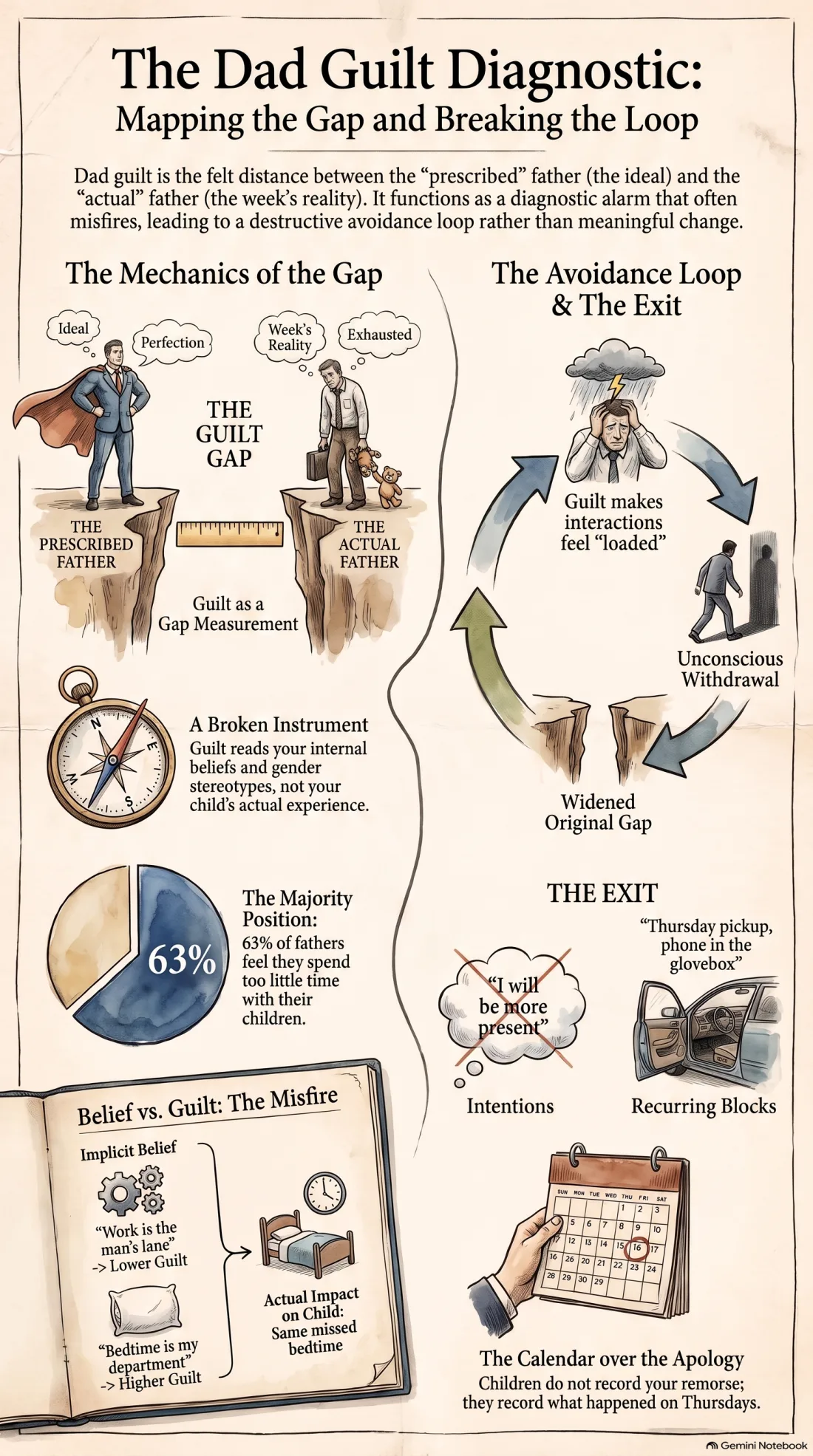
It runs like this. You feel guilty about the distance. The guilt makes the next interaction feel loaded, because you arrive owing something. Loaded interactions are unpleasant, so you unconsciously schedule fewer of them. Fewer interactions widen the distance. The widened distance produces more guilt. Nothing in this loop requires a bad man, an argument, or a decision. It runs on its own, quietly, for years, and every single turn of it is powered by the desire to be a better father.
This is the mechanism behind a lot of what we describe in the distant father: men who are not absent, not hostile, not uninterested, just strangers at their own table.
The exit is counterintuitive. You do not exit by resolving the guilt first. You exit by making the next contact small enough that it carries no debt. A twelve minute drive. A text with no question in it. Something so low-stakes that it cannot fail and therefore cannot add to the pile.
Converting guilt into fathering
Three moves. All of them are conversions, taking the feeling and turning it into something with a date on it.
Name the specific behaviour or discharge the alarm. Take the feeling and force it into one recordable sentence, as above. If a sentence exists, you have a target. If no sentence exists after five honest minutes, treat it as a false alarm and put it down. Ambient guilt with no behaviour attached is not conscience, it is noise, and carrying it costs you the energy you would need to actually change something.
Convert one target into a recurring slot, not an intention. "I will be more present" is not a plan and has never survived contact with a working week. "Thursday pickup, every week, phone in the glovebox" is. The unit of fathering is the recurring block, which is the whole argument of present, not just providing. One real block beats five intentions.
Audit the prescribed end once. Sit with the standard you are failing and ask where you got it. If it came from a film, a highlight reel, or a father who was measured badly himself, you are failing a test that was never valid. Lowering an invented standard is not letting yourself off. It is removing a distortion from the instrument so that the reading you get next time means something.
What none of these involve is telling your children how guilty you feel. A child cannot absorb a father's guilt without taking on the job of managing it, and that reverses the direction of care. Say what you are going to do differently. Then do that thing on a schedule. The apology that lands is the one with a calendar behind it.
When it is not guilt
Some of what gets filed as dad guilt is a different thing wearing its clothes, and the difference is not academic.
The US Surgeon General's advisory on the mental health and well-being of parents, published in 2024, reported that in 2023 data, 33 percent of parents reported high levels of stress in the past month against 20 percent of other adults, and 48 percent said that most days their stress is completely overwhelming, against 26 percent among other adults. Guilt sitting on top of a system already running at that load behaves differently. It does not motivate. It flattens.
Signals that what you are carrying needs more than a scheduling fix: the feeling does not lift even after a genuinely good day with your kids; you have stopped being able to enjoy the time you do get; you are avoiding contact entirely rather than dreading it; sleep and appetite have gone; or the thought has arrived that they would be better off without you.
That last one is not a thought to sit alone with. In the US, call or text 988, the Suicide and Crisis Lifeline. If any of the rest is describing your last few months, this is the point where a licensed clinician is the right next step, not another article, and not another resolution to try harder. Nothing on this page is a substitute for that.
Estrangement carries its own version of this, and we treat it separately in our piece on the estranged father, where the guilt is frequently tangled with grief and the two need separating before either one can be worked on.
The standard
Guilt is a smoke alarm. It is worth having in the house. It is not a fire report, it cannot tell you what is burning, and it goes off when someone makes toast.
The standard is this: every time it sounds, you either produce the specific behaviour it is pointing at and put a date on changing it, or you check the standard it is measuring you against and discharge it. What you do not do is let it run. An alarm left ringing in the background does not make anyone safer. It just makes the house harder to live in, and eventually everyone stops hearing it.
Your children are not keeping a record of how bad you felt. They are keeping a record of what happened on Thursdays.
Dad guilt in one picture
The gap, the broken gauge, and the loop, in one view.
Test yourself
A few questions on what the research does and does not support about guilt, and on which end of the gap is worth working.
Key takeaways
Last reviewed by The Father Standard Editorial Team on August 18, 2026. Our sourcing and AI-use rules are public on the editorial standards page.
FAQ
What is dad guilt?
Dad guilt is the felt distance between the father a man believes he is supposed to be and the father his actual week produced. It only shows up when you are holding yourself to some standard, which is why how much of it you feel says as much about your beliefs about the job as it does about anything your child actually experienced.
Is dad guilt normal?
It is the majority experience. In a Pew Research Center survey of US parents, 63 percent of fathers said they spend too little time with their children, against 36 percent who said they spend the right amount. Among mothers, 53 percent said the right amount. So the feeling is close to standard issue among fathers, and it is not on its own evidence of an unusual failing.
Why is dad guilt so common, even though mothers report more guilt overall?
Fathers report the specific belief that they spend too little time with their children far more often than mothers do, and work obligations are the reason they name most, at 62 percent of those who said too little. That is a different measurement from guilt itself. In the work-family guilt study cited above, mothers on average reported more guilt than fathers. For fathers, the amount of guilt they reported tracked how strongly they held the belief that work is the man's job, rather than what they actually did that week. Beliefs about role shape the reading, in both directions.
Does feeling guilty make you a better father?
No. Guilt is a signal that something may need checking, not an engine for change. Feeling worse produces no behaviour on its own. If anything it works against you, since it is the first turn of the avoidance loop described above, where the discomfort of the next contact is what gets it postponed. What changes a child's experience is a recurring block of time on a schedule, not the intensity of a father's remorse.
Should I tell my kids I feel guilty?
No. Tell them what you are going to do differently and then do it on a schedule. Handing a child your guilt puts them in the position of having to manage it, which reverses the direction of care and adds a job they did not ask for. An apology with a calendar behind it lands. An apology that asks for reassurance does not.
How do I stop feeling guilty as a dad?
Force the feeling into one sentence a camera could have recorded. If you can write that sentence, you have a target: convert it into one recurring slot in the week. If you cannot write it after five honest minutes, treat it as a false alarm and put it down. Then audit the standard itself, because a fair share of dad guilt is failing a test assembled from films and other people's highlight reels.
When is dad guilt a sign of something more serious?
When it does not lift after a genuinely good day with your children, when you have stopped enjoying the time you do get, when you are avoiding contact rather than dreading it, or when sleep and appetite have gone. Parents report far higher stress than other adults, with 48 percent saying most days their stress is completely overwhelming, so guilt often sits on top of an already loaded system. If the thought has arrived that your children would be better off without you, call or text 988 in the US, and speak to a licensed professional rather than working through it alone.
Sources
- most dads say they spend too little time with their children (pewresearch.org)
- key facts about dads in the US (pewresearch.org)
- work-family guilt and internalised gender stereotypes (pubmed.ncbi.nlm.nih.gov)
- parental burnout across 36 countries (pubmed.ncbi.nlm.nih.gov)
- the mental health and well-being of parents (hhs.gov)