Family Routines: The Boring Structure That Does the Heavy Lifting
Family routines are the structure that produces the moments a father actually wants. Moments are not produced by intention. They are produced by structure, which is the part nobody puts on a card. Routine is not the enemy of connection. Routine is the machine that manufactures the conditions for it, on the ordinary Tuesday when nobody is feeling especially close and the effort is not there.
Ask a father what he wants for his family and he will describe moments. The conversation on the drive. The kid who tells him something real. The house that feels warm instead of managed. Ask him how those moments get produced and the answer usually goes vague. Intention. Effort. Being a good dad.
The family that has good conversations at dinner is the family that eats dinner together on a schedule. The kid who talks in the car is the kid who is in the car with you twice a week because of a routine that predates the conversation.
This is the case for taking the boring parts of your week seriously.
What a family routine actually is
A family routine is an observable practice that repeats. Dinner at seven. Bath, book, lights out. Saturday morning errands with one kid in the passenger seat. Something a stranger watching your household for a week could write down.
The useful distinction was drawn by researchers reviewing fifty years of work on the subject. In their review of naturally occurring family routines and rituals, published in the Journal of Family Psychology in 2002, family routines are defined as observable practices while family rituals are the symbolic layer sitting on top of them: the same repeated act, but carrying meaning about who this family is. Their review of 32 publications going back to 1950 found routines and rituals associated with parenting competence, child adjustment, and marital satisfaction.
That distinction is the whole game for a father. The routine is the load-bearing beam. The ritual is what the beam is holding up. Dinner at seven is a routine. Dinner at seven where your kid knows he will be asked about his day and actually listened to is a ritual, and it is doing something the schedule alone cannot do.
Most households have plenty of routines and very few rituals. The conversion is cheap, and it is the single highest-return move in this article.
The evidence, stated honestly
Family routine advice tends to arrive with more confidence than the underlying research earns, so here is the actual state of it.
The strongest single number comes from a meta-analysis published in Pediatrics in 2011, which pooled 17 studies covering 182,836 children and adolescents. Kids sharing family meals three or more times a week were more likely to be in a normal weight range and to have healthier eating patterns. The authors put specific odds on it: a 12 percent reduction in the odds of being overweight, a 20 percent reduction in the odds of eating unhealthy foods, a 24 percent increase in the odds of eating healthy foods, and a 35 percent reduction in the odds of disordered eating.
A 2023 umbrella review in Nutrients pulled together 41 systematic reviews on family mealtimes and found greater family meal frequency associated with protection against poorer diet, obesity, risk behaviours, poorer mental health and wellbeing, and poorer academic outcomes. That same review reported that findings from interventions designed to increase family meals are mixed, which is the honest caveat: we know families who eat together look better on paper, and we know less about whether pushing a family to eat together produces the same benefit.
On the sleep side the pattern is unusually consistent. A study of 10,085 young children across more than a dozen countries and regions, published in the journal Sleep in 2015, found a dose-dependent relationship between a consistent bedtime routine and sleep outcomes: earlier bedtimes, faster time to fall asleep, fewer night wakings, longer total sleep. Dose-dependent is the important word, and it means more nights of routine were associated with better outcomes than fewer nights. That gradient is the shape you would expect from a real effect, though the study rests on parent-reported questionnaires rather than an experiment, so it cannot rule out that steadier or less stressed households both keep the routine and sleep better for the same underlying reason.
A follow-up review in Sleep Medicine Reviews argued that the benefits of a nightly bedtime routine extend past sleep into language development, literacy, emotional and behavioural regulation, parent-child attachment, and family functioning, because the routine bundles feeding, hygiene, communication, and physical contact into one predictable block.
Two limits worth holding onto. The 2002 review flagged real methodological problems in this literature, including inconsistent measurement and reliance on convenience samples. And a 2020 systematic review in the Journal of Nutrition Education and Behavior found that the evidence tying family meal frequency to family functioning was stronger than the evidence tying it to diet.
That last finding is the one a father should take home. The reason to defend the table is not nutrition. It is the family.
Why structure beats effort for a working father
You already know that motivation is unreliable. You have built a career on systems that produce output whether or not you feel like it that morning.
Home is the one place most men refuse to apply that lesson, because applying it feels cold. Scheduling your kid sounds like the opposite of loving him.
Look at what happens without the schedule. Connection gets funded out of leftover energy, and leftover energy is the most volatile line in a working father's budget. A hard quarter arrives and the discretionary spend goes first. Nothing is decided, nothing is announced, and six months later a man notices he has not had a real conversation with his son since spring. That is the mechanism behind most of the drift covered in the distant father playbook, and it says nothing about his character. It describes an unfunded budget line.
A routine converts connection from discretionary to fixed. That is its entire value. Spontaneity is warmer in the moment and worse over a decade, because reliability compounds and good intentions do not.
The advantage over willpower comes down to three mechanical effects. The first is that a routine removes the decision: nobody has to want it, propose it, or negotiate it, and where there is no decision there is nothing to skip. Thursday is simply the drive.
The second is predictability, which is what children are actually reading. The American Academy of Pediatrics puts the standard plainly in its guidance on the importance of family routines: children do best when routines are regular, predictable, and consistent. That predictability is what a child leans on when deciding, mostly unconsciously, whether you are someone he brings things to.
The third is surface area. Children do not schedule disclosures. They release them sideways during something else, which makes your odds a direct function of how many low-stakes, recurring, side-by-side blocks exist in the week. This is the same responsiveness loop that Harvard's Center on the Developing Child calls serve and return. You cannot return a serve you were not present for.
The four load-bearing routines
Not all routines carry weight. Most households have a dozen and only a few are structural. These four are the ones worth defending, in rough order of return per minute spent.
| Routine | What it actually does | What kills it | The father's move |
|---|---|---|---|
| The evening table | The single most studied family routine. Strongest evidence is for family functioning, not diet. | Staggered schedules, screens on the table, one parent eating standing up | Fix the nights it is realistic, three or four, not seven. Phones in another room, including yours. |
| The drive | Side-by-side, fixed end time, no eye contact required. The best conversation format you will get with a teenage son. | Taking calls in the car. One habit, and the block is gone. | Ban calls on any drive with a child in the vehicle. No exceptions, because exceptions are what the rule is made of. |
| The night check | For young kids the bedtime routine has dose-dependent sleep evidence. For older kids the same slot becomes the day's only unguarded window. | Getting home after it, or arriving with the office still running in your head | Be home for it on the nights you promised. Ten minutes, door open, no agenda, no questions about grades. |
| The weekly anchor | One named recurring slot per child. Converts your presence from weather into climate. | Work conflicts that win by default because the anchor was never really booked | Put it in the calendar under the child's name with the same protection level as a board commitment. |
Four is the number on purpose. A father who tries to install eight routines at once installs none. Pick the two that are weakest in your house, run them for a quarter, then look again.
Converting a routine into a ritual
The evidence describes the difference between a household that has routines and a household where those routines carry meaning. The conversion takes three moves and costs nothing.
Name it. An unnamed routine is a habit and dies quietly. A named one is a thing your family has. "Thursday drive." "Pancake Saturday." "The ten minutes." Children repeat names to other people, and the naming is most of what turns a scheduled block into an identity.
Defend it visibly. The first time your kid sees you move a work call to keep the routine, the routine changes category in his head. He learns what outranks what, and he learns it from behaviour, not from what you say about your priorities. That will happen roughly once a week and it is the price of the whole system.
Add one fixed marker. The same seat. The same music. The same first question. Markers are what let a child recognise the routine as itself, and they carry a surprising amount of the emotional freight. The marker also gives the routine somewhere to go when the format has to change: the Saturday breakfast that moves to a Sunday coffee is still recognisably the same ritual if the marker survives.
None of this requires a single extra hour. It is the same time you were already spending, labelled and protected. The mechanics of finding that time in a heavy calendar are covered in the working father's presence playbook.
Routines with teenagers, which is where most fathers quit
Somewhere around thirteen the routines stop working the way they used to and most fathers conclude that routines are for small children.
What actually changed is the format, not the need. A teenager will refuse a scheduled conversation and accept a scheduled activity. He will not sit down to talk and he will get in the car. The routine has to become lower-key, side-by-side, and optional-looking while remaining, on your end, completely non-negotiable.
Three adjustments hold routines together through the teenage years:
Drop the face-to-face format. Shoulder to shoulder, moving, with a task in front of you. Driving, cooking, the gym, the dog, the garage. The specifics of running this without triggering a shutdown are in how to reconnect with your teenage son.
Give up the agenda. The moment a routine becomes the delivery vehicle for a lecture about grades, the teenager identifies it correctly as a trap and stops attending. Cost of admission is that most of these blocks produce nothing. That is not failure. That is the price of the ones that produce something.
Let him renegotiate the shape, not the existence. A fifteen-year-old who wants to move the Saturday slot to Sunday afternoon is not rejecting you. Grant the change and hold the frequency. What the shift in the job actually involves at this stage is covered in teenager parenting.
The AAP guidance makes the same point from the medical side: the goal is a compromise between the chaos of no structure and a structure so rigid it offers children no choice. Rigidity is how fathers lose routines in the teenage years. Flexibility about form, rigidity about frequency.
When routines break
They will. A travel stretch, a hospital week, a separation, a quarter that eats everything. Routines break in every household and the break is not the problem.
The problem is that broken routines rarely get formally restarted. They lapse, the lapse becomes the new normal, and eighteen months later nobody can name when dinner stopped happening. The repair is short and it has to be explicit.
Say it out loud, to the kid, without a speech. "We stopped doing Thursdays. That was me. We are starting again this week." No apology tour, no explanation of the work situation, and no promise about the future beyond this Thursday. Then show up on Thursday.
Children forgive interruptions easily and read unacknowledged disappearances as information about where they rank. The naming is what separates the two.
One boundary worth stating plainly. Routines are infrastructure, and infrastructure is not treatment. If your household is dealing with a child's depression, self-harm, disordered eating, substance use, or an estrangement that has hardened over years, structure is a support and not a solution, and this is the point to bring in a licensed professional. In the United States, the 988 Suicide and Crisis Lifeline is available by call or text, 24 hours a day, for anyone in crisis or worried about someone who is.
The standard
The father who wins the decade is not the one who felt the most or intended the most. He is the one whose kids can name four things that reliably happen in their house, and who was there for them on the ordinary weeks when nothing was at stake.
That is what routines buy. Not warmth on demand. A structure that keeps producing the conditions for warmth on the nights nobody has any.
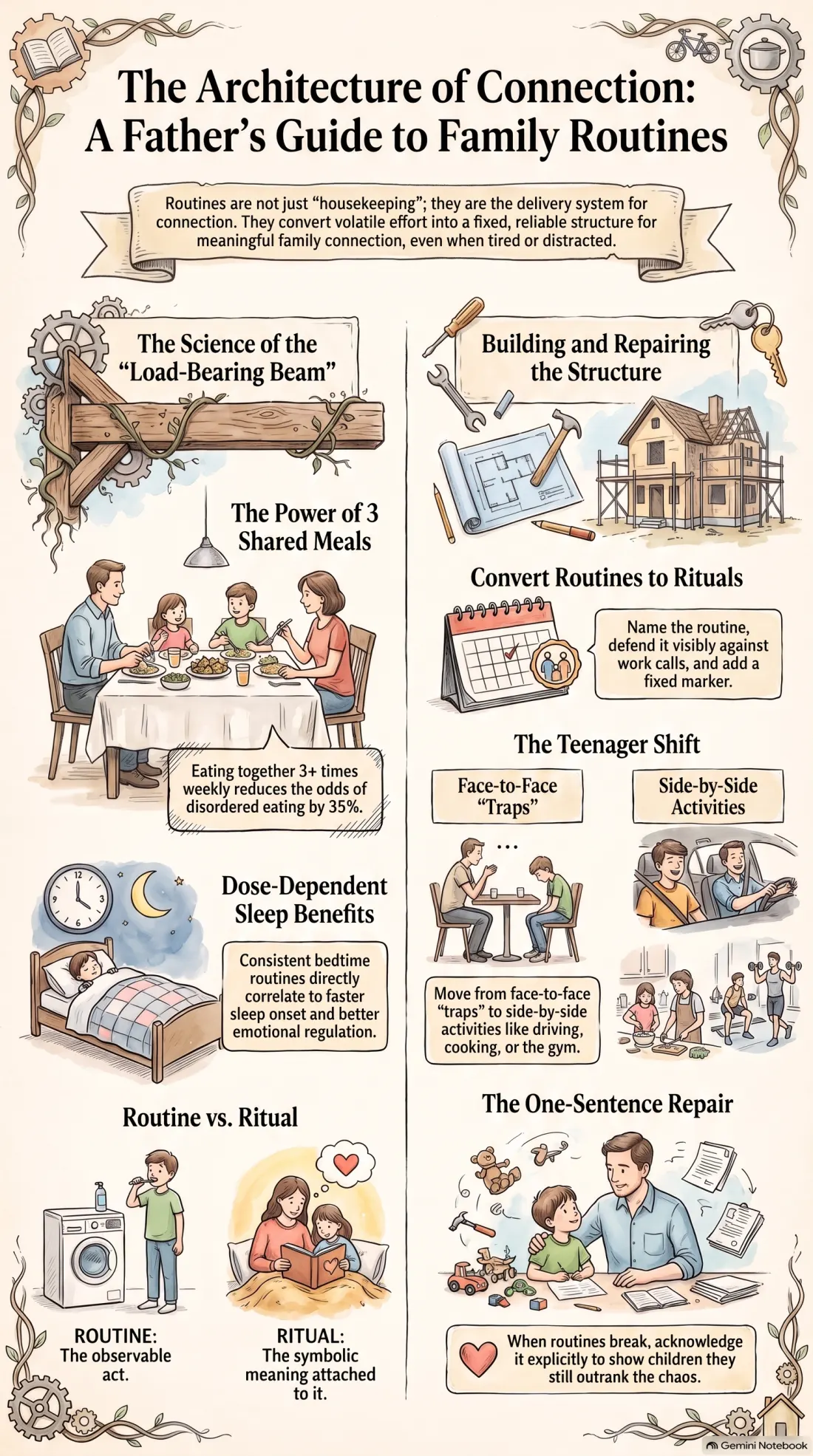
Family routines in one picture
The routine-to-ritual conversion and the four load-bearing blocks, in one view.
Test yourself
Five questions on what the research does and does not support, and on which routines carry weight.
Key takeaways
Last reviewed by The Father Standard Editorial Team on August 16, 2026. Our sourcing and AI-use rules are public on the editorial standards page.
FAQ
What are family routines?
Family routines are the repeating, observable practices of a household: a set dinner hour, a bedtime sequence, the weekly drive to practice, Saturday errands with one child riding along. Researchers draw a line between those practices and family rituals, which are the same acts once they carry meaning about the family's identity. The practical test is whether a child would notice the absence of the thing itself or the absence of what it stands for. A skipped meal is a scheduling problem. A table nobody sits at anymore is a message.
How do you turn a family routine into a ritual?
Three moves, none of which costs an extra hour. Name it, because an unnamed routine is a habit that dies quietly while a named one is a thing your family has, and children repeat the name to other people. Defend it visibly, because the first time your child sees you move a work call to keep the routine, he learns what outranks what from your behaviour rather than from anything you say about your priorities. Add one fixed marker, the same seat or the same music or the same first question, because a marker is what lets a child recognise the routine as itself. The marker is also what lets the routine survive a change of format, since a Saturday breakfast that moves to a Sunday coffee is still recognisably the same ritual if the marker survives.
Do family routines actually work, or is that just parenting advice?
They hold up, with a caveat the advice usually leaves out. The two best-evidenced routines are shared meals and a consistent bedtime, and the bedtime research is the stronger of the pair because it shows a dose response: more nights of the routine were associated with better sleep than fewer nights. Even there the data come from parent questionnaires rather than a controlled trial, so the gradient is suggestive rather than conclusive. Meals are murkier still. The association with better outcomes is consistent across a large body of work, but efforts to manufacture more family meals produce mixed results, which leaves open the possibility that frequent meals are partly a symptom of a functioning household and not purely a cause of one. Treat routines as high-value and low-risk, not as a guaranteed intervention.
How many nights a week should a family eat dinner together?
Three or more, which is the threshold the largest meta-analysis on the subject used to separate the groups it compared. Three is deliberately modest, and that is the point: three or four defended nights outperform seven aspirational ones, because a routine that keeps failing to happen has already stopped being a routine in the child's mind. Choose the nights your real schedule supports rather than the nights you wish it did, put phones somewhere else including your own, and treat those specific evenings as booked.
How do you keep family routines going with a teenager?
Hold the frequency and let the format move. Teenagers refuse scheduled conversations and accept scheduled activities, so the routine survives by becoming something you do next to each other with a task in hand: the car, the kitchen, the gym, the dog. The fastest way to kill one is to use it for a lecture about school, because the routine then gets correctly filed as a trap. Expect most of these blocks to produce nothing at all, and expect a teenager to want to shift the day or the hour. Granting the shift keeps the routine alive; granting a cancellation ends it.
What do you do when a family routine falls apart?
Name the lapse in one sentence and restart on the next occurrence. No speech, no explanation of the work situation, and no promise beyond the very next one, because a promise about the future is what the child has already learned to discount. Every household loses routines to travel, illness, or a punishing quarter, and the interruption itself does almost no damage. What does damage is the version where the routine simply evaporates and nobody ever mentions it, since a disappearance that goes unacknowledged reads to a child as a ranking.
Are routines the same as being strict?
No. A routine fixes when something happens; strictness governs how people must behave once it does. The Thursday drive is non-negotiable, while what gets said in the car, or whether anything gets said at all, is entirely open. Confusing the two is the most common way fathers lose routines with older kids, because a block that arrives with rules attached feels like supervision, and pediatric guidance on household structure warns specifically against rigidity that leaves a child no room for choice.
Sources
- review of naturally occurring family routines and rituals (pubmed.ncbi.nlm.nih.gov)
- 182,836 children and adolescents (pubmed.ncbi.nlm.nih.gov)
- 41 systematic reviews on family mealtimes (pubmed.ncbi.nlm.nih.gov)
- 10,085 young children across more than a dozen countries and regions (pubmed.ncbi.nlm.nih.gov)
- benefits of a nightly bedtime routine extend past sleep (pubmed.ncbi.nlm.nih.gov)
- family functioning was stronger than the evidence tying it to diet (pubmed.ncbi.nlm.nih.gov)
- the importance of family routines (healthychildren.org)
- serve and return (developingchild.harvard.edu)