When an Estranged Father Dies: Why the Grief Is Heavier Than You Expected
When an estranged father dies, the two most common reactions are a grief far heavier than you were braced for, and no reaction at all. Both are ordinary. Neither one is a verdict on whether you were right to keep your distance, and neither one tells you anything about how much you loved him.
What is throwing you is probably the size mismatch. You had prepared, without quite deciding to, for a loss scaled to the relationship, on the reasonable assumption that years of silence should cost about what an obituary for a distant relative costs. That is not how it is landing, and there is a reason for it that has nothing to do with your feelings being irrational.
You are not carrying what the relationship contained. You are carrying what it left open. Those are separate quantities, and the second one can be very large in a relationship that had almost nothing in it.
If you are in danger right now, this page is the wrong resource. If you are having thoughts of harming yourself, the 988 Suicide and Crisis Lifeline in the United States takes calls and texts around the clock, and it is for far more than emergencies. Local crisis lines cover the same ground elsewhere. The rest of this can wait an hour.
Below: what predicts a hard bereavement and why an estranged death loads it twice, what to expect from feelings that arrive out of order or not at all, how to treat the funeral as its own small question, what is still open to you now that he is gone, and where this stops being grief and starts being something with a name and a treatment.
Why this grief is heavier than the relationship was
Grief after a close relationship has material to work with. There were conversations. There was a person you knew well enough to miss accurately. What is gone has a shape, and the shape is what you mourn.
Grief after an estrangement has almost none of that. What it has instead is an account that was never settled. Every unsent message. Every year you assumed was still in hand. Every argument that was paused rather than finished. Every version of him you were waiting to see some evidence of before you decided anything. None of that got closed, and on the day he died all of it became permanent at once.
What is hitting you is the account closing. It is not, in most cases, the man leaving.
We would put it this way, as an editorial reading rather than a research finding: an estrangement is an unsettled account that both parties have agreed not to look at, and a death is the moment the ledger is taken away.
What predicts a hard bereavement
The evidence here is thinner than the confidence with which it usually gets repeated, so it is worth stating at its real strength rather than a convenient one. What follows is one cross-sectional study and one review of risk factors, not a settled literature.
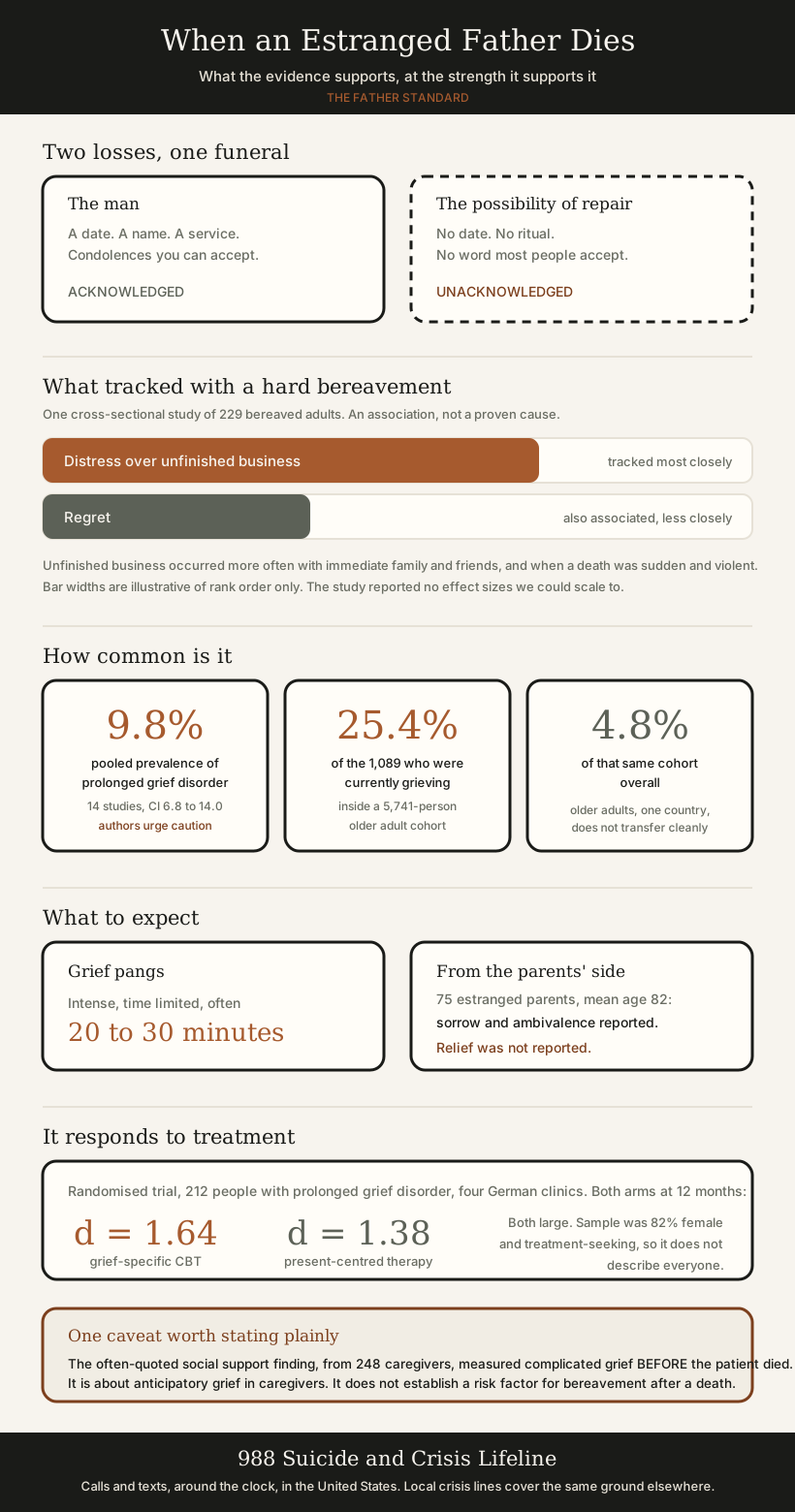
A study published in Death Studies examined bereavement-related regret and unfinished business in 229 bereaved individuals, treating them as two separate things rather than one. They turned out to be overlapping but distinct. Unfinished business, meaning lingering or unspoken conflict with the person who died, occurred more often with immediate family and friends than with other relationships, and more often when the death was sudden and violent. Both forms of unresolved issue were associated with how the bereavement went. The strongest of those associations was the one between distress over unfinished business and complicated grief symptoms.
One study, one sample, measured at a single point in time, with no causal chain demonstrated. That is the whole of what is behind it, and it is worth saying so plainly before drawing anything from it. What can fairly be drawn is narrow. Inside that sample, the burden did not follow the warmth of the relationship. It followed how much had been left unsettled.
The second factor is social, and here the evidence needs handling with care because it is easy to overstate and we nearly did. The National Cancer Institute's health professional summary on grief and bereavement, which is a cancer-bereavement clinical summary rather than a general one, lists interpersonal context including social support among the three categories of variable investigated as predictors of bereavement outcome. The one specific social-support finding it reports is narrower than that framing suggests: in a study of 248 caregivers of terminally ill cancer patients, a lack of perceived available social support was among the variables associated with higher levels of complicated grief measured before the patient died, not after.
So that finding is about anticipatory grief in caregivers, and it does not establish anything about bereavement after an estranged father's death. Read it as a reason to take the question seriously rather than as proof. What we would say beyond the evidence, and label as ours rather than the literature's, is that the word doing the work in it is perceived. It is not a count of the people around you. It is whether support registers to you as available.
An estranged death fails that test almost by design. The people who would ordinarily carry you through a father's death are frequently the same people who spent the estrangement telling you to get over it, or who are now grieving a version of him you do not recognise, or who are watching to see whether you cry the correct amount. Some of them are relatives you last spoke to at the funeral before this one.
So an estranged death tends to hand you both at once: an account that cannot now be settled, which is the one thing the bereavement evidence here does point at, and a support system you cannot lean on, which is our reading rather than a demonstrated risk factor. Neither is a sign your grief is disordered. Both follow from the shape of the situation.
The second loss, the one nobody sends a card for
There are two deaths here, and only one of them gets a service.
The first is the man. Whatever he was, he stopped existing on a specific date and you will be told about that one, and people will use his name, and there will be a form of acknowledgement available even if it does not fit.
The second is the possibility. As long as he was alive, some part of you was running a background process on a repair that had not happened yet. Not planning it. Most people who have been estranged for years are not planning anything. But holding the option open, the way you hold a door with your foot while carrying something. The letter you had not written. The thing you would say if he ever asked. The version of him at seventy who might have turned out to be easier than the version at fifty.
That option closed at the same moment he did, and there is no ritual for it, no card, and no vocabulary that most people around you will accept. If you have ever tried to explain to a colleague that you are not sad he is gone so much as sad that it is now settled, you have already found the edge of what other people can hold.
The National Institute on Aging's guidance on coping with grief and loss makes a point that reads differently in this situation than in the one it was written for. It notes that people often hesitate to bring up the loss or say the name of the person who died, worrying it will be hurtful, when talking directly about the loss is frequently what helps. In an estranged death that hesitation runs harder in both directions. Nobody knows whether to offer condolences, and you do not know what to do with them when they come.
The two losses, in one figure
The feelings arrive in the wrong order, and some do not arrive
Several things are likely happening that will feel like evidence something is wrong with you.
You may feel nothing. Not numbness exactly, more an absence where you expected weather. This is common enough that its absence would be more surprising, and it is not a verdict on your capacity to love people.
You may feel relief, and then feel appalled at yourself for feeling it. Relief when a difficult relationship ends is not a finding about your character, and it rarely arrives clean. It usually turns up alongside everything else rather than instead of it, which is what makes it disorienting instead of freeing.
If part of what you are doing is trying to work out what he had settled before he died, there is a limited answer available, and its limits matter as much as its content. It comes from 75 estranged parents aged 75 and over who were asked about their own estrangements. They are not your father, they were reporting on themselves at one moment, and there are only 75 of them, so nothing here describes any individual. Within those constraints: sorrow and ambivalence both showed up as parent sentiments, and relief did not show up at all. The one sex difference reported is that ambivalence was expressed by more of the men than the women, and sorrow by more of the women than the men. That is a comparison between the two groups, not a statement that ambivalence was the commonest thing any father felt. Ambivalence is the state of holding two positions and resolving neither. The useful implication is not about him specifically. It is that a settled position is not the normal end state of these relationships, so if you were waiting to find out where he had landed, the likeliest answer is nowhere in particular.
You may get hit at full force in twenty-minute stretches, at intervals that have no logic to them. The National Cancer Institute summary describes these as grief pangs or bursts, intense and time-limited, often running twenty to thirty minutes, sometimes triggered by a reminder and sometimes by nothing identifiable. Knowing they are a described pattern with a known shape and a known ending makes them survivable in a way that being ambushed by them does not.
And you may find the anger fully intact, with nowhere left to put it. Nothing about the death settles it. It only removes the one person who could have.
What you are likely to be told, and what the evidence supports
A great deal of advice will arrive this month. Most of it is well meant and some of it is actively unhelpful in this specific situation.
| What you will be told | What the evidence actually supports |
|---|---|
| "At least you had made your peace with it." | Distance is not the same as closure. Of the two unresolved-issue constructs tested in the 229-person Death Studies sample, distress over unfinished business tracked complicated grief symptoms most closely. Being estranged does not empty that account, it freezes it. |
| "You should feel relieved." | You might, and that is allowed. But relief was not among the sentiments reported by the 75 estranged parents in the 2026 Scandinavian Journal of Psychology study either. Sorrow and ambivalence were. Expecting relief from anyone in this situation, including yourself, is not well supported. |
| "It will hit you in a year." | Nobody can tell you that. Time since bereavement was one of the factors predictive of complicated grief in the Rotterdam cohort, but a prediction about a population is not a schedule for a person. Treat any specific timeline you are handed as a guess. |
| "You need to forgive him now." | No evidence establishes forgiveness as a requirement for a bereavement to resolve. What the research points at is the distress attached to unfinished business, which can be reduced by saying the thing somewhere it can land, not by issuing a verdict you do not hold. |
| "Grief is worst when you were closest." | In the 5,741-person Rotterdam Study cohort, relationship to the deceased did predict complicated grief, most strongly for a spouse or a child. That cohort was older adults, so most parent deaths in it were long past, and it does not settle the estranged-parent case in either direction. Nothing there licenses the assumption that a distant relationship produces an easy grief. |
The funeral is a separate decision, and it is smaller than it feels
Whether to go to the funeral is a narrower question than how you feel about him, and it is not a referendum on the estrangement. It is a logistics question about one afternoon in a room with a specific set of people.
Three things make it more decidable. First, name what you are going for, and let the answer be small. Going to see him buried, going for a sibling, going so that you have seen it happen, or going because not going would cost you more argument than attending, are all sufficient reasons. If what you are hoping for is a reconciliation scene with the surviving family, that hope is a reasonable thing to want and a poor thing to travel on, because a funeral rarely delivers it. Worth bringing a second, smaller reason to be in the room as well.
Second, decide the exit before you arrive. An hour you have already agreed with yourself to leave at is holdable. An open-ended day with relatives is not, and this is not the week to test your capacity.
Third, decide the funeral separately from the estate, the notifications, and the paperwork. Those come with their own pressures and their own clock. The National Institute on Aging's practical guidance on what to do after someone dies walks through the sequence, which is worth reading once for the plain fact that most of it is not your job unless you choose to make it yours. Whether you have any formal role in the rest of it, as an heir, an executor, or someone with a say in the arrangements, is decided by state law, by whether there is a will, and by family structure. It is not decided by how close the two of you were. Find out which of those applies to you before somebody hands you a document in a bad week.
If you do not go, put the reasons in writing this week, while you can still name them plainly. Not for anyone else to read. Grief is unreliable about its own history, and the version of you who gets asked about this at the next family gathering will not necessarily remember why it felt obvious now. The same protection is worth having for anyone still facing the earlier decision, which we cover in what to do when an estranged father is dying.
What is still available to you
What the Death Studies sample associated with a hard bereavement was the distress people carried around unfinished business, not the absence of a conversation that never happened. Read closely, that is a distinction with an opening in it. The distress is yours. It was never held jointly, and it does not require him to be alive to be worked on.
Write the letter. This week, addressed to him, and sent nowhere. Put down the specific thing rather than a summary of the history, because the specific thing is what was being carried. One sentence is enough if it is the right one.
Then say it out loud, once, to somebody who was there. A sibling, your mother, the aunt who watched it happen. Someone who needs no background and will not ask you to be fair about him.
If neither of those moves it, that is the point to bring in somebody trained for exactly this. It is a well-mapped clinical area, and needing it says nothing about how you handled the estrangement.
One thing to be careful of. The strong instinct after an estranged death is to reopen the whole account and total it, line by line, at three in the morning. It does not resolve, because both sets of records are incomplete and one party has stopped filing. That is the same machinery we describe in what dad guilt is measuring, running now against a balance that cannot be struck. The way out is not a final number. It is closing the book.
When this is more than grief
There is a threshold where this stops being a hard bereavement and becomes a condition with a name and a treatment, and it is worth knowing where it sits.
Prolonged grief disorder is now a recognised diagnosis in the international classification systems. A systematic review and meta-analysis in the Journal of Affective Disorders pooled 14 studies of adults after non-violent bereavement and found a prevalence of 9.8 percent, with a confidence interval running from 6.8 to 14.0 percent. The authors were explicit that the studies varied a great deal and that the figure should be read cautiously. Roughly one in ten is the right order of magnitude, not a precise rate.
Among people who are actively grieving, the proportion is higher. A population-based study of 5,741 older adults in the Rotterdam Study found complicated grief in 4.8 percent of the whole cohort, but of the 1,089 who reported current grief, 277 met criteria, which is 25.4 percent. That cohort is older adults in one country, so it does not transfer cleanly to every reader. It does establish that this is not a rare outcome among people currently in it.
The National Institute on Aging describes complicated grief as mourning that goes on so long or becomes so distressing that it stops being healthy, with signs including being unable to accept the loss, overwhelming negative emotion, preoccupation with the person who died or with the circumstances, and being unable to resume your own life or make plans.
The part worth knowing is that this responds to treatment. A randomised clinical trial published in JAMA Psychiatry compared grief-specific cognitive behavioural therapy against present-centred therapy in 212 people with prolonged grief disorder across four German university outpatient clinics. Both arms produced large reductions in grief severity at twelve-month follow-up, with effect sizes of 1.64 and 1.38. The grief-specific therapy was ahead of the comparison immediately after treatment, and at follow-up its clear remaining advantage was on depressive and general symptoms rather than on grief severity, where the difference was only at trend level. Two honest limits: the sample was 82 percent female, and it was people who had sought treatment, so it does not describe what happens to everyone. What it establishes is that both of these are real treatments with large effects, not a coin flip.
Two markers are worth watching for in yourself. One is when the thought of harming yourself stops being a passing shape and starts being a plan. The other is when whole days go by in which you do not eat, sleep, work or answer anybody. Either of those is past what a page can carry. The 988 line named at the top of this article is reachable by call or text at any hour, and local crisis lines cover the same ground outside the United States. Nothing written here substitutes for care from a person who can see you.
Reading this from the other end
If you are the one who has been out of contact rather than the one grieving, you have just read the account from the other end, and there is one thing in it for you.
The load is the open account, not the distance. Of everything on this page, the unsettled part is the only piece still within reach while you are alive, and reaching it does not require them to answer, to meet you, or to forgive anything. It requires the specific thing to be said once, plainly, by you, with nothing attached to it. That is available today. The mechanics are in how a father begins closing an estrangement, and the slow pattern most of these ruptures grow from is set out in what a distant father transmits over years.
When an estranged father dies, in one picture
Test yourself
Key takeaways
Last reviewed by The Father Standard Editorial Team on August 25, 2026. Our sourcing and AI-use rules are public on the editorial standards page.
FAQ
Why am I grieving so hard for an estranged father I barely spoke to?
Because the size of this is not being set by how close you were. It is being set by how much was left unsettled, and an estrangement leaves almost everything unsettled by definition. The evidence pointing this way is one cross-sectional study rather than a settled literature, so treat it as a useful lens and not a law. As a lens it explains the mismatch you are feeling: you were braced for a loss proportional to the contact, and what arrived was proportional to the silence.
Is it normal to feel nothing when an estranged parent dies?
Yes, and it needs no justification. The National Institute on Aging is explicit that there are no rules about how you should feel and no right or wrong way to mourn. Numbness, delay, and flat absence are all inside the normal range, and none of them predicts what will happen in six months. What is worth watching is not whether feeling arrives on schedule, but whether months on you are unable to make plans, unable to resume your life, or preoccupied with the death to the exclusion of everything else. Those point somewhere clinical. An empty first fortnight does not.
What do I say when people offer condolences and they do not know we were estranged?
You are allowed to accept a condolence without correcting the record. "Thank you, it is complicated" is a complete sentence and it closes the topic without lying or explaining. Decide in advance which two or three people get the real version, and let everyone else have the short one. The pressure to perform a grief that matches other people's assumptions is one of the genuinely exhausting parts of this week, and you are not obliged to hand strangers the history to justify your reaction.
Why do I feel relieved that my estranged father died?
Look at what specifically eased, because it is usually not his death. More often it is the end of a standing obligation: the birthday you had to decide about every year, the question at every family gathering, the low hum of a decision you were postponing. Those genuinely did end, and noticing that is not the same as being glad he is gone. The reason it curdles into guilt so fast is that the two get filed under one word. Separating them, in writing if it helps, tends to take most of the charge out of it. If the guilt is running the show rather than passing through, that is worth raising with somebody trained for it rather than arguing with yourself about whether you are a bad person.
Do you have to forgive an estranged parent who died?
No. No evidence establishes forgiveness as a requirement for a bereavement to resolve, so "you need to forgive him now" is a custom being handed to you rather than a finding. What the evidence points at is narrower: the distress attached to unfinished business, which was the unresolved-issue construct tracking complicated grief symptoms most closely in the 229-person Death Studies sample. That is one cross-sectional study, so treat it as a lens rather than a law. What it points at is reduced by saying the thing somewhere it can land, not by issuing a verdict you do not hold. Forgiveness may arrive later, on your own schedule or not at all. It is not the toll you pay to stop hurting.
What if there is nobody left to say it to?
This is the harder version and it is more common than it sounds, because estrangements often take the siblings and the witnesses with them. If there is no one who was in the house, the saying still works without an audience: the unsent letter, a recording you make once and never play back, a grave or a bench or any fixed place you can return to. If what you need is someone who will not need the background explained, that is a reasonable thing to bring to a bereavement counsellor rather than a relative. The point was never that a particular person heard it. It was that it stopped being carried silently.
Do I have to be involved in the funeral, the estate, or the paperwork?
Being asked to help is one thing and being obliged to is another, and the two get conflated in the first week because everything arrives at once and sounds urgent. Almost none of it is. If you want out of the administrative side, you can generally say so once, in writing, to whoever is organising, and decline without giving reasons. Declining is not abandonment. What it does or does not affect legally is a separate question, decided by state law and by the particular circumstances rather than by whether you turned up, so it is worth confirming rather than assuming in either direction. That is the one thing here worth doing early instead of avoiding.
When does grief after an estranged death need professional help?
When it stops being painful and starts being disabling. The markers are the ones set out in the section above: inability to accept the loss, preoccupation with the death, and being unable to resume your life or plan a future, persisting rather than easing. Around one in ten bereaved adults is estimated to develop prolonged grief disorder, and it responds to treatment, with a randomised trial of 212 people finding large reductions in grief severity in both therapies it tested. If you have reached thoughts of harming yourself, use the 988 line rather than waiting to see whether it passes.
Sources
- 988 Suicide and Crisis Lifeline (988lifeline.org)
- bereavement-related regret and unfinished business in 229 bereaved individuals (pubmed.ncbi.nlm.nih.gov)
- health professional summary on grief and bereavement (cancer.gov)
- coping with grief and loss (nia.nih.gov)
- 75 estranged parents aged 75 and over (pubmed.ncbi.nlm.nih.gov)
- what to do after someone dies (nia.nih.gov)
- 14 studies of adults after non-violent bereavement and found a prevalence of 9.8 percent (pubmed.ncbi.nlm.nih.gov)
- 5,741 older adults in the Rotterdam Study (pubmed.ncbi.nlm.nih.gov)
- grief-specific cognitive behavioural therapy against present-centred therapy in 212 people with prolonged grief disorder (pubmed.ncbi.nlm.nih.gov)