When an Estranged Father Is Dying: How to Decide Whether to Go
If your estranged father is dying and you are trying to decide whether to go, the honest answer is that going is not the same as forgiving him, and the research on regret does not measure whether you showed up. It measures whether something you needed to say or settle was left unsaid. Those are different decisions, and only the second one is actually on a clock.
That distinction matters because the clock is doing something to your judgement right now. A terminal diagnosis compresses a relationship that took decades to break into a window measured in weeks, and it hands you a question you were allowed to leave open for years. The pressure to decide fast is real. The obligation to decide correctly on someone else's schedule is not.
What follows is what the palliative care evidence actually found about who ends up carrying regret, what predicts it, what your father is statistically likely to be feeling if he is an older estranged parent, what the visit is and is not, and how to choose not to go in a way that holds up later.
The decision you are actually making
Most of what gets said to someone in your position collapses two separate questions into one. Should you go, and should you forgive him. They are not the same question and they do not share a deadline.
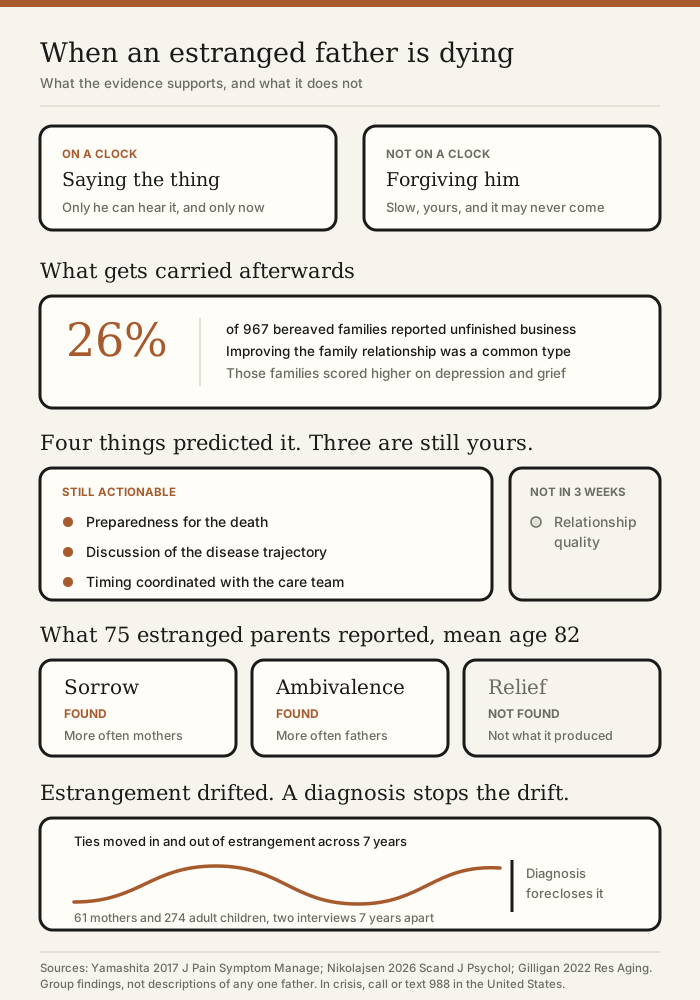
Forgiveness, if it ever happens, is slow and it is yours. It can arrive years after a funeral or never. Nothing about a terminal prognosis obliges you to produce it inside three weeks because a hospital has told you the timeline. Anyone pressuring you to reach it now is asking you to perform something on their schedule for their comfort.
The question that does have a deadline is narrower. Is there something you would need to have said, and would still need at fifty or sixty, that only he can hear. For some people the answer is a clear no, and that is a legitimate answer rather than a failure of feeling. For others the answer is yes and it is one sentence long. Getting clear on which of those you are is the whole decision. The rest is logistics.
What the research actually measured, and what it found
There is real evidence here, and it is more specific than the general advice you will have been given.
A Japanese study published in the Journal of Pain and Symptom Management surveyed 967 bereaved families of terminally ill cancer patients admitted to palliative care units, with a 73 percent response rate. It asked whether the family was left with unfinished business, what kind, and how they were doing afterwards.
Twenty six percent reported unfinished business. Improvement of the patient and family relationship was among the common types. And the families who reported unfinished business had significantly higher depression and grief scores after the bereavement than the families who did not.
Read what that does and does not establish. It shows an association between unresolved business and worse outcomes afterwards, in families of cancer patients in palliative care units in Japan. It does not prove that a visit causes a better outcome, it was not a trial, and it was not a study of estranged families specifically. What it does do is put a number on something usually left vague: roughly a quarter of families come away from a death with something still open, and relationship repair is one of the things most commonly left open.
The part that should change how you decide
Here is the finding worth sitting with, because it moves the decision away from the question you are stuck on.
The same study identified what influenced whether a family ended up with unfinished business. Four things reached significance: how prepared the family was for the death, whether the patient and family had discussed the disease trajectory and how to spend daily life, whether the patient and family relationship was good, and whether the family and the health care professionals worked out together the appropriate timing to do what the family wanted to do.
Three of those four are about preparation, conversation and timing. Only one is about the state of the relationship itself. That is a genuinely useful result for someone in an estranged family, because the relationship quality is the variable you cannot change in three weeks and the other three are the ones you can still act on today.
| What predicted unfinished business | Can you still change it | What that looks like this week |
|---|---|---|
| Preparedness for the death | Yes | Ask the care team directly what the realistic window is instead of guessing from what relatives report |
| Discussion of the disease trajectory and daily life | Yes | One phone call to whoever is coordinating care, so your decision runs on facts rather than on a rumour of days left |
| Whether the timing was worked out with the care team | Yes | Ask when he is most lucid and least in pain, and go then rather than whenever you can face it |
| Quality of the patient and family relationship | Not in three weeks | Nothing. This is the one you are being asked to fix on a deadline, and it is the one you cannot |
The practical reading is that if you are going to go, going informed and at the right hour is not administrative detail. It is the part the evidence associates with how you come out of this.
What an estranged father is likely feeling, if he is old
You may be trying to guess what is happening on his side. There is at least one piece of direct evidence rather than speculation.
A 2026 study in the Scandinavian Journal of Psychology surveyed 75 estranged parents aged 75 and over, mean age 82, about their sentiments toward the estrangement. It tested three: sorrow, ambivalence, and relief. Sorrow and ambivalence both showed up as parent sentiments. Relief did not. More women expressed sorrow, and more men expressed ambivalence. Estrangement from all of one's children was associated with ambivalence.
Hold that at its real size. It is 75 people, cross-sectional, in Denmark, and it does not tell you what your father feels. What it does say is that among older estranged parents studied, relief was not what the estrangement produced, and that the sentiment more characteristic of the fathers was ambivalence rather than clean sorrow.
Ambivalence is worth understanding before you walk into a room, because it does not look like remorse. It looks like a man holding two things at once and resolving neither: some version of missing you alongside some version of still believing he was wronged. If you arrive expecting an apology and meet ambivalence, it can read as coldness or as a refusal. It is more likely to be the documented shape of the thing. That is not a reason to excuse it. It is a reason not to be ambushed by it.
Estrangement was never as fixed as it felt, and the clock just changed
One thing worth knowing before you decide, because it cuts against how permanent this has probably felt.
A prospective study in Research on Aging followed 61 older mothers and their 274 adult children across two rounds of face to face interviews seven years apart. Ties did not simply stay estranged or stay close. They moved in and out of estrangement over time, and the movement came through gradual shifts in contact and closeness rather than through abrupt events in either person's life.
That research is on mothers, and we say so rather than quietly generalising it to fathers. The relevant point survives anyway. Estrangement in later-life families behaves like a state that drifts, not a verdict that was entered. We make the same argument at length in our main piece on what estrangement between a father and his child actually is.
A terminal diagnosis removes the drift. Whatever was going to happen slowly now either happens on a short clock or does not happen. That is the actual change a dying father introduces. Not a new obligation, a foreclosed option.
If you go, know what the visit is
The visit is not a negotiation and it is not a hearing. If you go in expecting him to concede the history, you are likely to come out worse.
The National Institute on Aging, writing for families of dying people, notes that spiritual needs near the end of life may include finding meaning, ending disagreements with others, or making peace with life circumstances, and that the dying person might find comfort in resolving unsettled issues with family. The same guidance describes a pattern worth knowing: family and friends sometimes stop visiting because they do not know how to help, or withdraw because they are already grieving. Avoidance around a deathbed is common and it is not evidence that you are unusually cold.
Three things make the visit survivable. Decide in advance what you are there to say, and keep it to one or two sentences you would still stand behind in ten years. Set the length before you arrive, because thirty deliberate minutes are easier to hold than an open-ended afternoon. And bring someone who is on your side, even if they wait in the corridor.
You are also allowed to go and say almost nothing. Presence without absolution is a real option, and it closes the unfinished-business question without requiring you to hand him a verdict he has not earned.
If you decide not to go
Not going is a legitimate decision, and it is the right one where the relationship involved abuse, where contact would put you or your children at risk, or where you have already done this work and reached an end. It is also legitimate when the barrier is practical rather than emotional: the cost of travel, nobody to cover your children or your job, or a body that cannot make the trip. None of those require a better excuse than the plain fact of them. The unfinished business finding is about things left unsaid, and there is nothing left unsaid when you said it and he did not change.
What protects you afterwards is not attendance, it is deliberateness. Write down now, in your own words, why you are deciding this. Grief distorts memory, and in eight months a version of you who is exhausted and being asked about the funeral will want to read what the clear-headed version decided and why. Do the saying somewhere else if you need it: a letter you do not send, one conversation with a therapist, one hour with the sibling who was in the house with you. And decide separately about the funeral, because it is a different event with a different set of people and it does not need to be settled today.
If the pressure is coming from relatives, it is worth naming plainly that people who did not live in your house do not get a vote on this, and that a phone call urging you to make peace is usually about their discomfort. Some of that pressure will come from people who spent years telling you he was just not a talker or not the affectionate type.
Where this stops being a decision and needs help
There is a point where this is no longer a choice to weigh and is instead a load that needs proper support.
If you are having thoughts of harming yourself, if you cannot function for days at a time, or if this is pulling up trauma from the years the estrangement came out of, that is the territory for a licensed professional rather than an article. In the United States, the 988 Suicide and Crisis Lifeline is reachable by call or text, around the clock, and is for crises well short of an emergency, including this one. Outside the US, your local crisis line covers the same ground.
Grief that follows an estranged death is genuinely harder than grief that follows a close one, because you are mourning both the man and the relationship that never got built. A therapist who works with bereavement is the right resource, and wanting one is not a sign that you have handled this badly.
There is also the practical layer, and it is worth handling early rather than in the week after. The National Institute on Aging's guidance on advance care planning sets out how health care directives and proxy decisions work, which matters if you are being asked to make decisions for a man you have not spoken to in years. Knowing what you are legally being asked, and what you are not, removes one source of pressure from a week that has plenty.
If you are the father, and you are the one dying
Some readers are on the other side of this page. You are ill, the window is short, and the child you are estranged from has not come.
The one useful thing the evidence offers you is about what to send. In the study of estranged parents, the sentiment fathers most characteristically reported was ambivalence, and ambivalence is exactly what does not travel well across a broken relationship. A message that holds both your regret and your case will be read as the case. If you have one contact left, spend it on the part that is only yours: what you did, without the surrounding argument, and no request attached. A message that asks for nothing cannot be refused, which is precisely why it is the one that can be kept.
The wider evidence on why these ruptures form points to accumulated distance in values and closeness rather than a single scandal, which is what a study of 2,013 mother and adult child pairs found when it tested value dissimilarity against the violation of serious social norms. Value distance predicted estrangement. Norm violation did not. That study was of mothers and their adult children rather than fathers, so it is the closest available evidence and not a direct finding about father and child estrangement. Which means the thing to name at the end is usually the accumulation, not one incident. That is the same ground we cover in what a distant father is actually transmitting over years.
When an estranged father is dying, in one picture
Test yourself
Key takeaways
Last reviewed by The Father Standard Editorial Team on August 21, 2026. Our sourcing and AI-use rules are public on the editorial standards page.
FAQ
Should I visit my estranged father before he dies?
Only you can answer it, but the question is narrower than it feels. Going is not the same as forgiving him, and the research on post-bereavement regret does not measure attendance. It measures whether something was left unsaid or unsettled. So the test is whether there is something you would need to have said, and would still need years from now, that only he can hear. If there is, go and say that one thing. If there is not, or if contact would put you at risk, not going is a legitimate answer rather than a failure.
Will I regret not seeing my estranged father before he died?
Nobody can promise either way, and be wary of anyone who does. What the evidence gives you is a pattern rather than a prediction. In a survey of 967 bereaved families of terminally ill cancer patients, 26 percent reported unfinished business, improving the family relationship was among the common types, and those families had higher depression and grief scores afterwards. That is an association in one population, not a law about you. It suggests that what tends to be carried afterwards is the unsaid thing, not the missed visit, which is why deciding deliberately and writing down your reasons protects you more than attendance does.
What do you say to a dying father you are estranged from?
Keep it to one or two sentences you would still stand behind in ten years, and decide them before you arrive. It does not have to be forgiveness, and it does not have to be a summary of the history. National Institute on Aging guidance for families notes that dying people may find comfort in resolving unsettled issues, which is about the issue being named rather than the argument being won. Presence without absolution is a real option. So is going and saying almost nothing.
Why is my dying estranged father not apologising?
Because remorse and ambivalence look different, and ambivalence appears to be the more characteristic state. In a 2026 study of 75 estranged parents aged 75 and over, sorrow and ambivalence both showed up as parent sentiments, relief did not, and ambivalence was expressed more often by the fathers. Ambivalence means holding two positions at once and resolving neither, so it can present as coolness or as a refusal to concede. That is a group finding rather than a diagnosis of your father, and it does not oblige you to accept the non-apology. It does mean an apology is not the likeliest thing to walk out with.
My estranged father is dying and my family is pressuring me to go. What do I do?
Separate the decision from the pressure, and separate the funeral from the visit. People who did not live in your house do not get a vote, and urgency from relatives is frequently about their own discomfort with the situation rather than about your relationship with him. The one thing worth taking from them is factual: ask the care team, not the relatives, what the realistic window is and when he is most lucid, because coordinated timing was one of the four things that predicted whether families ended up with unfinished business.
Is it too late to reconcile with a dying father?
Reconciliation in the full sense usually is not available on a three week clock, and treating that as the goal sets up a failure. Something smaller is available: a thing said, an issue named, a presence offered without any verdict attached. It is also worth knowing that estrangement was never the fixed state it felt like. A seven year prospective study of 61 older mothers and their 274 adult children found ties moving in and out of estrangement through gradual shifts rather than single events. What a terminal diagnosis removes is the slow drift, not the possibility of one honest exchange.
How do I grieve a father I was estranged from?
Expect it to be harder rather than easier, and expect it to be two griefs at once: the man who died, and the relationship that never got built. That second one has no funeral and few people will acknowledge it, which is part of why it lands heavily. A therapist who works with bereavement is the right resource here rather than a reading list, and needing one is not evidence that you handled the estrangement badly. If you reach the point of thoughts of harming yourself, the 988 Suicide and Crisis Lifeline in the United States takes calls and texts around the clock, and local crisis lines cover the same ground elsewhere.
Sources
- 967 bereaved families of terminally ill cancer patients (pubmed.ncbi.nlm.nih.gov)
- 75 estranged parents aged 75 and over (pubmed.ncbi.nlm.nih.gov)
- 61 older mothers and their 274 adult children (pubmed.ncbi.nlm.nih.gov)
- may include finding meaning, ending disagreements with others, or making peace with life circumstances (nia.nih.gov)
- 988 Suicide and Crisis Lifeline (988lifeline.org)
- National Institute on Aging's guidance on advance care planning (nia.nih.gov)
- 2,013 mother and adult child pairs (pubmed.ncbi.nlm.nih.gov)