The Relationship Between a Father and Son: Why It Goes Quiet and How It Comes Back
The relationship between a father and son almost never breaks in a single scene. There is no slammed door that explains it. It thins out over years, one skipped conversation, one swallowed feeling, one "I'm fine" at a time, until two men who love each other can sit in the same room and have nothing to say. If you are the father in that room, the good news is plain: the bond thinned in increments, and it thickens back the same way.
Ask most men about their father and you get one of two answers. Either a warmth they can barely put into words, or a careful, flat sentence that closes the subject. The second answer is more common than any of us admit, and the men who give it are usually not angry. They are just describing a relationship that went quiet a long time ago and never came back.
Here is what a son actually takes from his father, according to the evidence rather than the greeting cards, what quietly erodes the relationship, and how you rebuild it whether your son is a boy at home, a teenager, or a grown man.
What a son actually takes from his father
Fathers are invested. In one national survey, most dads said parenting is extremely important to their identity, about the same share as mothers. The harder question is what that investment should aim at, and the research points somewhere specific. A systematic review of 24 longitudinal studies on father involvement found that 22 of them reported positive effects on children's development, and the effects were not vague. Active, regular engagement, meaning direct interaction rather than just living in the house, predicted fewer behavioral problems in boys, stronger cognitive development overall, and, for children in low-income families, less delinquency and economic disadvantage.
Read that carefully, because it corrects a common assumption. What moved the outcomes was not the father's income, his discipline, or his presence as a name on a birth certificate. It was engagement. The review also found that no specific form of engagement has been shown to work better than another, so it does not have to be sports or fishing. What the evidence backs is direct interaction itself, doing something with the child rather than nothing. A son does not need his father to coach the team. He needs his father in the room, doing a thing with him, on a repeating basis, over years.
This is why so many providing fathers are stunned when the relationship turns cold. They kept the lights on, paid for the shoes, and never missed a mortgage, and they cannot understand the distance. The distance is the answer to a question they never heard: not "did you provide for me," but "were you engaged with me." We take that gap apart in being present, not just providing, because it is the single most common way good men lose their sons without ever meaning to.
Why the relationship goes quiet
If engagement builds the bond, disengagement thins it, and it usually happens without a decision. A father gets busier at work. The son gets a phone, a friend group, a bedroom door that stays shut. Conversations shrink to logistics. Nobody chose the silence, and that is exactly why nobody notices it forming.
The pattern is so gradual that it earns its own name. A father can become a stranger to his own son inside the same house, in small increments, over a decade, and we walk through the mechanics of how that happens in the distant father. The father in that story is rarely cruel. He is tired, busy, and running the same emotional playbook his own father ran, which for a lot of men was silence dressed up as strength.
There is a second, harder version. Some sons grow up with a father who was there and still absent, physically present but emotionally unreachable, and that leaves its own kind of mark. If that describes your house, whether as the son who lived it or the father worried he is repeating it, the absent father covers what that absence does and how it gets carried forward into the next generation. For the son-specific measurements, and the finding that the gap opens years after the separation rather than at it, see absent father effects on sons.
The thing that actually breaks it
Distance thins a relationship slowly. Rejection breaks it fast, and the evidence is unusually clear about which is more dangerous. The largest meta-analysis on the subject, covering 161 studies on parenting and delinquency, found that the strongest links to bad outcomes were not weak rules or missed curfews. They were rejection, hostility, and harsh criticism, along with parents simply not knowing what was going on in their child's life. Manipulative, guilt-based pressure, what researchers call psychological control, carried its own real risk. Firm rules on their own barely registered.
For a father, that reorders the whole priority list. A son can survive a father who is strict. What corrodes a son is a father who is contemptuous, who leads with criticism, who makes love feel conditional on performance. If your default register with your son is disappointment, the relationship is not being held together by your high standards. It is being eroded by them, one flinch at a time.
The performance you are both running
There is a specific trap fathers and sons fall into together: the performance of being fine. He learns young that you meet feeling with a fix or a lecture, so he stops bringing feeling. You read his silence as contentment, so you stop asking. Both of you call it peace. It is actually two people managing each other, and it can run for twenty years.
Breaking it is not a grand confrontation. It is a father who starts answering honestly first. Pediatric guidance on talking with kids lands on the same posture, listen more than you lecture, because a lectured child stops bringing you anything real. A son does not open up to a wall of competence. He opens up to a father who admits he found the same things hard, who says "I got that wrong with you" and does not immediately explain it away. Every time you drop the performance one inch, you give your son permission to drop his. That is the actual mechanism of a close father-son relationship, and it runs on your willingness to go first.
What fathers assume, and what the evidence points to
The instincts most men inherited about fathering a son are not evil. They are just aimed at the wrong target. Here is the gap, side by side.
| What it touches | What most fathers assume | What the evidence points to |
|---|---|---|
| The core of the bond | Providing and protecting | Direct, repeated engagement |
| Presence | Being in the house | Doing something together, regularly |
| Standards | Criticism keeps him sharp | Warmth earns the right to be heard |
| Discipline | Rules are the main lever | Rejection and hostility do the real damage |
| Emotional talk | It makes a boy soft | Reachability is what keeps him talking to you |
| Closeness | It happens on big occasions | It is built on ordinary, findable days |
None of this lowers the standard you hold for your son. It relocates it. The standard is not enforced through pressure and disappointment. It is transmitted by a father his son actually wants to be like, which only happens inside a relationship warm enough to carry it.
How to rebuild it when it has already gone quiet
If the relationship is already cold, the work is repair, and repair has an order. You do not open with the heavy talk. You rebuild the format first, the low-stakes, repeating, shoulder-to-shoulder time where boys and men actually talk, and let the harder conversations arrive on their own schedule.
- Rebuild a repeating slot before you attempt a big conversation. A standing drive, a Saturday task, a shared show. The regularity is the point, not the depth.
- Lead with interest, not inspection. Ask about his actual life, the game, the friend, the thing he is into, and resist turning it into an evaluation.
- Go first on honesty. Name something you got wrong as a father before you ask anything of him.
- Do not require a breakthrough. Sons disclose sideways, in the car, during the task, never on command across a table.
- Show up on ordinary days, not just the ones with a candle in a cake.
If the son in question is a teenager who has gone quiet, the reopening has its own playbook, because a teenage boy pulling away is usually doing developmental work rather than rendering a verdict, and the line reopens through activity rather than confrontation. We lay out the exact moves in how to reconnect with your teenage son, and the broader shift the teenage years demand, from managing your son to consulting for him, is covered in teenager parenting.
When the son is grown
The adult father-son relationship confuses a lot of men, because the old tools are gone. You cannot require his time, and advice he did not ask for now reads as the same criticism he grew up under. What replaces authority is invitation. You stay reachable, you stay warm, you take an interest in the life he actually built rather than the one you pictured, and you let him set the pace of the closeness.
The men who reconnect with grown sons almost never do it by relitigating the past. They do it by becoming, in the present, the father the son can finally relax around. That is available at fifty and at seventy. Engagement was the lever when he was six, and it is still the lever now. The form changed. The mechanism did not.
When the silence is estrangement
Sometimes the quiet is not distance, it is a door that has been deliberately shut. If your son has cut contact, the repair still starts with warmth and with owning your part, but it moves at his speed, and pushing usually pushes him further away. Estrangement is heavy ground, and if it is weighing on your mental health, that is worth treating as seriously as any other health concern. This article is general information, not clinical or crisis advice. If you or your son is in crisis, the 988 Suicide and Crisis Lifeline connects you to a trained counselor by call or text, 24 hours a day in the US, and a licensed therapist who works with family estrangement can help you carry it and figure out the next honest step.
The relationship between a father and son is not fixed at any age. It thinned in small increments, and it comes back in small increments: one repeating slot, one honest sentence, one ordinary day you chose to show up for. You do not need a breakthrough. You need to go first, and then keep going.
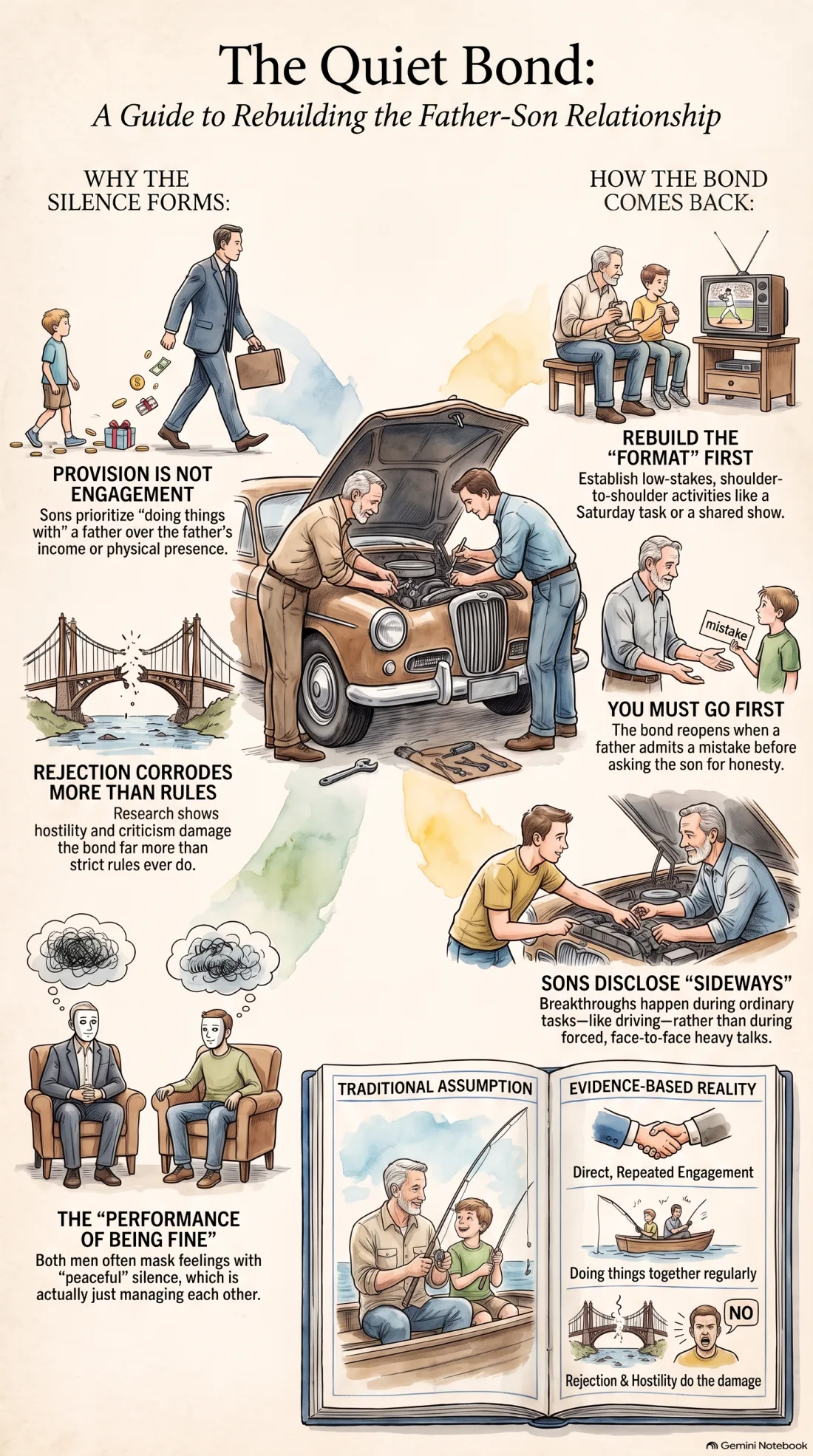
The father and son relationship in one picture
Everything above in one view: what a son actually takes from an involved father, what erodes the bond, and the order repair follows.
Test yourself
Five scenario questions drawn from the evidence above: engagement versus provision, warmth versus criticism, and the order repair follows. Each answer explains the reasoning, so a wrong guess teaches more than a right one.
Key takeaways
Last reviewed by The Father Standard Editorial Team on August 8, 2026. Our sourcing and AI-use rules are public on the editorial standards page.
FAQ
Why is the relationship between a father and son so hard?
Because most men inherited a script that aims at the wrong target. The instinct is to provide, protect, and hold high standards, and the evidence points instead to direct engagement and warmth as the things that actually build the bond. A systematic review of longitudinal studies found that father involvement, meaning regular hands-on interaction rather than just being in the house, predicted fewer behavioral problems in boys and better development overall. When a father runs the provide-and-correct script and skips the engagement, the relationship thins even though he is doing what he thinks a good father does.
What does a son really need from his father?
Engagement, repeated over years. The research is clear that no single activity beats the others, so it does not have to be sports or fishing or anything specific. What matters is direct interaction on a recurring basis: doing a thing together, being reachable on ordinary days, meeting his feelings with steadiness rather than a lecture. The ordinary, repeated moments are what accumulate into a relationship, which is why a father who shows up only at big events can still feel distant.
How do I fix a broken relationship with my son?
Rebuild the format before you attempt the heavy conversation. Re-establish a low-stakes, repeating, shoulder-to-shoulder slot, a standing drive, a shared task, a regular show, because that is where fathers and sons actually talk. Lead with genuine interest rather than inspection, and go first on honesty by naming something you got wrong before you ask anything of him. Do not require a breakthrough; sons disclose sideways and on their own schedule. Warmth and consistency reopen the line. Pressure and relitigating the past close it.
Can a father and adult son rebuild their relationship?
Yes, and the mechanism is the same as it was in childhood, only the form changes. You can no longer require an adult son's time or hand him unrequested advice without it landing as criticism. What works is invitation: staying reachable and warm, taking a real interest in the life he actually built, and letting him set the pace. Men reconnect with grown sons not by relitigating the past but by becoming, in the present, the father the son can finally relax around. That is available at fifty and at seventy.
What damages a father-son relationship the most?
Rejection, hostility, and harsh criticism, far more than strict rules. The largest meta-analysis on parenting and delinquency, covering 161 studies, found that rejection and low knowledge of a child's life were among the strongest links to poor outcomes, while firm rules on their own barely registered. Guilt-based, manipulative pressure carried its own real risk. A son can survive a strict father. What corrodes him is a father whose default register is disappointment and whose love feels conditional on performance.
My father was present but emotionally distant. How do I not repeat that with my son?
Start by naming the pattern instead of denying it, because the emotionally distant father usually repeats what he lived rather than what he chose. The correction is engagement plus honesty: build repeating one-on-one time, and be the one who drops the performance of being fine first. Every time you answer your son honestly about something being hard, you give him permission to do the same. If you grew up with a father who was there and still unreachable, our piece on the absent father covers how that absence gets carried forward and how to stop the handoff.
How much time does a father need to spend with his son?
A regular standing activity, plus being genuinely reachable on ordinary days, tends to do more than an occasional big trip. The evidence favors consistency over volume: a modest, repeating slot of direct engagement beats a rare, elaborate outing. Less than most men fear, in other words, but far more regularly than most men manage. The failure mode is not too few grand gestures. It is the slow disappearance of ordinary, repeated presence, which thins the relationship one skipped week at a time.
Sources
- most dads said parenting is extremely important to their identity (pewresearch.org)
- 24 longitudinal studies on father involvement (pubmed.ncbi.nlm.nih.gov)
- 161 studies on parenting and delinquency (pubmed.ncbi.nlm.nih.gov)
- listen more than you lecture (healthychildren.org)