The Older I Get, the More I Dislike My Dad: How Common It Is, and Why He Probably Rates the Relationship Higher Than You Do
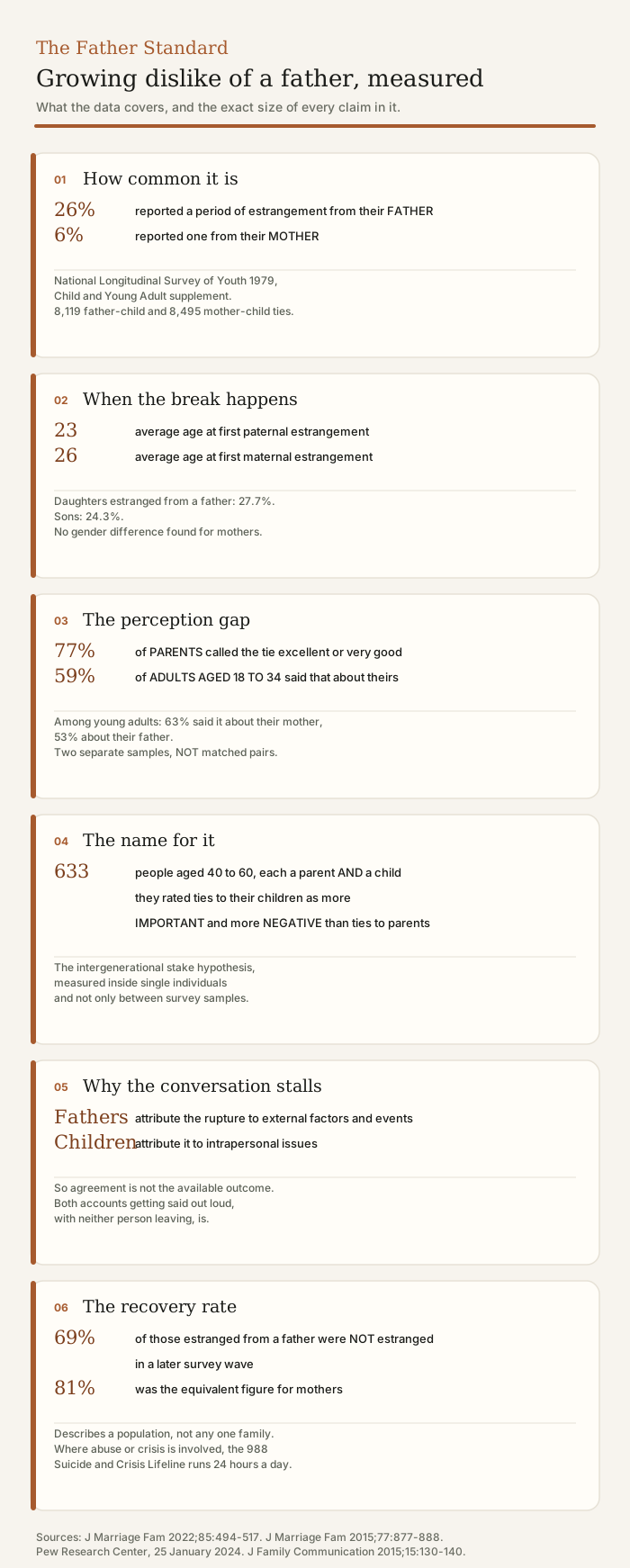
About a quarter of adult children in the United States report a period of complete estrangement from their father. For mothers the figure is closer to one in sixteen. The average age at which that first paternal break happens is 23. So whatever has been happening to you around your father as you get older has happened to a lot of people, at roughly the same stage of life, and it runs in one direction far more often than the other. You are not describing a defect in yourself.
The harder half is why this page sits on a site written for fathers. On the population evidence, he is probably not seeing what you are seeing. When large surveys ask parents and young adults to rate the same kind of relationship in the same fortnight, the parents rate it much higher, and the young adults rate their fathers below their mothers. None of that settles anything about your father specifically. What it does is put a second explanation on the table next to "he knows and does not care", and the second one turns out to be far more common than most people who type your sentence expect.
If what you are describing is abuse rather than distance, or if you are in crisis right now, stop reading and use 988lifeline.org, which takes calls and texts around the clock in the United States.
The section on what this page is not explains why everything below is the wrong instrument for that case.
Where to start
Three different questions are hiding inside the search that brought you here. Dislike is a mood you are in this month. Estrangement is a decision, and it has a measured base rate. Abuse is a fact about what happened to you. A search bar collapses all three into one sentence. Nothing else does, so pull them apart before you do anything with them.
Then work out which of these three you are, because the material below only fits one:
- The grievance has a name and it is abuse or neglect. The perception-gap framing below does not apply and should never be used to argue you out of your own read. Skip to what this page is not.
- The grievances are real, specific, and short of abuse. Chronic criticism, obvious favouritism, promises broken often enough that you stopped counting them, a father who was in the house and unreachable. The perception gap does not replace those complaints or soften them. It sits on top of them, and it is usually the reason he has never once addressed any of them.
- You cannot name it. A slow souring you could not justify to a friend if they asked you to. Here the gap between his rating and yours is the strongest candidate for what you are actually feeling.
A quarter of adult children go further than dislike
Most adult children never cut contact with their father. A quarter of them do, at least for a while, and that is four times the rate for mothers.
Those figures come from a 2022 study in the Journal of Marriage and Family by Rin Reczek, Lawrence Stacey and Mieke Beth Thomeer, Parent-Adult Child Estrangement in the United States by Gender, Race/ethnicity, and Sexuality, volume 85, pages 494 to 517. It draws on the National Longitudinal Survey of Youth 1979 Child and Young Adult supplement, which follows the same people across many waves instead of asking them to remember, and it covers 8,495 mother-child and 8,119 father-child relationships.
| Measure | Fathers | Mothers |
|---|---|---|
| Reported a period of estrangement | 26% | 6% |
| Average age at first estrangement | 23 | 26 |
| Daughters reporting it | 27.7% | no gender difference found |
| Sons reporting it | 24.3% | no gender difference found |
| No longer estranged in a later wave | 69% | 81% |
Three rows there are worth slowing down on.
The ratio is the first. A four to one skew is large enough to show up in a nationally representative dataset, which means the feeling you are having does not sit on a family quirk. It sits on a pattern.
The age is the second. First paternal estrangement averages 23, three years earlier than maternal.
The recovery rate is the third, and this whole page is built around it. Most of these breaks did not hold. Sixty-nine percent of the adult children estranged from their fathers were no longer estranged in a later wave.
One honest limit before any of that travels too far. This study counts estrangement, which is the endpoint. It does not count dislike, which sits upstream of it. No national survey has produced a comparable figure for adult children who simply like their father less each year. So the 26 percent works as a floor for how common the underlying feeling must be, and not as a measurement of it. Plenty of people feel exactly this and never stop picking up the phone.
"The older I get" is doing the heaviest work in that sentence
The search phrase points at him and its actual subject is you. It does not report that he got worse. It reports that you got older.
Those two carry completely different implications. If he is deteriorating, the question is what changed in him. If your reading of him is what changed, the evidence has been sitting there for twenty years and what arrived recently is your ability to read it. Nothing we can cite settles which of the two is happening in your family, and we will not pretend otherwise. What the data does establish is that the timing is not random: the average first break lands at 23, at the life stage where a person picks up enough distance and enough comparison to re-read a childhood.
Our gloss on that, offered as editorial interpretation and not as a finding of the study, is that most of these are re-readings. You move out and see how other households run. You start managing people at work and discover that the way he handled conflict was a choice and not a law of physics. You have a child of your own and find out exactly what a bedtime costs, which for some people raises their estimate of him and for plenty of others lowers it. Twenty-three is a plausible age for that to start, though the authors report the ages without explaining them, and the explanation here is ours. Calling any of it ingratitude misses what happened. A person finally got a control group.
He is rating a different relationship, and the numbers on that are stark
Parents in these surveys are not describing a relationship in trouble. They are describing a good one.
In January 2024 the Pew Research Center published Parents, Young Adult Children and the Transition to Adulthood, built on two surveys fielded from October 24 to November 5 2023: 3,017 United States parents with at least one child aged 18 to 34, and 1,495 adults aged 18 to 34 with at least one living parent.
Seventy-seven percent of parents said the relationship with their young adult children was excellent or very good. Fifty-nine percent of young adults said that about their parents. Split by parent, young adults were likelier to say it about their mother, 63 percent, than about their father, 53 percent. Asked whether they can be their true self around each parent all or most of the time, 73 percent said yes about mom and 64 percent about dad.
The limit on that comparison has to be said out loud, because this is the sort of number that gets quoted carelessly. Pew surveyed parents and young adults as two separate samples, not as matched pairs. These are not the same families answering about each other. The 18 point spread describes two populations rating the same kind of tie. It is not a measured disagreement inside one household, and it proves nothing about whether your father specifically overrates you by 18 points. Note also what the confirmed figures do and do not cover: the mother and father split, 63 against 53, comes from the young adults' ratings. Pew's headline 77 percent is a single parent-side figure, so this page makes no claim that the parent-child gap itself is wider for fathers.
The other half of the Pew data is the part fathers should read twice. Forty-four percent of dads said they communicate with their adult child less often than they would like, against 30 percent of moms, and 33 percent said they are less involved than they would like to be, against 22 percent of moms. So the picture that emerges is not a contented man who thinks everything is perfect. It is a man who rates the relationship highly and wishes there were more of it, and that combination can sit still for years without ever producing a phone call.
The phenomenon has a name and it has been measured inside single people
The pattern where the older generation reports a warmer tie than the younger one is called the intergenerational stake hypothesis, and it predates the Pew data by decades. A 2015 study in the Journal of Marriage and Family by Kira Birditt and colleagues, Extending the Intergenerational Stake Hypothesis: Evidence of an Intraindividual Stake and Implications for Well-Being, volume 77, pages 877 to 888, tested it in an unusual way. Instead of comparing parents to children, it took 633 people aged 40 to 60 who were simultaneously somebody's child and somebody's parent, and asked them about both ties at once.
Those people reported that their relationships with their children were more important and more negative than their relationships with their own parents. The authors read that as support for the intergenerational stake operating inside a single head: the tie you are more invested in is the tie you carry more friction about. They also report that individuals whose feelings ran the opposite way, with greater investment in parents than children, reported poorer well-being.
That study measured neither dislike nor estrangement. What it establishes is narrower and still useful. The asymmetry is structural, it turns up within individuals rather than only between survey samples, and it is the most economical explanation for why your father can say the relationship is good on the same day you type that it is not.
You are not going to agree about the cause, and that is the normal result
If the conversation ever happens, expect this. A 2015 study in the Journal of Family Communication by Kristen Carr, Amanda Holman, Jenna Abetz, Jody Koenig Kellas and Elizabeth Vagnoni, volume 15, pages 130 to 140, compared the reasons estranged parents and estranged adult children give for the rupture. As the peer-reviewed paper by Audrey Linden and Elizabeth Sillence summarises it in Families, Relationships and Societies, volume 10, pages 325 to 341, Carr and colleagues found "a disconnection between reasons given by estranged parents and adult children, with parents often attributing estrangement to external factors and events, and adult children often attributing estrangement to intrapersonal issues."
Translated: the children point at who he is, the fathers point at what happened. Neither side is performing. Each is doing the ordinary human thing of explaining their own conduct by circumstance and the other person's by character.
Knowing this in advance matters, because most people walk into that conversation treating agreement as the sign it went well. Agreement is not on the menu. What is on the menu is both accounts getting said out loud while neither person leaves the room. Our piece on the estranged father covers what the research supports once contact has already stopped, and those moves start somewhere else entirely.
What this page is not
Everything above assumes a relationship that soured, not one that did damage. If your growing dislike traces to abuse, to neglect, or to a pattern you can name and date, the perception-gap framing does not apply to you and it is not a reason to reconsider your own read. Distance is a reasonable response to some fathers. An article about measurement asymmetry does not entitle one of them to another chance.
None of this substitutes for a licensed professional either. If this sits on top of persistent low mood, hopelessness lasting more than two weeks, or any thought of self-harm, that belongs with a clinician and not with an article. In the United States the 988 Suicide and Crisis Lifeline takes calls and texts around the clock at 988lifeline.org. Family estrangement is squarely inside what a licensed family therapist works on, and booking one is an ordinary move at this stage of a family's life.
If you are the adult child who typed that sentence
List the incidents, not the moods. Write down the things a friend would need to hear before agreeing you have a case: what he did, roughly when, and what it cost. "I dislike my dad" cannot be worked with and for most people it is not even accurate. A list can be worked with. If the list refuses to come, that is information too, and it points at something missing in the relationship instead of something done to you in it.
Then set two dials separately, because they are separate. Contact is how often. Closeness is how much you let in. Plenty of people run high contact and low closeness with a father for decades and are fine, and plenty run the reverse. Decide which one you actually want to move before you decide what to say, because a conversation aimed at the wrong dial tends to make the other one worse. Cutting off entirely is a real option, the data says it is a common one, and the same data says most of those breaks did not last.
If you do want something to change, the asymmetry above is your lever. He is working from a different set of observations. You have spent years collecting evidence he has never been shown, while he has been rating the relationship off the visible surface of it. That is not an argument that you owe him a conversation. It is an argument that if you choose to have one, what you say will land as news.
If you are the father who found this page
Start from the assumption that the relationship is rated lower on the other side than on yours. Not the worst case, and not that your child hates you. Just the gap, because that is what the population numbers describe, and the alternative is waiting for evidence that arrives as a crisis.
What that means in practice is going after the specifics before they harden into a category. The thing that eventually becomes "the older I get the more I dislike my dad" starts as a handful of concrete unresolved items, and concrete items are far easier to deal with than a settled verdict. So ask a question you do not already know the answer to. Then take the answer without correcting it. We would put that second part first in difficulty, because a correction can read to your child as confirmation of exactly what they expected from you, and that is a suggestion from this desk rather than a finding from any study. Our piece on how to be a better father argues the same case from another direction: the failure mode is rarely insufficient effort, it is effort spent on the wrong dial.
And keep the base rate in view. Sixty-nine percent of the adult children estranged from their fathers in that national sample were not estranged in a later wave. That describes a population and not your family, and it says nothing about how those reconciliations happened or how good they turned out. What it rules out is the belief that a break of this kind is normally permanent. Most of them were not. If you are already past dislike and the contact has stopped, the distant father and our work on father-daughter relationship psychology both cover what the evidence supports next.
The sentence in the title is usually accurate about the person who wrote it and unknown to the person it describes. Closing that gap repairs nothing by itself. What it changes is the thing the two of you would be arguing about: a verdict he has never seen, swapped for a set of specifics he can actually answer. Smaller job. It still has to go first.
Test yourself
Key takeaways
Last reviewed by The Father Standard Editorial Team on September 3, 2026. Our sourcing and AI-use rules are public on the editorial standards page.
FAQ
Is it normal to dislike your dad more as you get older?
Common enough to show up in national data, though what gets counted is the stronger version. In the National Longitudinal Survey of Youth 1979 Child and Young Adult supplement, 26 percent of adult children reported a period of complete estrangement from their father, against 6 percent from their mother. No survey has produced a comparable count of people who simply like their father less each year, so treat 26 percent as a floor for how common the underlying feeling must be and not as a measure of it.
Why does it get worse with age instead of better?
The data supplies the timing and not the reason. First paternal estrangement averages age 23, a stage by which many people have moved out and picked up an outside comparison. Our editorial reading, offered as a reading and not as a finding, is that what usually changes is the vantage point and not the father. The childhood evidence stays where it was. Your ability to interpret it improves.
Does my dad know how I feel about him?
The population data says probably not, and it cannot say more than that. In Pew Research Center surveys fielded in late 2023, 77 percent of parents called the relationship with their young adult child excellent or very good while 59 percent of 18 to 34 year olds said that about their parents. Those were two separate samples and not matched pairs, so this is evidence of a systematic gap across populations and proof of nothing about one particular father.
Are fathers really rated lower than mothers, or does it just feel that way?
Lower, on every Pew measure that splits by parent. Young adults rated the relationship excellent or very good for 63 percent of mothers and 53 percent of fathers, and said they can be their true self all or most of the time around 73 percent of mothers and 64 percent of fathers. The estrangement gap is wider still, at roughly four to one.
Do daughters and sons differ on this?
For fathers, slightly. Daughters reported estrangement from a father at 27.7 percent against 24.3 percent of sons in that national sample. For mothers there was no statistical difference by the child's gender. The daughter and son gap on fathers is real but small, and it is nowhere near large enough to carry a conclusion about any individual family.
If I cut contact with my father, is that permanent?
Usually not, on the population evidence. Sixty-nine percent of the adult children who had been estranged from a father were no longer estranged in a later survey wave, against 81 percent for mothers. That figure says nothing about whether those reconciliations were good ones or how they came about. It does rule out the assumption that this kind of break is normally final.
My dad says our relationship is fine. Is he lying?
Very likely not. The pattern where the older generation reports a warmer tie than the younger one is called the intergenerational stake hypothesis and it has been measured for decades. A study of 633 people aged 40 to 60, each of them simultaneously a parent and a child, found they rated the ties to their own children as both more important and more negative than the ties to their own parents. He may be reporting honestly off a different instrument.
Will we agree about what went wrong if we talk about it?
Expect not to, and do not read that as the conversation failing. Research comparing the explanations estranged parents and adult children give found parents tend to attribute the rupture to external factors and events while adult children attribute it to the parent's own characteristics. Agreement is not the available outcome. Both accounts getting said out loud, with neither person leaving, is.
When is this a matter for a professional instead of a conversation?
When it is sitting on your mental health rather than only on the relationship, or when the history involves abuse. Persistent low mood or hopelessness lasting more than two weeks, or any thought of self-harm, calls for a licensed clinician. In the United States the 988 Suicide and Crisis Lifeline takes calls and texts around the clock. Family estrangement is also squarely within what a licensed family therapist handles.
Sources
- 988lifeline.org (988lifeline.org)
- Parent-Adult Child Estrangement in the United States by Gender, Race/ethnicity, and Sexuality (pmc.ncbi.nlm.nih.gov)
- Parents, Young Adult Children and the Transition to Adulthood (pewresearch.org)
- Extending the Intergenerational Stake Hypothesis: Evidence of an Intraindividual Stake and Implications for Well-Being (europepmc.org)
- Families, Relationships and Societies (discovery.ucl.ac.uk)