How to Be a Better Husband and Father: One Job, and the Half You Judge Worst
Being a better husband and father is not two jobs competing for one week. The question is almost always asked as though it were, as though an hour given to one were an hour taken from the other. The national survey data does not describe two jobs competing. It describes one job with two different auditors, and on one line of the scorecard it shows fathers doing something they do nowhere else.
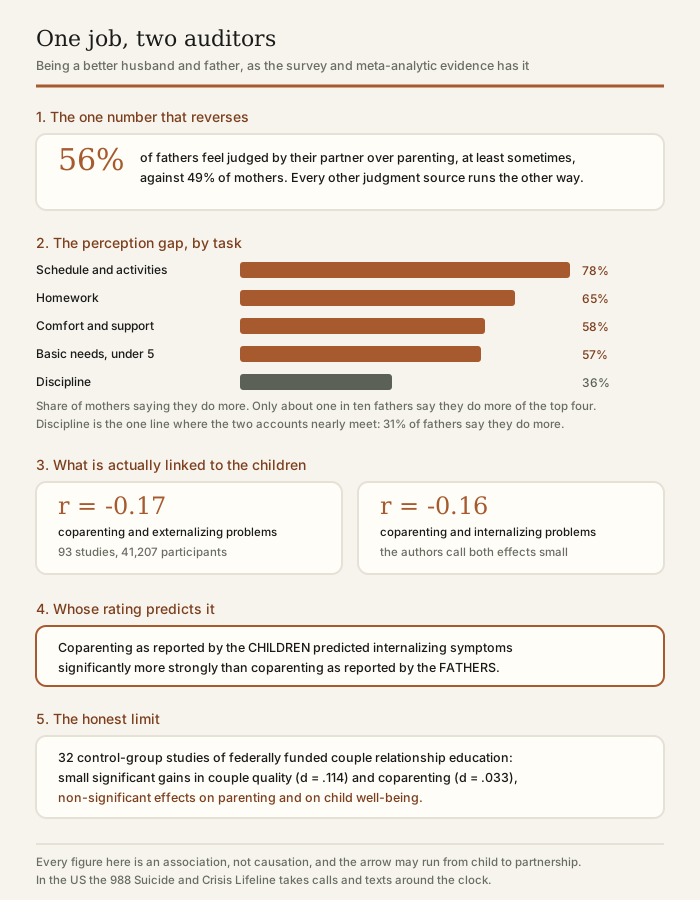
Pew Research Center asked a nationally representative sample of United States parents how often they feel judged for the way they parent, and by whom. Mothers reported more judgment than fathers from almost every source: their own parents, other parents in their community, their friends, online groups. There is exactly one source where the direction reverses. Among parents who are married or living with a partner, 56% of fathers say they feel judged by their spouse or partner at least sometimes for how they parent their children, against 49% of mothers, in Pew's findings on gender and parenting.
That is the problem stated in one number. The person a man is trying to be a better husband to is also the person most likely to be grading him as a father. The two roles are not competing for his week. They are being scored by the same auditor, and he is the only one in the household who feels it that way.
Start here
Take over one thing your partner currently does and you do not, completely, for a month. Stop routing your disagreements with her through your children. Say the specific thank-you out loud instead of leaving it in your head, for reasons set out further down.
Then calibrate. The state of the working partnership between you and your children's mother is the strongest measured correlate anyone has on this question, and it is still a small one. It is not a fix. The evidence does not support the idea that repairing the marriage repairs the children as a downstream consequence, and the rating that best predicts child adjustment is not yours. Measure yourself by what your children and your partner actually notice rather than by how the week felt to you.
The perception gap is measurable, and it is not small
Before anything can be improved, the two auditors have to be reading the same instrument. Pew's survey of married and cohabiting parents in opposite-sex relationships shows they are not. Mothers overwhelmingly report doing more of the daily operational work. Fathers overwhelmingly report that the same work is shared about equally.
| Responsibility | Mothers who say they do more | Fathers who say they do more |
|---|---|---|
| Managing the children's schedule and activities | 78% | 12% |
| Helping with homework or school assignments (school-age children) | 65% | 24%, the single exception Pew names |
| Providing comfort or emotional support | 58% | 9% |
| Meeting basic needs such as feeding, bathing, changing (children under 5) | 57% | 9% |
| Disciplining the children | 36% | 31% |
Read the last row against the four above it. Discipline is the one responsibility where the two accounts nearly converge: 36% of mothers say they do more of it, 31% of fathers say they do more of it, and roughly half of each group says it is shared about equally. Every other line on the table is a gap of forty points or more, and the widest of them, scheduling, is a gap of sixty-six.
There is a pattern in which tasks converge and which diverge, though Pew's survey records the gap without testing why it exists. Our reading is that discipline is episodic, visible and remembered by both parents because it is an event, while scheduling, comfort and basic needs are continuous, low in visibility and easy to be unaware of because someone else absorbed them before they became an event.
This is not a question of honesty. Nobody counts the work they did not do. On that reading a father reports accurately on the portion of the household that left him a memory, and the task worth looking for is the one you would have to ask about in order to answer.
This is the same measurement failure we documented on the time axis in how to be a better father, where fathers have nearly tripled their hours since 1965 and a majority still report giving too little time. The instrument is the man's own sense of the week, and on both axes it reads badly.
What the evidence actually links to your children
The short version, before the notation. How well you and your children's mother function as a working unit is linked to how your children are doing, at roughly the same strength as how much you are on your phone in front of them. Real, worth changing, and a long way from destiny.
The strongest available synthesis on this question is a 2022 meta-analysis of coparenting behavior and child mental health, covering 93 studies and 41,207 participants, published in the International Journal of Environmental Research and Public Health and indexed as PMID 36011980. Coparenting behavior here means the working partnership itself: how integrated, cooperative, conflicted, competitive or triangulating the two parents are with each other in the raising of the child.
Its headline results are worth quoting at their real size rather than inflating them. Coparenting behavior was, in the authors' own wording, slightly and significantly related to children's externalizing problems, r = -0.17, 95% CI [-0.194, -0.15], and to internalizing problems, r = -0.16, 95% CI [-0.18, -0.14]. Integrity, cooperation, conflict, competitiveness and triangulation were each significantly related to both outcome families.
A correlation near 0.17 is a real finding and a small one. To put the size in a band a father can judge, a 2025 systematic review and meta-analysis in JAMA Pediatrics covering 21 studies and 14,900 participants across 10 countries measured parental technology use in a young child's presence, and reported associations of r = 0.15 with externalizing behavior, r = 0.13 with internalizing behavior and emotions, and r = -0.10 with attachment, indexed as PMID 40323594. The authors describe those effect sizes as small.
So the partnership matters at roughly the scale that being on your phone in front of your child matters. Neither one determines a childhood. Both are worth changing, and both belong to the category of things that only show up when they run for years rather than for a weekend.
Whose rating predicts it, and why it is not yours
The most useful finding in that meta-analysis is buried in its moderation analysis, and it goes directly to the measurement problem this article opened with.
The authors tested whether it mattered who was reporting on the coparenting relationship. It did. Coparenting as reported by the children showed a significantly stronger relation with children's internalizing symptoms than coparenting as reported by the fathers.
Of the available raters of your partnership, the father's own account turned out to be the weaker predictor of how his children were doing, and the children's read of that same partnership the stronger one. Since a man reports on the part of the household he witnessed, and the part he did not witness still reaches his children, this lands in the same place as the division-of-labour table above rather than anywhere new.
This is also why the advice to work on your marriage so your kids benefit needs an instrument that is not your own satisfaction. Your children are running their own continuous assessment of whether the two adults in the house are a working unit. That assessment, not yours, is the one that tracks their symptoms.
The husband half, measured the same way
Everything above concerns the partnership as your children see it. The other half of the question is the marriage itself, and it deserves an answer on its own terms rather than only as a lever on the kids.
The intervention evidence is quietly encouraging here, in the one place it was positive. In that same review of federally funded programs, the largest of the significant effects was on relationship skills (d = .132), slightly ahead of couple relationship quality (d = .114). Structured effort aimed at the couple did move the couple. It just never reached the children, which is a limit on the claim rather than on the marriage.
Then the instrument problem turns up a third time, in a narrower population. Five studies published in the Journal of Personality and Social Psychology examined whether a partner's expressions of gratitude protect people high in attachment anxiety or avoidance from the low relationship satisfaction that insecurity otherwise predicts, indexed as PMID 30702317. Buried in the results is a measurement finding. For those insecurely attached partners, it was gratitude as perceived by the receiving partner, rather than the expressing partner's own self-reported gratitude, that buffered their daily dissatisfaction. The thanks a man believed he communicated did not carry the effect for the people this study measured. The thanks his partner registered did. Whether the same holds for securely attached couples is not something these studies tested.
That is three axes pointing the same way, with the third one resting on a narrower population than the other two. Your fathering, better captured by counted frequency than by how the week felt. Your coparenting, predicted better by your children's read than by yours. Your marriage, where at least among insecurely attached partners it was the appreciation actually perceived that did the work. In each case the man's own account is the weakest instrument in the house.
Three things follow for the husband role specifically:
- Say it out loud, and make it specific enough to be unmistakable. Gratitude that stayed in your head was not the version that carried the effect in the study above. Unspoken appreciation and unfelt appreciation are the same thing from the other side of the kitchen.
- Protect one hour a week that is not about the children, the house, or logistics. If the only live channel between two parents is operational, there is nothing left to be a husband inside of.
- Ask her one question that is not a handover. Handover talk is coordination. Coordination is not contact, and the two are easy to confuse when the week is full.
The first of those follows from the gratitude finding. The other two are our editorial judgement about what makes it possible rather than measured results, and we would rather label them than dress them up.
The honest limit, and it is a real one
Here is where most writing on this subject overreaches, so we will state the contrary evidence plainly.
Since 2006 the United States Administration for Children and Families has committed 1.2 billion dollars to a Healthy Marriage and Relationship Education initiative built to test close to this exact question. The plain result first: it made couples modestly better at being couples, and it did not make their children measurably better off.
A 2022 meta-analytic review in Family Process examined every evaluation report of the adult couple relationship education programs funded under it, indexed as PMID 35040124. Across 32 control-group studies it found a range of small but significant effects for couple relationship quality (d = .114), relationship skills (d = .132), mental health (d = .074) and coparenting (d = .033).
It also found non-significant effects for relationship stability, for parenting, and for child well-being.
That is the largest deliberate test anyone has run of the proposition at the centre of this question, and the proposition did not come through intact. Structured programs moved the couple's own relationship metrics by a little. They did not produce a measurable improvement in parenting or in how the children were doing. Any page that tells you to fix the marriage and watch the children improve is promising an outcome that a billion dollars of federally evaluated programming has not demonstrated.
The correct conclusion is narrower and more useful. The state of the partnership is associated with child adjustment. Attending a course to improve the partnership has not been shown to change child adjustment. Those are compatible, and the gap between them is where honest advice lives.
Four changes, none of which cost you the other role
Four things follow. None of them require choosing between the two roles.
Replace your rating with theirs. You already know your own account of the partnership is the weakest available predictor, and the correction for a bad instrument is a different instrument rather than a longer look through the same one. Ask your children a specific, answerable question rather than a global one. Not whether they think you and their mother are happy, which invites management. Something closer to whether they know what happens when the two of you disagree.
Ask it once, in passing, and not as an interview. If the answer is hard to hear, that is information for you to act on quietly. Carrying it back to your partner as evidence, in front of the child, converts the question into the exact triangulation the meta-analysis found significantly related to child problems.
Audit the invisible column, not the visible one. The table above shows fathers and mothers converge on discipline and diverge by nearly fifty points or more on scheduling, comfort and basic needs. Those three are the tasks that leave no memory in the person who did not do them. Pick the one you would have to ask about to answer accurately, and take it whole for a month. Taking a task whole is what changes the count. Helping with it does not.
Move the conflict off the children's channel. The meta-analysis found conflict and triangulation each significantly related to both externalizing and internalizing problems. Triangulation is the specific mechanism of routing a disagreement between the adults through the child, and it is the one item on the list that a father can stop unilaterally, today, without his partner's agreement. If the split has already happened, the operating standard we set out in co-parenting after a split applies with more force rather than less.
Calibrate to the real effect size. You are working on something with a correlation near 0.17 that accumulates over years. It is normal for this to look like nothing after a few weeks, and at this effect size that is exactly what it should look like rather than evidence it is not working. The structural fix is to stop grading the outcome and start running the routine, which is the argument for family routines doing the heavy lifting.
Where this evidence stops
It will not tell you that a better marriage causes better-adjusted children. Every figure on this page is an association. The coparenting meta-analysis reports correlations from cross-sectional and longitudinal studies, and the one large body of intervention research that could have shown causation reported non-significant effects on child well-being.
It will not tell you the direction of the arrow. A child with fewer externalizing problems is easier to coparent around. Some of the correlation is very likely running from the child to the partnership rather than only from the partnership to the child.
It will not tell you what to do inside a marriage that is ending, or one where the conflict is not the ordinary kind. None of the research above studied coercion or abuse, and none of its advice is written for those conditions.
If tonight feels heavier than a household under strain, and closer to something breaking, then everything above is not enough and was never meant to be. If what you are dealing with is not an ordinary bad patch but a family crisis, estrangement, or your own mental health coming apart, this page is the wrong tool. In the United States the 988 Suicide and Crisis Lifeline takes calls and texts at 988 around the clock, and a licensed family therapist is the appropriate next step for a rupture rather than a routine.
One job, two auditors, on a single page
Test yourself
Key takeaways
Last reviewed by The Father Standard Editorial Team on August 30, 2026. Our sourcing and AI-use rules are public on the editorial standards page.
FAQ
Can I be a good father if my marriage is bad?
The evidence does not treat these as the same question. What the coparenting meta-analysis links to child adjustment is the working partnership around the child, meaning cooperation, conflict, competitiveness and triangulation, rather than the romantic satisfaction of the couple. Those overlap but they are not identical, and the first can be operated deliberately when the second is poor.
Should I go to a marriage course to become a better father?
Go if you want the marriage to improve, and expect a small gain. Across 32 control-group studies of federally funded couple relationship education, effects on couple relationship quality were small but significant (d = .114), while effects on parenting and on child well-being were not statistically significant. There is no good evidence that this route improves your children.
Which should come first, my wife or my kids?
The framing assumes a trade-off the data does not show. The measured link between the coparenting partnership and child outcomes means work on the partnership is not time taken away from the children. It is associated with how they are doing, at a modest effect size, which is not the same as a proven route to a particular result.
Why do I feel judged by my partner more than she feels judged by me?
That gap is real and it is measured: 56% of fathers against 49% of mothers report feeling judged by their spouse or partner at least sometimes over parenting. Pew's data records the perception without explaining its cause. The division-of-labour figures on this page are one plausible part of it, since the parent doing more of the invisible daily work has more occasions to form a view.
How do I know if our coparenting is actually bad?
Not from your own rating, which the meta-analysis found to be a weaker predictor of children's internalizing symptoms than the children's own rating of the same relationship. Ask the children something specific and answerable about what happens when the two of you disagree. Ask it once, in passing, and not as an interview, then treat the answer as private information to act on quietly. Carrying it back to your partner as evidence, in front of the child, recreates the triangulation that same meta-analysis linked to child problems.
We are separated. Does any of this still apply?
Yes, and the conflict and triangulation findings apply with more force, because both were significantly related to child problems in the meta-analysis. Our operating standard for that situation is set out separately in co-parenting after a split.
What is the one thing I can do as a husband this week?
Say a specific thank-you out loud. Five studies of gratitude between romantic partners found that among partners scoring higher on attachment anxiety or avoidance, it was the gratitude the receiving partner perceived, rather than the gratitude the expressing partner reported giving, that buffered their daily dissatisfaction. Those studies did not test whether the pattern generalises past that group. Silent appreciation was not the version measured as protective, and saying it out loud costs you a sentence.
Is a small effect size worth acting on?
A correlation near 0.17 will not turn a childhood around by itself, and any page promising that is overselling. It is also the same band as parental phone use in a child's presence, which most fathers already accept is worth changing. Small effects that run for fifteen years are not the same as small effects that run for a weekend.
Sources
- gender and parenting (pewresearch.org)
- PMID 36011980 (pubmed.ncbi.nlm.nih.gov)
- PMID 40323594 (pubmed.ncbi.nlm.nih.gov)
- PMID 30702317 (pubmed.ncbi.nlm.nih.gov)
- PMID 35040124 (pubmed.ncbi.nlm.nih.gov)