Raising a Daughter: The Advice Aims at Her Self-Image, the Trial Moved Everything Except That
The strongest evidence on raising a daughter comes from a randomized trial, and the things it moved were her social-emotional competence and the relationship itself. Her global self-perception did not move. That matters because self-image is the target most advice on this subject is aimed at, and it is the one outcome in the trial that stayed flat while others improved.
Most guidance for fathers of daughters is a script of things to say. Praise her for her mind rather than her appearance. Be the standard she measures men against. Protect her confidence. The program that was actually tested against a control group was not built out of sentences. It was built out of doing things together every week, and the results came back in that shape.
If what you are dealing with is a daughter in crisis, an eating disorder, or violence in your home, this page is the wrong instrument. In the United States, 988lifeline.org takes calls and texts around the clock, and a licensed clinician is the correct next step rather than a parenting article.
Where to start
Three separate questions hide inside the phrase "raising a daughter", and confusing them is why the advice feels both endless and useless.
- What does a daughter need from her father? There is one experimental answer here, and it is narrower and more practical than the folklore.
- Which of the famous daughter-specific claims survive testing? Fewer than you would expect, and the most repeated one is not daughter-specific at all.
- What is actually inside my week with her? This is the only one you control, and the trial evidence points squarely at it.
Most fathers open this page hunting for the right thing to say. The trial evidence points them at a calendar instead. The companion page on a father raising a daughter takes the same evidence from the father's side of the room.
This subject has exactly one place where a father was tested rather than surveyed
Nearly everything written about fathers and daughters rests on correlational data. Close fathers have daughters who do better, and the studies cannot tell you whether the closeness produced the outcome, the outcome produced the closeness, or a third thing produced both.
One program breaks that pattern. A 2019 randomized controlled trial in the Journal of Consulting and Clinical Psychology by Myles Young, David Lubans, Alyce Barnes, Narelle Eather, Emma Pollock and Philip Morgan, Impact of a father-daughter physical activity program on girls' social-emotional well-being, volume 87, pages 294 to 307, randomized 115 fathers aged 29 to 53 and their 153 daughters aged 4 to 12 to either the program or a wait-list control. The program ran as weekly educational and practical sessions plus home-based challenges. Assessments were taken at baseline, at two months, and again at nine months, with 94 percent retention.
The companion paper on physical activity outcomes, a 2019 trial report in Annals of Behavioral Medicine by Philip Morgan, Myles Young, Alyce Barnes, Narelle Eather, Emma Pollock and David Lubans, Engaging Fathers to Increase Physical Activity in Girls, volume 53, pages 39 to 52, measured activity by pedometry rather than by asking, and found favourable effects for daughters at d = 0.4.
The background section of that second paper contains a line worth reading twice, because it is the quiet premise of this entire page. Fathers, the authors note, often spend more time with their sons and rarely take part in family-based programs. The starting condition being corrected was not a father saying the wrong thing. It was a father being less present.
What moved, and what did not
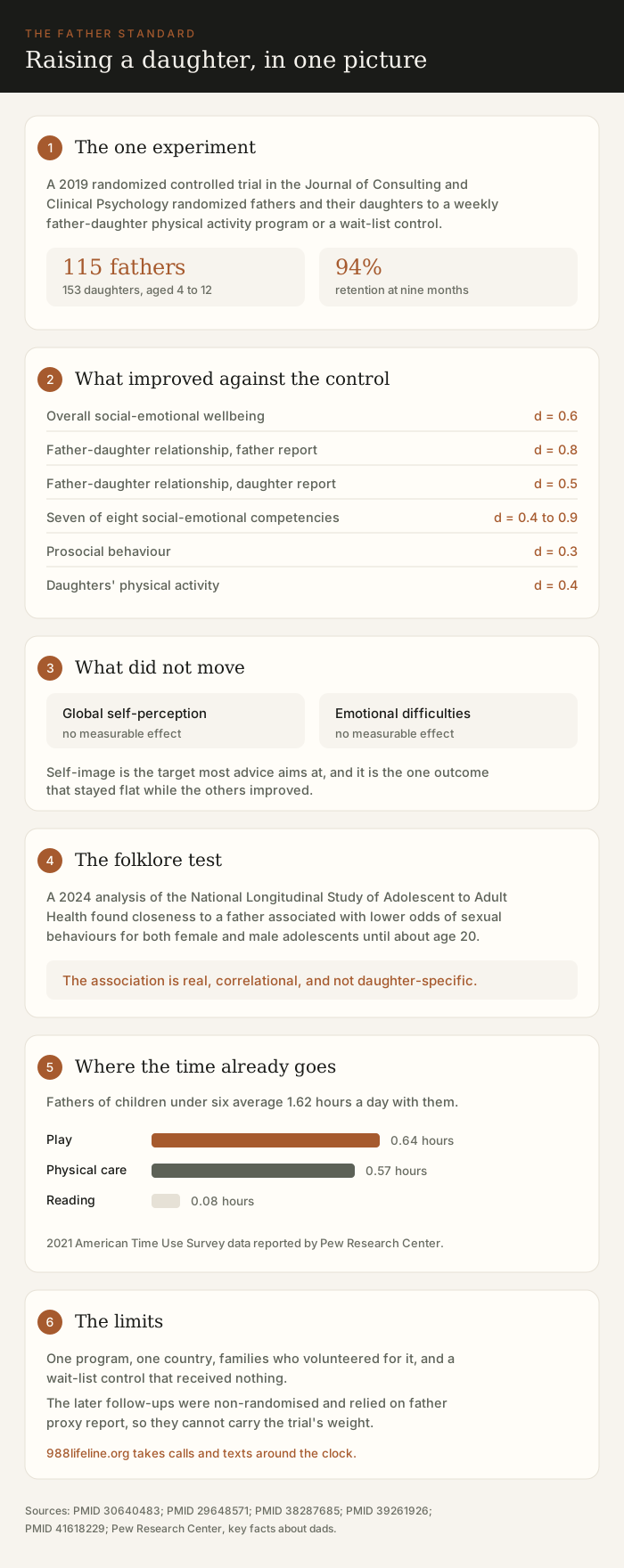
The table below is the clearest single summary of what the trial did and did not move.
| Outcome measured | Result against control |
|---|---|
| Overall social-emotional wellbeing | Improved, d = 0.6 |
| Father-daughter relationship quality | Improved, d = 0.8 by father report |
| Father-daughter relationship quality | Improved, d = 0.5 by daughter report |
| Seven of eight social-emotional competencies | Improved, d = 0.4 to 0.9 |
| Prosocial behaviour | Improved, d = 0.3 |
| Daughters' physical activity | Improved, d = 0.4 |
| Global self-perception | No measurable effect |
| Emotional difficulties | No measurable effect |
The wellbeing gain was reported as 24.9 units with a 95 percent confidence interval running from 8.6 to 41.1, and 54 percent of intervention daughters reached a clinically meaningful improvement against 18 percent of controls. Most outcomes were still improved at nine months.
Now read the last two rows again. Global self-perception did not move, and neither did emotional difficulties. A program that reliably improved seven of eight competencies, the relationship on both people's reports, and her prosocial behaviour did not shift how she rated herself overall.
No effect on self-perception does not mean self-esteem is unimportant. It means global self-perception is a stable, slow-moving construct, and a nine-session program is not the instrument that moves it. Competence, connection and activity are more tractable on that timescale. A father who has been told his job is to install his daughter's self-image has been handed the one target in the trial that stayed still.
The most repeated daughter-specific claim is not daughter-specific
The strongest folk belief in this niche is that a father governs his daughter's romantic and sexual life in a way that has no equivalent for sons. The best available test of that does not support the asymmetry.
A 2024 study in the Journal of Research on Adolescence by Lu Jiang, Xiaomin Wang, Shiyu Cui and Sara Vasilenko, Time-varying associations between parental closeness, self-esteem, and sexual behavior across adolescence and emerging adulthood, volume 34, pages 192 to 204, applied a time-varying effect model to the National Longitudinal Study of Adolescent to Adult Health. Closeness to a father was associated with lower odds of sexual behaviours for both female and male adolescents until around age 20. Closeness to a mother predicted only for female adolescents, and only between roughly ages 13 and 15.
So the paternal association is real in this dataset, and it is not a daughter effect. It runs through sons on the same terms. The parent whose association was sex-specific and narrow in this analysis was the mother, which is the reverse of how the folklore is usually told.
Two cautions belong with that finding rather than after it. It is correlational, so it establishes association and not cause. And an association between closeness and delayed sexual behaviour says nothing about whether that delay is the outcome a father should be optimising for.
Where a real measured difference does show up
None of the above means parent and child gender never matter. A 2025 study in the Infant Mental Health Journal by Marina Matetovici, Anouk Spruit, Cristina Colonnesi, Mauricio Garnier-Villarreal and Marc Noom, Parent and child gender effects in the relationship between attachment and both internalizing and externalizing problems, volume 46, pages 424 to 444, modelled 446 parent-child pairs in the Netherlands with children aged 2 to 5.
The association between attachment quality and internalizing problems was stronger in father-son pairs than in father-daughter pairs. Sons also showed stronger associations than daughters between secure attachment and lower externalizing problems.
This does not say fathers matter less to daughters. It says that in this preschool sample, the statistical link between attachment security and this particular set of problem behaviours was tighter for sons. A weaker association can mean the outcome is driven by other things in daughters, and it is not a measure of how much a father is worth to his daughter. Our page on the father-daughter relationship covers what that bond is asked to carry at each age.
What this changes about the ordinary week
Shared physical activity is the channel with experimental support behind it. Not conversation, not correction, not the speech about how a man should treat her. The tested program put a father and a daughter in motion together, physically, on a weekly schedule, and measured what came out.
Some of that time is probably already there, pointed at the wrong kind of activity. Pew Research Center's key facts about dads reports that fathers of children under six average 1.62 hours a day with them, of which 0.64 hours is play and 0.08 hours is reading. Play is already the largest single block. The trial did not test play in general. It tested a repeating, physical, deliberately scheduled version of it, which is the part worth borrowing.
Stop grading yourself on her self-image. It is the outcome that did not move under the best conditions anyone has tested. Judging your fathering by her confidence on a given Tuesday is measuring yourself against the least responsive variable available.
Presence precedes technique. The premise being corrected in the trial was fathers spending less time with daughters than with sons. Our page on raising a son reaches the same conclusion from the other direction, and our page on raising a strong daughter shows what happens when a father tries to add pressure instead of presence.
The honest limits
This page rests on a single trial and three correlational studies, and four boundaries limit how far any of it travels.
The trial tested one program, in Australia, with daughters aged 4 to 12, in families who volunteered for a father-daughter physical activity program. Fathers who sign up for that are not a random sample of fathers. The result travels as evidence that shared structured activity can move these outcomes. It does not travel as a claim that any father doing any activity gets d = 0.6.
The wait-list control design means the comparison group received nothing. Some of the gain will be attention and structure rather than the specific content, which is true of most parenting trials and is a reason to hold effect sizes loosely.
The later work in this program is weaker by design, and should not be quoted as if it were the trial. A 2024 report in the International Journal of Behavioral Nutrition and Physical Activity by Lee Ashton and colleagues, Twelve-month outcomes of a community-based, father-daughter physical activity program, volume 21, article 101, followed 257 fathers and 285 daughters and found fathers meeting activity recommendations on 19 percent more days at twelve months. It was single-arm and non-randomised, so it has no control group. A 2026 mixed-methods follow-up in BMC Public Health by Philip Morgan, Jacqueline Grounds, Rebecca O'Connor, Drew Lee and Lee Ashton, Long-term outcomes of a father-daughter program, volume 26, article 742, surveyed 197 fathers three to eight years later and reported sustained themes including closer relationships in the teenage years. Every claim about the daughters in that paper came through father proxy report, from half of those invited, with no control group. Fathers who felt the program worked are the fathers most likely to answer a survey about it.
The attachment study is correlational, Dutch, and preschool-aged. Nothing in it should be carried to a teenager.
Where this evidence stops applying
The trial enrolled daughters aged 4 to 12, so that is the range it speaks to, and a father of a daughter in it can act on this directly: one repeating shared physical activity you both actually like, on the calendar, defended against everything that will try to take the slot.
Past that age range the honest answer is that this page runs out of evidence. Nothing in the trial was measured on teenagers, a hobby imposed on a fifteen-year-old is not the intervention that was tested, and the father-daughter relationship is the more useful page. If what stands between you is heavier than distance, a licensed family therapist is the correct referral rather than any article on this site.
Raising a daughter in one picture
Last reviewed by The Father Standard Editorial Team on September 7, 2026. Our sourcing and AI-use rules are public on the editorial standards page.
FAQ
What does a daughter actually need from her father?
On the only randomized test available, what moved her outcomes was structured shared physical activity with him on a repeating schedule. That produced medium to large gains in her social-emotional competence and in the relationship on both people's reports. It is a narrower answer than the usual advice gives, and it is the one with an experiment behind it rather than a correlation.
Can a father build his daughter's self-esteem?
Not directly, on this evidence. The trial that improved seven of eight social-emotional competencies and the relationship itself found no measurable effect on daughters' global self-perception. That is not proof it cannot be influenced. It does mean self-image is slow-moving and is a poor scoreboard for your own fathering.
Does a father determine who his daughter dates?
The claim is far stronger than the data. In an analysis of the National Longitudinal Study of Adolescent to Adult Health, closeness to a father was associated with lower odds of sexual behaviours for both sons and daughters until about age 20. It was an association rather than a cause, and it was not daughter-specific.
Should I raise my daughter differently from my son?
The measured evidence gives you less licence for that than the folklore does. The trial worked through involvement and shared activity, which is not gender-specific machinery. Fathers do behave differently with sons and daughters, and our page on raising a son works through what that difference is and is not evidence of.
How much time does this actually take?
The tested program was weekly sessions plus home tasks over roughly two months, and effects were largely still present at nine months. Fathers of children under six already average 1.62 hours a day with them, and 0.64 of that is play. The change is usually in shape and consistency rather than in total hours.
Is it too late if my daughter is already a teenager?
The trial studied daughters aged 4 to 12, so nothing here is evidence about teenagers. The follow-up work reported closer relationships in the teenage years, but that came through father proxy report with no control group and cannot carry that weight. For an older daughter the relevant page is the father-daughter relationship, and the survey data on raising a teenage daughter is measured at that age rather than carried to it.
Does being tougher on her prepare her for the world?
The pooled evidence runs the other way. Our page on raising a strong daughter covers the meta-analysis on that instinct, which associates added pressure, control and overprotection with more internalizing symptoms rather than fewer.
Do the effect sizes in this trial mean my daughter will change?
No. An effect size of 0.6 describes an average difference between two groups, not a prediction for one child. Roughly half the intervention daughters reached a clinically meaningful improvement, which also means many did not. Group averages are a guide to what to try, not a forecast for your household.
When is this a matter for a professional rather than for parenting?
When you are seeing persistent low mood, disordered eating, self-harm, withdrawal that lasts weeks rather than days, or any safety concern. None of the research on this page is a treatment, and a shared activity is not an intervention for a mental health condition. In the United States, 988lifeline.org is available around the clock, and a licensed clinician is the right next step.
Sources
- 988lifeline.org (988lifeline.org)
- Impact of a father-daughter physical activity program on girls' social-emotional well-being (europepmc.org)
- Engaging Fathers to Increase Physical Activity in Girls (europepmc.org)
- Time-varying associations between parental closeness, self-esteem, and sexual behavior across adolescence and emerging adulthood (europepmc.org)
- Parent and child gender effects in the relationship between attachment and both internalizing and externalizing problems (europepmc.org)
- key facts about dads (pewresearch.org)
- Twelve-month outcomes of a community-based, father-daughter physical activity program (europepmc.org)
- Long-term outcomes of a father-daughter program (europepmc.org)