Raising a Strong Daughter: Why the Instinct to Push Harder Measures the Wrong Way
Raising a strong daughter is closer to a subtraction problem than an addition problem. When a father decides that his daughter should be strong, the instinct is to add things: more pressure so she learns to cope, more protection so nothing breaks her, more correction so she gets it right, more of him in the room making sure the outcome lands. Each of those feels like an investment. The largest pooled body of evidence on that whole family of behaviours points the other way, and it points there consistently enough to be worth a father's attention before he adds anything else.
The word doing the damage is "strong" itself. Treated as a trait you install by application of force, it licenses exactly the parenting the measurement literature associates with more anxiety and more low mood, not less.
Where to start
Take one thing away before adding anything. Pick the single behaviour you perform most often in the name of her strength, the check-in that is really a check-up, the correction offered before it was asked for, the decision you make on her behalf because your version would be better, and stop doing that one thing for a month. Then watch what fills the space.
The direction of the evidence is that the intrusive half of a father's effort carries a measurable cost, while the parts that do the building are relationship quality and met psychological needs rather than pressure. Calibrate honestly as you read on. These associations are modest, correlational, and nowhere near destiny.
The instinct has been measured, and it runs the wrong way
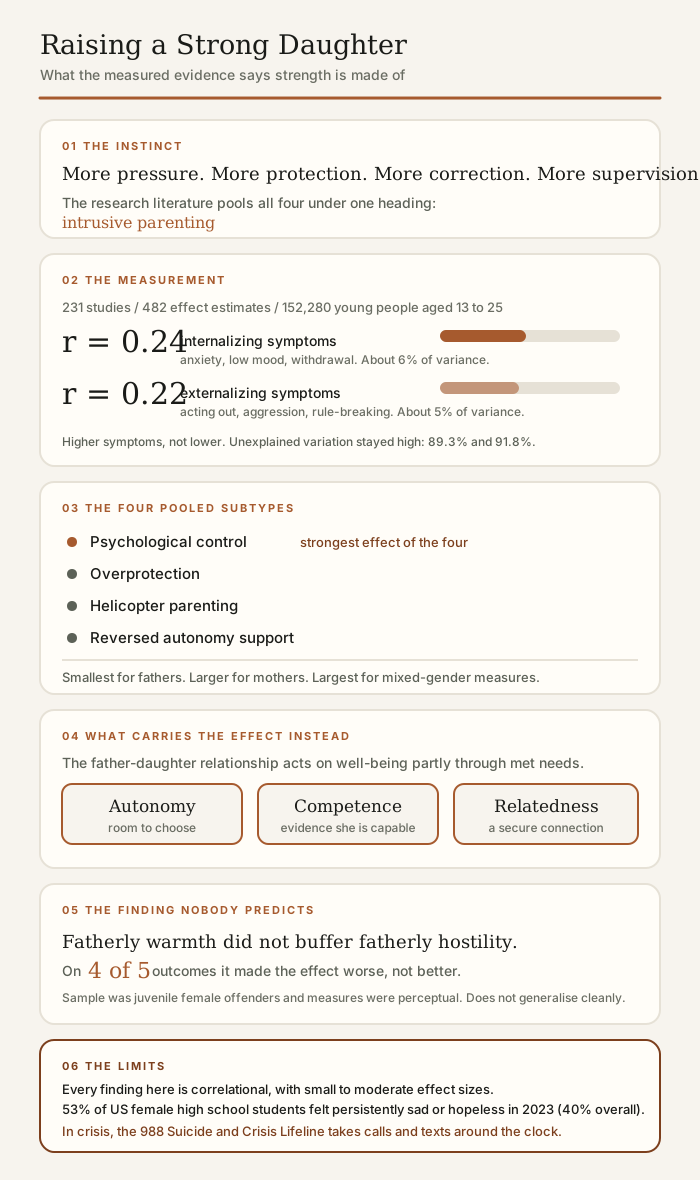
A 2026 three-level meta-analytic review in Clinical Child and Family Psychology Review pooled 231 studies published between 2000 and 2025, indexed as PMID 41511635. It contributed 482 effect estimates linking intrusive parenting to internalizing symptoms in young people aged 13 to 25, across a combined sample of 152,280, and a further 232 effect estimates linking it to externalizing symptoms across 85,711.
Intrusive parenting was associated with higher symptoms in both directions: a pooled effect of r = 0.24 for internalizing symptoms, which is the anxiety, sadness and withdrawal cluster, and r = 0.22 for externalizing symptoms, which is acting out, aggression and rule-breaking. The useful part for a father is what the authors folded into that single category, because it is not a list of obviously bad behaviour.
| Subtype the analysis pooled | What it looks like at home | The version a father tells himself |
|---|---|---|
| Psychological control | Guilt, withdrawal of approval, conditional regard, managing how she feels about herself | Teaching her that actions have consequences |
| Overprotective | Removing risk, pre-solving problems, restricting range | Keeping her safe until she is ready |
| Helicopter | Constant monitoring, hovering, involvement past the point she asked for | Staying involved so she never feels alone |
| Autonomy support reversed | Deciding for her, overriding her preferences, low room to choose | Steering her away from a mistake I already made |
Every row in that middle column reads like effort. Every row in the right-hand column is a sentence a decent father has said. That is the whole difficulty with this topic, and it is why the finding is worth more than another list of things not to shout.
Two moderator results deserve to be quoted rather than smoothed over, because both cut against a tidy story. Psychological control produced a stronger effect than helicopter parenting or reversed autonomy support, so the subtypes are not interchangeable. And the effect was smallest for fathers, larger for mothers, and largest of all in studies that folded both parents into one mixed-gender measure. A father reading this is not being told his intrusion is the heaviest in the house. The authors' own closing line is that intrusive parenting should be considered "one partial indicator of elevated symptoms among youth". That is language of degree, not of causation, and the distinction is theirs rather than ours.
Whose report the number came from changes the number
The same analysis found that studies relying on the child's report produced larger associations than studies using multiple reporters. That is a familiar pattern on this site: we have written about the same measurement problem in father-daughter relationship psychology, and it recurs because it is structural rather than incidental.
A 2026 preregistered set of meta-analyses in the same journal went after it directly by dropping questionnaires and using observed behaviour instead. Indexed as PMID 42247102, it pooled 90 studies, 350 effect sizes across five observed parenting behaviours and 131 across six observed child behaviours in recorded parent and child interactions.
The results were narrower than the questionnaire literature, and the narrowing is the finding. Observed parental warmth and support, and observed harsh control and criticism, both co-occurred with and preceded childhood depression, with small effect sizes. Depression generally did not precede negative parenting, which is a genuine point in favour of the arrow running parent to child rather than the reverse.
Then the part that a father who wants to be honest with himself should sit with: observed autonomy granting, guidance and structure, and parental depressed affect showed no relationship to childhood depression at all. Autonomy granting is the exact behaviour the intrusive-parenting literature implies you should increase. Watched rather than asked about, it did not move the outcome. Warmth and the absence of harshness survived the switch to observation. The autonomy story did not.
What carries the father-daughter effect
Where the effect does appear to travel is through met psychological needs rather than through anything a father applies. A study in the Journal of Adolescence surveyed 310 girls aged 14 to 18 in a Turkish population-based sample, indexed as PMID 30014954. Structural equation modelling found the father-daughter relationship directly associated with higher well-being and lower ill-being, and found the indirect path through basic psychological need satisfaction significant as well.
The needs in that framework are autonomy, competence and relatedness: room to choose, evidence she is capable, and the sense of being securely connected to somebody. Read that list next to the four intrusive subtypes in the table above and the conflict is plain. Overprotection removes the raw material for competence. Deciding for her removes autonomy. Psychological control makes relatedness conditional on performance. A father pushing hard for strength is frequently spending down the three accounts the evidence associates with it.
This is a single cross-sectional self-report study in one country, so it establishes a pattern rather than a mechanism. It earns a place here because its direction agrees with the two much larger analyses above while arriving from an entirely different design.
The finding about warmth that nobody predicts
There is a comfortable version of all this in which a father's warmth cancels his worst days. One study set out to confirm exactly that and found the opposite.
Published in Frontiers in Psychology in 2023 and indexed as PMID 37020913, it examined perceived warmth and hostility in both the father-daughter and mother-daughter relationships against five outcomes: depressive symptoms, anxiety symptoms, romantic partner warmth, romantic partner hostility, and the daughter's sense of agency. The stated hypothesis was that high warmth would protect daughters from the effects of parental hostility, more strongly for fathers than mothers.
On four of the five outcomes, the moderation ran in the opposite direction. High perceived father warmth made the effects of father hostility worse. Maternal warmth, and not maternal hostility, showed a direct association with those same four outcomes. The authors' reading is that daughters appear to model and internalize the relationship with their father when they perceive it as warm, for better and for worse, which would mean a warm and hostile father is teaching a template rather than offsetting a debt.
Two limits belong in the same breath as that result. The sample was juvenile female offenders, a high-risk group, so it does not generalise cleanly to a typical household. And it measures perception, not conduct. What it establishes is that the arithmetic a father does in his head, where affection on Saturday nets off the cold Tuesday, has no support in this data and one direct challenge. If you have been running that ledger, the case for repairing the Tuesday rather than topping up the Saturday just got stronger. We have written about what that repair looks like in how to be a better father.
The honest limits
Every association in this article is correlational, and the effect sizes are small to moderate. None of it licenses the conclusion that a father who has been overprotective has damaged his daughter, and none of it licenses the reverse conclusion that fathering barely matters.
Population data does say the setting is genuinely harder for girls right now. The Centers for Disease Control and Prevention's Youth Risk Behavior Survey Data Summary and Trends Report for 2013 to 2023 records that 40% of United States high school students experienced persistent feelings of sadness or hopelessness in 2023, up from 30% in 2013 but down from 42% in 2021, and reports that female students were more likely than male students to experience it. The CDC's summary of the 2023 survey results puts the female figure at 53%, down from 57% in 2021, alongside a fall in the share of female students who seriously considered attempting suicide from 30% to 27%. Those are the first movements in the right direction in a decade, and they are still the highest numbers on the page.
If your daughter is in distress, this article is not the instrument. Persistent low mood, hopelessness lasting more than two weeks, or any talk of self-harm calls for a licensed professional rather than a change of parenting style. In the United States the 988 Suicide and Crisis Lifeline takes calls and texts around the clock at 988lifeline.org. Bringing in help is not a father failing to handle it himself.
What to actually do
Stop auditing her and start auditing the instrument. Ask what she gets to decide this month that she did not get to decide last month. Ask which problem currently on her plate you would normally have solved by Thursday, and leave it there. Ask whether your warmth is offered freely or released on results, because the conditional kind is the psychological control that the strongest effect in this literature attaches to.
If she is grown and out of the house, the same audit works with the objects swapped. The day-to-day version of it sits on a father raising a daughter. Which advice do you offer unasked. Which of her decisions do you still weigh in on before she has asked you to. Which call do you make just to check, more for your comfort than for hers.
Then hold the standard for yourself first. The Harvard Center on the Developing Child's work on resilience puts at least one stable, committed relationship with a supportive adult at the centre of how children come through hard things. That is a description of availability, not of pressure. It is also the one variable in this entire article you control outright.
Strength, on this reading, is not something you build into her. It is what shows up in a person whose needs were met and whose father got out of the way at the right moments. The work is real. It is just quieter than the version you were planning.
Test yourself
Key takeaways
Last reviewed by The Father Standard Editorial Team on September 1, 2026. Our sourcing and AI-use rules are public on the editorial standards page.
FAQ
What actually makes a daughter strong?
The measured evidence points at met psychological needs rather than applied pressure. Room to choose, repeated evidence that she is capable, and a secure connection to at least one committed adult are the components that keep appearing. A study of 310 adolescent girls found the father-daughter relationship associated with higher well-being partly through exactly those needs being satisfied. The national survey behind raising a teenage daughter points the same way, at logistics rather than emotional fluency.
Does being tough on my daughter build resilience?
There is no support for it in the pooled data, and there is a measurable cost on the other side. Across 231 studies covering more than 152,000 young people, intrusive parenting, which includes psychological control and overprotection, was associated with higher internalizing symptoms at r = 0.24 rather than lower. That is a modest association, not a catastrophe, but it runs against the toughening theory rather than for it.
Is protecting her from failure the same as overprotection?
The literature pools overprotection with intrusive parenting, and the mechanism is straightforward: competence is one of the three basic psychological needs, and it is built from problems she solved rather than problems that were removed. Judgement still applies. Removing a genuine danger is not the same behaviour as pre-solving an ordinary difficulty because your version would be faster.
Does my warmth cancel out the times I lose my temper?
One study designed to test that hypothesis in at-risk adolescent girls found the opposite on four of five outcomes: high perceived father warmth made the effects of father hostility worse rather than buffering them. The sample was a high-risk one and the measures were perceptual, so it is not the last word. It is enough to say that repairing the hostility is the better use of your effort than adding warmth on top of it.
Are these effects big enough to worry about?
Small to moderate. The authors of the largest analysis describe intrusive parenting as one partial indicator of elevated symptoms rather than a cause they have identified, and the chart above shows how modest the association is against the full range. Big enough to justify dropping a habit. Not big enough to support a conclusion about any one father and any one daughter.
Do fathers matter more or less than mothers here?
Less, on this specific measure, which is worth stating plainly. The intrusive parenting effect was smallest for fathers, larger for mothers, and largest in studies that folded both parents into a single mixed-gender measure. A separate study found maternal warmth, rather than paternal, carrying the direct association with four daughter outcomes. Fathering is not the heaviest weight in the house, and pretending otherwise helps nobody.
My daughter seems fine. Do I need to change anything?
Then the audit is cheap and the answer may well be no. The practical version is to name the one behaviour you perform most often in the name of her strength, pause it for a month, and observe. If nothing changes, you have lost nothing. If she starts bringing you things she was not bringing you before, that was the answer.
When is this a matter for a professional rather than for parenting?
When it stops being about the relationship and starts being about her mental health. Persistent low mood or hopelessness lasting more than two weeks, withdrawal from things she used to do, or any mention of self-harm calls for a licensed clinician. In the United States the 988 Suicide and Crisis Lifeline takes calls and texts around the clock. National survey data records that 53% of female high school students felt persistently sad or hopeless in 2023, against 40% of students overall, so this is common ground rather than rare ground.
Sources
- PMID 41511635 (pubmed.ncbi.nlm.nih.gov)
- PMID 42247102 (pubmed.ncbi.nlm.nih.gov)
- PMID 30014954 (pubmed.ncbi.nlm.nih.gov)
- PMID 37020913 (pubmed.ncbi.nlm.nih.gov)
- Youth Risk Behavior Survey Data Summary and Trends Report for 2013 to 2023 (cdc.gov)
- 2023 survey results (cdc.gov)
- 988lifeline.org (988lifeline.org)
- resilience (developingchild.harvard.edu)