Raising a Son: The Measured Gap Is in the Father's Defaults, Not in the Boy
Fathers do reliably behave differently with sons than with daughters, and that difference has been measured in home recordings rather than inferred from surveys. What has not been established is that sons need the difference. The gap that shows up most clearly in the research is a gap in the father's default settings, and defaults are the one thing in this whole subject a father can actually change this week.
Most advice about raising a son starts from the opposite premise, that a boy needs something different. Wrestle with him. Push him. Do not coddle him. He will not talk face to face, so talk shoulder to shoulder. Some of that survives contact with the evidence and some of it does not, but the more useful result sits one level below all of it.
If what you are dealing with is a boy in crisis, or violence in your home, this page is the wrong instrument. In the United States, 988lifeline.org takes calls and texts around the clock.
Where to start
Three questions get compressed into the phrase "raising a son", and they need different answers.
- What does a boy need from his father? The pooled evidence points at involvement, and it does not point at a male-specific version of it.
- What do fathers actually do with sons? Something measurably distinct from what they do with daughters, whether or not they intended it.
- Which of my own habits is a decision and which is a default? This is the only one of the three you control, and the research is unusually helpful on it.
Work top to bottom. Most fathers arrive wanting an answer to the first question and leave having discovered that their real problem was the third.
Fathers behave differently with sons, and it was recorded rather than reported
The strongest observational work here did not ask fathers what they do. It listened.
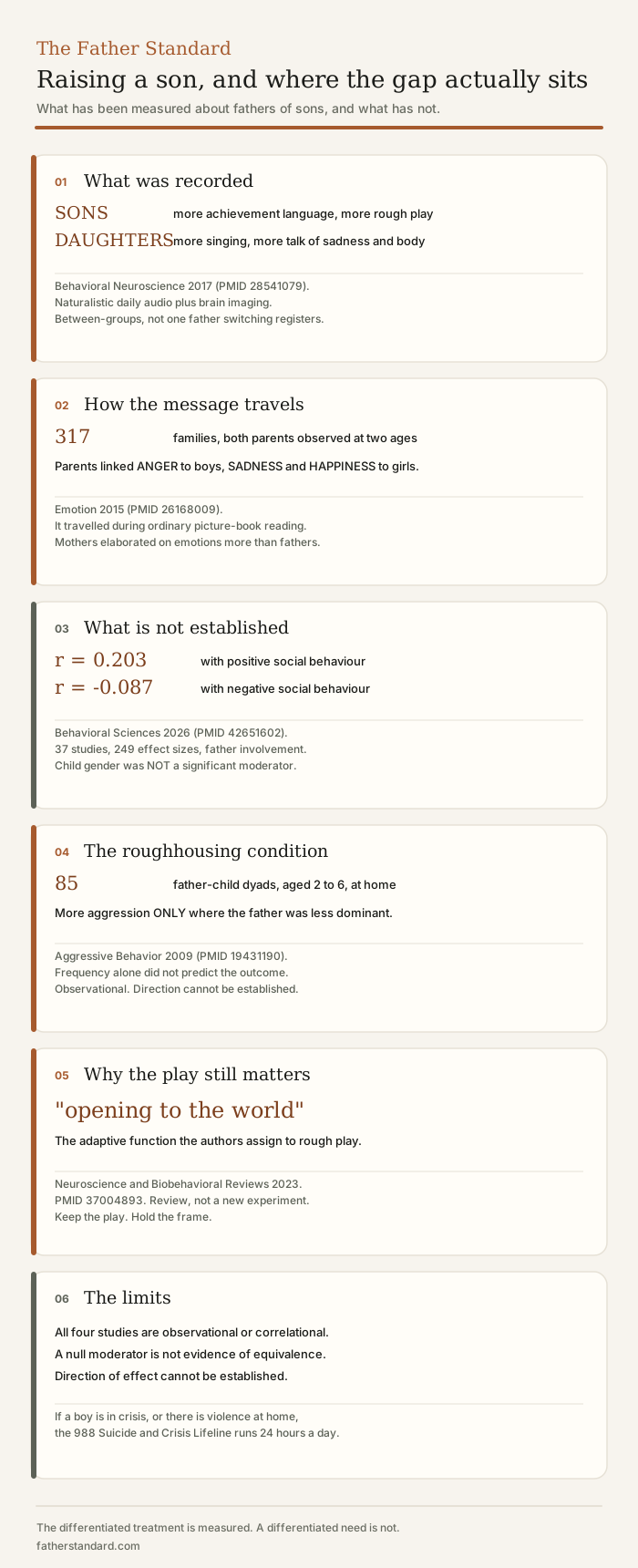
A 2017 study in Behavioral Neuroscience by Jennifer Mascaro, Kelly Rentscher, Patrick Hackett, Matthias Mehl and James Rilling, Child gender influences paternal behavior, language, and brain function, volume 131, pages 262 to 273, combined naturalistic recordings of everyday caregiving with brain imaging. Fathers wore a device that sampled audio from their ordinary days, so the behaviour counted was behaviour that happened rather than behaviour recalled.
The contrast the authors report is specific. Compared with fathers of sons, fathers of daughters were more attentively engaged, sang more, and used more analytical language and more language relating to sadness and the body. Fathers of sons engaged in more rough-and-tumble play and used more achievement language. The imaging half found a stronger response to a daughter's happy face in reward and emotion regulation regions, and a stronger response to a son's neutral face.
Read the language finding slowly, because it is the one that matters at a kitchen table. Fathers of sons talked more about winning and less about sadness. Not because those fathers had decided sadness was off limits for boys. The recordings simply caught what came out.
A second study, from a different country and a different method, lands in the same place. A 2015 paper in Emotion by Lotte van der Pol and colleagues at Leiden University, Fathers' and mothers' emotion talk with their girls and boys from toddlerhood to preschool age, volume 15, pages 854 to 864, observed both parents in 317 families discussing a picture book of children showing anger, fear, sadness and happiness, at two ages twelve months apart. Mothers elaborated on emotions more than fathers did. When parents applied gender labels to the children in the drawings, they associated anger more with boys, and sadness and happiness more with girls.
The authors read that as parents conveying stereotyped gender messages while doing something as ordinary as turning pages. That is worth sitting with. The transmission did not require a lecture about how men handle things. It happened inside a bedtime book.
The uncomfortable part is what the outcome research does not find
If sons were getting a tailored approach because sons need a tailored approach, the payoff would differ by gender. On the largest pooled estimate available, it does not.
A 2026 three-level meta-analysis in Behavioral Sciences by Y. Li and J. Hao pooled 37 studies and 249 effect sizes on father involvement and children's social behaviour, indexed as PMID 42651602. Father involvement correlated with positive social behaviour at r = 0.203 and with negative social behaviour at r = -0.087. Several moderators mattered. The child's gender was not one of them.
Our signs of a bad father son relationship page works through that dataset in more detail, including the finding that who reports the involvement changes the size of the result. For this page one implication is enough, and it should be stated carefully rather than stretched.
The differentiated treatment is measured. A differentiated need is not. That is not proof that boys and girls need identical fathering, and this page does not claim it. Absence of a moderating effect in a pooled correlational dataset is weak evidence, not a verdict. What it does mean is that a father who has been running a male-specific playbook is running it on an assumption, and the assumption is doing more work than the evidence underneath it.
The roughhousing advice is real, and it comes with a condition
Rough-and-tumble play is the one piece of the traditional script with genuine research behind it, which makes the fine print more important rather than less.
A 2023 review in Neuroscience and Biobehavioral Reviews by Daniel Paquette and Jennifer StGeorge, Proximate and ultimate mechanisms of human father-child rough-and-tumble play, volume 149, article 105151, compared human father-child rough play with peer play across mammals and concluded it appears to serve a biological adaptive function the authors describe as "opening to the world". Roughhousing, on this reading, is not filler. It is how a child practises risk, surprise and physical negotiation with someone safe.
Then comes the condition. A 2009 observational study in Aggressive Behavior by Joseph Flanders, Vanessa Leo, Daniel Paquette, Robert Pihl and Jean Séguin, Rough-and-tumble play and the regulation of aggression, volume 35, pages 285 to 295, videotaped 85 children aged 2 to 6 in free play with their fathers at home and rated how far the father dominated the interaction.
The result was an interaction rather than a main effect. Rough play frequency was associated with higher physical aggression, but specifically among children whose fathers were the less dominant playmate. Where the father remained the dominant partner in the game, the same frequency of rough play did not carry that association.
| Question a father actually asks | What the study measured |
|---|---|
| Is roughhousing good for him? | Frequency alone did not predict a good outcome |
| What changed the result? | Whether the father stayed the dominant playmate |
| Which way did it go? | More rough play, more aggression, in less dominant dyads |
| Does this prove causation? | No. It is observational and correlational |
| Ages studied | 2 to 6 years, 85 dyads, home free play |
Dominant here is a rating of the play interaction, not a description of a parenting philosophy, and it is not a licence to overpower a child. The practical reading is closer to refereeing. The adult sets the ceiling, calls the stop, and decides when the game is finished. Rough play with no one holding the frame is where the association showed up.
What this changes about the ordinary week
None of the above tells you to stop wrestling with your son or to start interrogating him about his feelings. Both readings would be overcorrections, and the second one is how a boy learns to give one-word answers.
What it does is identify where the slack is.
Achievement language is not the enemy. Being the only register you have is. A father who only ever asks about the score has not done anything wrong in any single conversation. He has narrowed the range across a thousand of them, and that kind of pattern only becomes visible when something is counting.
Sadness needs to be sayable in the house before it is needed. The van der Pol result is about ordinary parents doing ordinary book reading, which is exactly when a vocabulary gets built or does not. A boy who has heard his father name disappointment, worry and regret in low-stakes moments has somewhere to put the high-stakes one. Our page on how to reconnect with your teenage son covers what to do when that groundwork was not laid early.
Keep the rough play and hold the frame. On the Flanders result, the version that carried risk was rough play where the father was not the dominant partner in the game. Start it, referee it, end it while it is still fun.
Presence is the part with the pooled evidence behind it. Involvement is what the meta-analysis measured, and it did not require a male-specific technique. If you are choosing between reading the perfect article on boys and being in the room, the evidence favours the room. That is the same argument our how to be a better father page makes from a different direction.
The honest limits
This page rests on four studies, and each one has a boundary worth naming.
The Mascaro work compared fathers of sons with fathers of daughters. It is a between-groups comparison, so it does not show a single father switching registers between his own two children. The imaging findings are group-level associations and carry no implication about any individual father.
The van der Pol study observed parents discussing drawings, not their own children's real distress. Gender labelling in that setting is a strong signal about the messages available to a household. It is not a measurement of how those parents respond when a boy actually cries.
The Flanders study is observational, with 85 dyads and children aged 2 to 6. An association between rough play frequency and aggression in less dominant dyads does not establish direction. A more aggressive child may well pull his father into more rough play, and the design cannot rule that out.
The Li and Hao meta-analysis is a pooled correlational estimate, and effect sizes of 0.203 and -0.087 are modest. Its null result on gender carries the lightest load of anything cited on this page, because moderator tests of that kind are frequently underpowered and routinely miss effects that are really there.
Taken together the studies are consistent, and consistency is not proof. Treat all of it as a good reason to widen your range and a bad reason to conclude anything final about your particular son.
If this describes a household you recognise
Two directions from here, depending on which one you are.
If your son is young and none of this has hardened yet, the work is vocabulary and range. Keep the rough play, add the register that the recordings suggest goes missing. Our sibling page on raising a strong daughter reaches a structurally similar conclusion from the opposite starting point, which is itself a small piece of evidence that the mechanism is not gender-specific. If there is no father in the house at all, the research answers a narrower question than the headlines suggest, and our page on raising a son as a single mom sets out what the more rigorous designs actually found.
If he is already grown and quiet, the vocabulary argument is late but not void, and the relevant page is the relationship between a father and son. Nothing measured here explains estrangement, and nothing here should be used to talk yourself out of a rupture that has a real cause behind it.
Raising a son in one picture
Test yourself
Key takeaways
Last reviewed by The Father Standard Editorial Team on September 6, 2026. Our sourcing and AI-use rules are public on the editorial standards page.
FAQ
What does a son actually need from his father?
The pooled evidence points at involvement rather than at a male-specific technique. Across 37 studies, father involvement correlated with children's positive social behaviour at r = 0.203, and the child's gender did not significantly moderate it. The practical reading is that you do not need a boy-specific method before you start. Presence comes first and technique a long way after.
Do fathers really treat sons differently from daughters?
Yes, and it has been recorded rather than self-reported. A 2017 Behavioral Neuroscience study using naturalistic daily audio found fathers of sons used more achievement language and more rough-and-tumble play, while fathers of daughters sang more and used more language about sadness and the body.
Should I roughhouse with my son?
Yes, and a 2023 review concluded this kind of play appears to serve an adaptive function its authors call opening to the world. The condition worth checking is not how often you play but who holds the frame. If you cannot stop the game with one word, you are a participant rather than the referee, and that is the arrangement the evidence flags.
Does rough play make boys aggressive?
Not on its own. In a 2009 study of 85 dyads, frequency alone did not predict the outcome. The association with higher physical aggression appeared only where the father was the less dominant playmate. The design is observational, so it cannot establish direction, and a more aggressive child may well be pulling his father into more rough play rather than the other way round.
Am I damaging my son by talking about sport instead of feelings?
No single conversation does that, and achievement language is not the problem. The concern is range rather than content. A usable self-check: over the past week, can you recall naming any feeling in front of him other than pride or frustration? If nothing comes to mind, that is the gap, and it is a vocabulary problem rather than a character one.
Do boys need less emotional conversation than girls?
Nothing reviewed here establishes that. What has been measured is that they receive less of it. In 317 families, parents associated anger more with boys and sadness and happiness more with girls while simply discussing a picture book. The useful detail is where it happened. The message travelled during ordinary reading, not during a conversation anyone would have labelled as being about feelings.
Is it too late if my son is already a teenager or an adult?
The vocabulary argument is late but not void. Widening your range still changes what is sayable between you. If contact has broken down, the cause is usually specific and this material is not a substitute for addressing it.
Does any of this prove boys and girls should be parented identically?
No, and this page does not claim it. A non-significant moderator in correlational data is weak evidence rather than a verdict, and moderator tests are often underpowered. It is a reason to check your assumptions, not to adopt a new certainty.
When is this a matter for a professional rather than for parenting?
When there is violence, self-harm, substance dependence, or a sustained change in mood and functioning. Those need assessment, not a change of register. In the United States, the 988 Suicide and Crisis Lifeline takes calls and texts around the clock.
Sources
- 988lifeline.org (988lifeline.org)
- Child gender influences paternal behavior, language, and brain function (europepmc.org)
- Fathers' and mothers' emotion talk with their girls and boys from toddlerhood to preschool age (europepmc.org)
- PMID 42651602 (europepmc.org)
- Proximate and ultimate mechanisms of human father-child rough-and-tumble play (europepmc.org)
- Rough-and-tumble play and the regulation of aggression (europepmc.org)