Father-Daughter Relationship Psychology: What the Research Establishes, and What It Only Guesses
Father-daughter relationship psychology is a real body of research, and it is quieter and more hedged than almost anything written in its name. What it supports well is that the caregiving behaviour which builds a secure bond between a mother and a child works in fathers at close to the same strength. What it supports poorly, because it has barely been measured, is nearly everything specific about daughters.
That gap is worth knowing before you read another article telling you what you have already done to your daughter. Most of those claims are running ahead of their evidence. A few of them are running in the wrong direction entirely.
This page is about what the psychology actually establishes, how far each claim can be pushed before it breaks, and the one finding about timing that changes what a father should conclude about a grown daughter who no longer calls.
What this field actually studies
Most of the psychology here is not about fathers and daughters specifically. It is about attachment, and fathers were added to it late.
The central idea is narrow and testable. Sensitive caregiving, meaning the ability to notice a child's signal, read it correctly, and respond to it quickly, predicts whether that child forms a secure bond with that caregiver. The measurement is behavioural, not attitudinal. It is not what you feel about your daughter. It is whether the signal she sent got read and answered.
Everything else you have seen attributed to father-daughter psychology sits downstream of that one mechanism, usually several inferential steps downstream, and the confidence tends to grow with each step away from the data.
The mechanism works in fathers. The evidence base does not match
A 2024 meta-analysis in Psychological Bulletin pooled the whole literature on caregiver sensitivity and child attachment security. Across all caregiver types it found an association of r = .25, from 174 studies and 22,914 children.
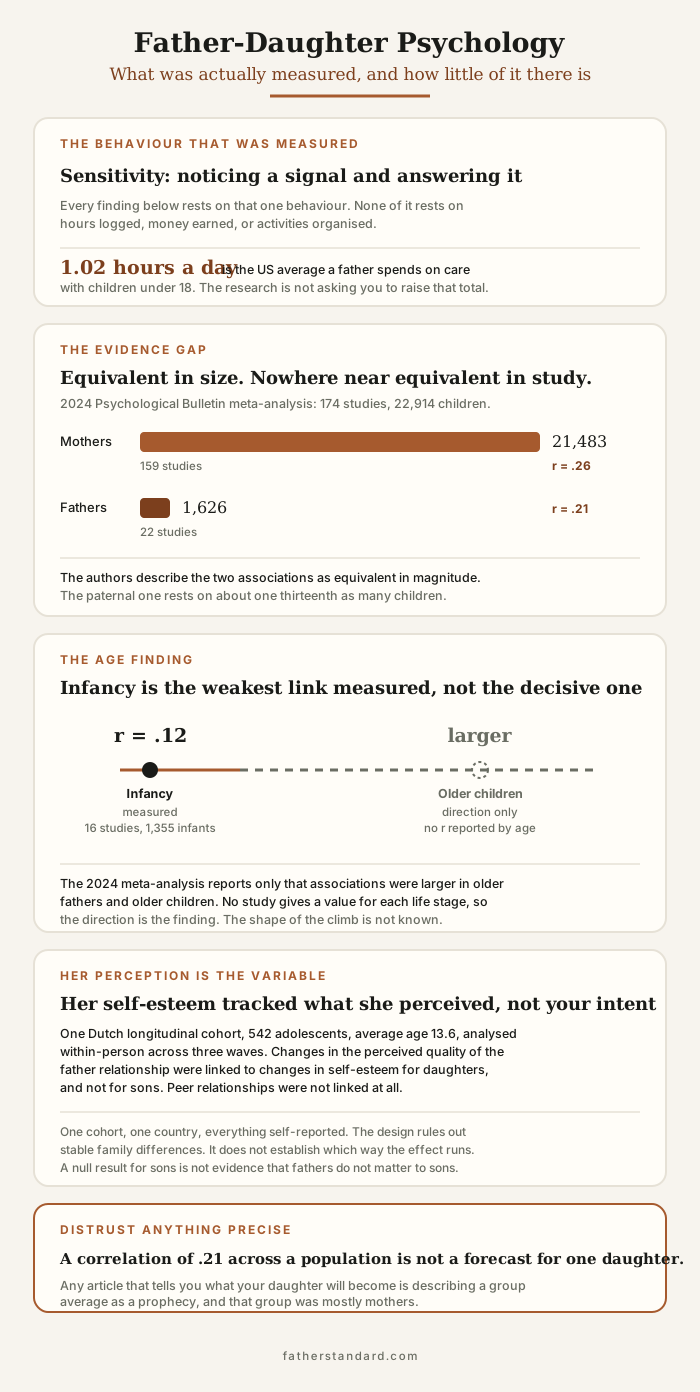
Split by parent, the numbers are the interesting part. Maternal sensitivity and child attachment security came out at r = .26, from 159 studies and 21,483 children. Paternal sensitivity came out at r = .21, from 22 studies and 1,626 children. The authors describe the two as equivalent in magnitude.
Read those sample sizes again. The father figure rests on roughly one thirteenth of the children and one seventh of the studies. The mechanism is not weaker in fathers. It has been looked at a fraction as often, with much wider uncertainty around the answer, which is why the confidence interval on the paternal figure is nearly twice as wide as the maternal one, .13 against .07.
This is the single most useful thing to hold on to when you read anything else in this field. Absence of research about fathers has repeatedly been reported as though it were research about fathers not mattering.
The finding about timing that almost nobody passes on
Here is where the evidence goes against the story most fathers have been told.
The common belief is that the bond is made early, that the first two or three years set it, and that a father who was absent or distracted then has already spent his window. The attachment literature on fathers does not support that.
An earlier meta-analysis in the Journal of Family Psychology examined paternal sensitivity and infant-father attachment security across three decades of studies. Pooling all available work, higher paternal sensitivity was associated with more infant-father attachment security at r = .12, from 16 studies and 1,355 infants. That is a weak association. The same paper found that fathers' sensitive play combined with stimulation was not more strongly linked to attachment security than sensitive interaction without it, and that the association had not strengthened in more recent years despite changing father roles.
Now set that beside the 2024 meta-analysis, which reported that for paternal sensitivity specifically, associations were larger in older fathers and older children.
Those two results point the same way. The link between what a father does and how securely his child is bonded to him appears to be weakest in infancy and stronger later. That is close to the opposite of the mother pattern that most parenting advice was built on, and it is the most quietly hopeful finding in this literature.
It does not mean the early years were unimportant. It means the evidence gives you no grounds for concluding that a father-daughter relationship is settled by age three, and some grounds for the reverse. A daughter is twenty six and has not called since spring. The research does not say that door closed in 2003. If you want the practical version of that argument, we covered it in what the father-daughter relationship asks of you at every age.
What changed in daughters when the father bond changed
The strongest daughter-specific finding we could locate is a Dutch longitudinal study in the Journal of Youth and Adolescence on perceived attachment quality and adolescents' self-esteem.
The design is what makes it worth your time. It used all three waves of a cohort of 542 adolescents, average age 13.6 at the first wave, roughly half female, and it analysed only within-person variation. That means it asked whether a change in one adolescent's perceived closeness to their father tracked a change in that same adolescent's self-esteem, which rules out stable differences between families as an explanation. It also controlled for the quality of the parents' own relationship and for peer relationships.
The result: changes in perceived quality of the father-adolescent attachment relationship were significantly linked to changes in self-esteem for daughters, and not for sons. Changes in the mother relationship were linked for both. Changes in peer relationships were not linked at all, which surprised the authors given how much time adolescents spend with friends.
Three honest limits before you carry that anywhere. It is one cohort in one country. Everything is self-reported, including the attachment measure, so it captures how the daughter perceived the relationship rather than what a camera would have recorded. And a null result for sons in one study is not evidence that fathers do not matter to sons' self-esteem.
What survives those limits is still worth having. In the study that was best designed to catch it, the thing that moved with a teenage daughter's sense of her own worth was her perception of her father, and it moved as it changed, not as it had been fixed years earlier.
The causal question, handled honestly
Almost every alarming statistic about daughters and absent fathers comes from correlational work, where families who differ in father involvement differ in many other ways at the same time.
One study went after that problem directly. Published in the Journal of Personality and Social Psychology, it tested the effects of paternal disengagement on women's sexual decision making across five experiments, using randomised assignment to eliminate the genetic and environmental confounds baked into observational studies. Reminders of paternal disengagement increased women's activation of sexual thoughts, increased sexual permissiveness, and increased negativity toward condom use. The effects were specific to sexual decision making rather than general risk taking.
That is a real contribution and it should not be oversold. The experiments primed a memory in a laboratory and measured a decision minutes later. They do not demonstrate that a distant father produces a particular adult life, and they do not license any prediction about a specific daughter. A prime is not a childhood. We take a fuller look at the observational side of this in the effect of an absent father on daughters.
Roughhousing, and a sample that surprises people
The folk version of father psychology is physical play, and it is usually assumed to be a father-and-son business.
A review and meta-analysis in Infant Mental Health Journal examined father-child rough and tumble play and child behaviour across 16 studies and 1,521 father-child dyads. It found weak to moderate population effects linking father-child physical play to child aggression, social competence, emotional skills and self-regulation. The authors were explicit that the field is held back by inconsistent definitions of what counts as physical play and by settings that do not let boisterous play happen.
The detail worth noticing is the sample. It was 35 percent boys. Nearly two thirds of the children in the physical play research on fathers were girls. Whatever this kind of play is doing, it was not measured as a thing fathers only do with sons.
| The claim you have read | What sits behind it | How far it actually goes |
|---|---|---|
| A father shapes his daughter's capacity for relationships | Attachment research, largely correlational, overwhelmingly conducted on mothers | Supported as a direction across groups. Carries no prediction about any individual daughter |
| The bond is set in the first few years | Infant meta-analysis, r = .12, 16 studies, 1,355 infants | Not supported. Infancy is the weakest link measured, and associations were larger in older fathers and children |
| Father absence causes daughters' early sexual behaviour | Five randomised lab experiments plus a large observational literature | Primes moved decisions minutes later in a lab. Life outcomes were not tested |
| Fathers matter mainly through roughhousing | Meta-analysis of 16 studies, 1,521 dyads | Weak to moderate effects, definitions inconsistent, and the sample was about two thirds girls |
| The father bond drives a teenage daughter's self-esteem | One Dutch cohort, 542 adolescents, within-person longitudinal design | Overstated. Changes in the two tracked each other for daughters and not sons in that cohort. The design rules out stable family differences but not which way the effect runs |
What a father should actually take from this
Four things follow from the evidence rather than from the commentary around it.
The measured behaviour is noticing, not providing. Every finding above rests on sensitivity, defined as reading a signal and answering it. None of it rests on hours logged, money earned, or activities organised. US fathers average 1.02 hours a day of care with children under 18, and Pew Research Center's summary of the American Time Use Survey data shows most of that is play and physical care, with about 0.05 hours a day spent reading with them. The research is not asking you to raise that total. It is asking whether the signals inside it get answered.
Her perception is the variable, not your intention. The self-esteem study measured perceived quality. What tracked her self-worth was what she perceived, which is the only version of you she has access to. This is the part fathers find hardest, and it is why guilt is such a poor instrument for reading your own fathering. Guilt reports on your standards. It has no channel to her experience.
Later is not too late, and that is a finding, not a comfort. The association between paternal sensitivity and attachment was weakest in infancy and larger in older fathers and children. Whatever you conclude about the years behind you, the evidence does not support treating them as final.
If you are the father of that twenty six year old, one practical point follows from all of this. Nothing in the research requires her to signal first. Sensitivity is measured as noticing a signal and answering it, so the move available to you is to make contact and then pay close attention to what comes back, including a short reply or no reply at all. That is the behaviour being measured. Waiting to be invited is not a neutral position, it just removes you from the measurement entirely. What that looks like week to week is set out on how to be a better father to your daughter.
Distrust anything precise. A correlation of .21 across a population is not a forecast for one daughter. Any article that tells you what your daughter will become because of what you did is describing a group average as though it were a prophecy, and the group it is describing was mostly mothers.
When this stops being psychology
Everything above is general information written for fathers, drawn from research on groups. It is not clinical guidance, it cannot assess your family, and it is not a substitute for a licensed professional who can.
If the distance between you and your daughter involves ongoing harm, coercion, or a pattern that leaves either of you unsafe, that is different territory and it is covered in what makes a father-daughter relationship unhealthy. If a daughter of any age has said anything about not wanting to be alive, or you are frightened for her, the 988 Suicide and Crisis Lifeline takes calls and texts around the clock in the US, 911 covers immediate danger, and a licensed professional needs to be involved rather than an article.
Father-daughter psychology in one picture
The mechanism, the evidence gap, and the direction of travel, in one view.
Test yourself
A few questions on what this research does and does not support, and on which claims outrun their evidence.
Key takeaways
Last reviewed by The Father Standard Editorial Team on August 19, 2026. Our sourcing and AI-use rules are public on the editorial standards page.
FAQ
What does psychology say about the father-daughter relationship?
The best supported finding is that sensitive caregiving, meaning noticing a daughter's signal and answering it, predicts a secure bond with her father at close to the same strength as it does with her mother. A 2024 meta-analysis in Psychological Bulletin put the paternal association at r = .21 against a maternal .26 and described them as equivalent. Most other claims you will read are several inferential steps further from the data than that one.
Does a father affect his daughter's self-esteem?
In the best designed study on this question, yes, and specifically for daughters. A Dutch longitudinal study of 542 adolescents analysed only within-person change and found that changes in the perceived quality of the father-adolescent attachment relationship were linked to changes in self-esteem for daughters, though not for sons. It is one cohort and everything was self-reported, so it should be held as a strong signal rather than a settled fact.
Is it too late to build a bond with my adult daughter?
The evidence gives no support to the idea that the relationship is fixed in early childhood. The association between paternal sensitivity and attachment security was weakest in infancy, at r = .12, and a 2024 meta-analysis found the paternal association was larger in older fathers and older children. That is the reverse of the pattern most fathers assume.
Does any of this apply to stepfathers and adoptive fathers?
The studies above did not report separate results for stepfathers or adoptive fathers, so no honest figure can be given for either group. What can be said is what the research actually measures. Sensitivity is defined as a behaviour, noticing a child's signal and answering it, and the 2024 pooled analysis was conducted across child and caregiver dyads rather than on biological relatedness. Nothing in the measurement depends on genetics. Treat the mechanism as plausible for any man doing the caregiving, and the precise numbers as untested for these groups.
Does rough and tumble play with a daughter matter?
Probably, though this is the shakiest evidence on the page, and the reason is methodological. Across 16 studies and 1,521 father-child dyads the measured effects were only weak to moderate, and the review's authors put part of that down to the field itself. Researchers do not agree on what counts as physical play, and the settings used often do not let boisterous play happen at all. A weak result here may reflect the measuring more than the playing. Worth knowing either way: about two thirds of the children in that research were girls, so this is not a father-and-son finding.
Sources
- caregiver sensitivity and child attachment security (pubmed.ncbi.nlm.nih.gov)
- paternal sensitivity and infant-father attachment security (pubmed.ncbi.nlm.nih.gov)
- perceived attachment quality and adolescents' self-esteem (pubmed.ncbi.nlm.nih.gov)
- the effects of paternal disengagement on women's sexual decision making (pubmed.ncbi.nlm.nih.gov)
- father-child rough and tumble play and child behaviour (pubmed.ncbi.nlm.nih.gov)
- Pew Research Center's summary of the American Time Use Survey data (pewresearch.org)