Christian Parenting of a Teenager: What Transfers, and What Only Looks Like It Does
Christian parenting of a teenager runs into one problem that almost nothing in church life prepares a father for: the two things you can see, attendance and behaviour, are the two things that transfer most easily and tell you least. The things you actually want, conviction and ownership, transfer far less reliably, and they are close to invisible from where you are standing. In a Pew Research Center survey of 1,811 teenagers each paired with one of their own parents, teens attended religious services at almost exactly the rate their parents did, while the share saying religion was very important in their lives ran at little more than half the parents' rate.
So the starting point is that your teenager showing up on Sunday is a fact about your household, not a reading on their faith. Those are separate quantities, and confusing them is how good fathers get blindsided at nineteen.
Four things are worth your time here: what the transmission evidence measures and what it refuses to measure, the gap you cannot read from inside your own house, why the most committed homes are not the ones with the highest transfer rates, and the short list of things that appear to be inside a father's control.
The short answer
Attendance transfers. Conviction does not transfer on its own. If you want the second one, the closest evidence available, which is a health study about family connectedness rather than a study about religion, points at the relationship carrying it rather than the requirement carrying it, and at your teenager being able to tell you the truth about where they actually are.
What the transmission data actually shows
The central source here is a Pew Research Center report published in September 2020, U.S. Teens Take After Their Parents Religiously. It surveyed 1,811 teenagers aged 13 to 17, each alongside one parent or legal guardian, online through the Ipsos KnowledgePanel between March 29 and April 14 of 2019. Its design is the reason it is worth more than the usual parenting survey: it asked the parent and the teenager the same questions separately, so it can measure the distance between what a parent believes about their child and what that child reports.
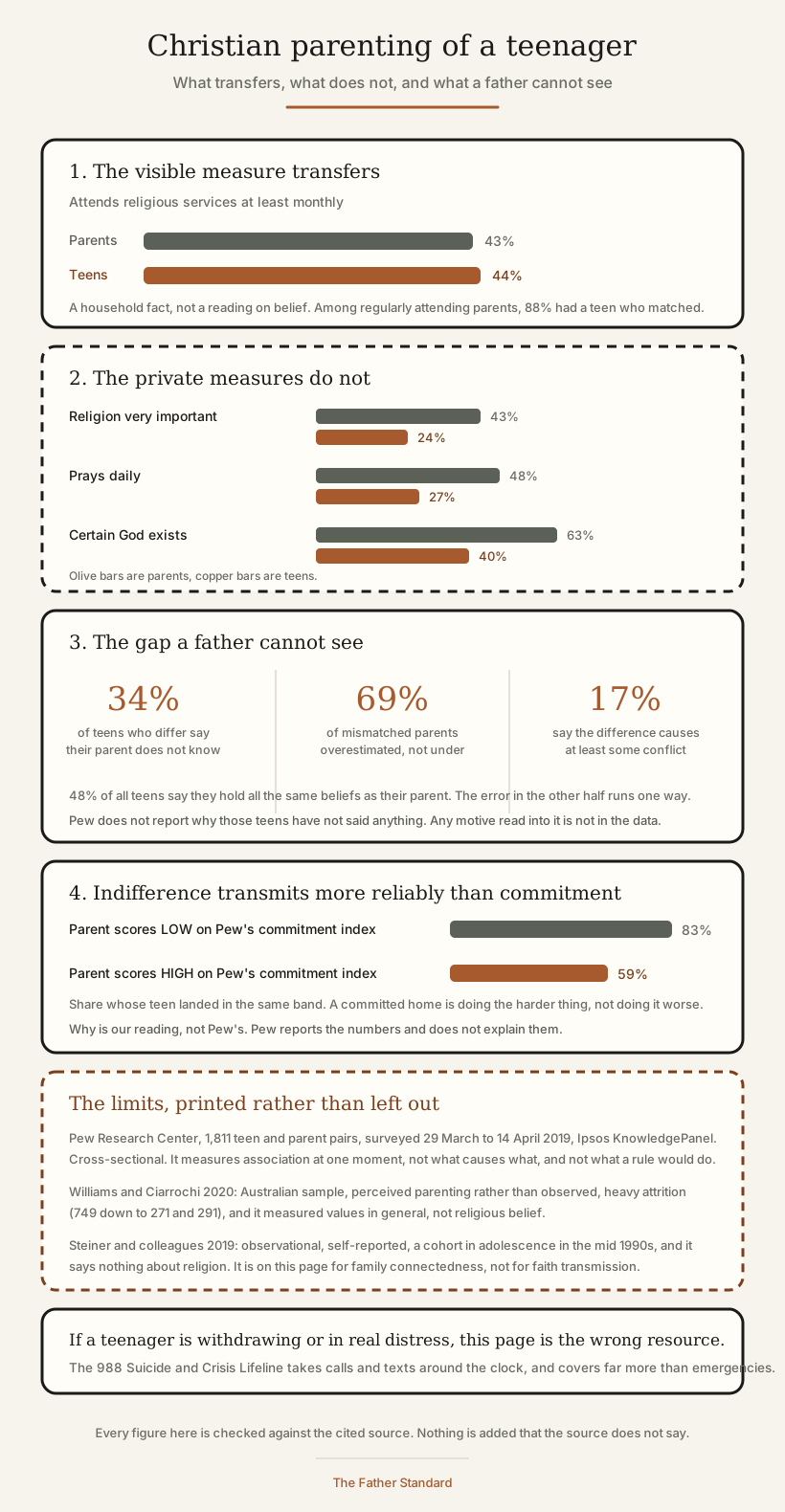
On the public measures, parents and teens track each other closely. Forty four percent of teens said they attend religious services at least monthly, against 43% of parents. Among parents who attend regularly, meaning once or twice a month or more, 88% had a teen reporting the same rate.
On the private measures, the two separate.
| Measure | Parents | Teens | What the gap is telling you |
|---|---|---|---|
| Attends religious services at least monthly | 43% | 44% | Attendance is a household fact. It moves with the family calendar and the car keys, not with belief. |
| Says religion is very important in their life | 43% | 24% | The thing you are actually trying to hand over arrives at roughly half the rate you hold it. |
| Prays daily | 48% | 27% | Private practice, done unobserved. The nearest available proxy for ownership rather than compliance. |
| Believes in God with absolute certainty | 63% | 40% | Belief itself is more common than certainty. Doubt at sixteen is ordinary, not defection. |
| Scores high on Pew's four-part religious commitment index | 48% | 34% | The composite lands between the public and private numbers, which is what you would expect if only one half is transferring. |
Read the first row against the second and you have the practical finding. If you are reading your teenager's faith off the fact that they are in the pew beside you, you are reading a number that is 43 against 44 and drawing a conclusion about a number that is 43 against 24.
Pew also notes that religious attendance declines in the final two years of high school, which is when much of the household constraint starts lifting. And it is careful about what any of this predicts. Pew's language here is a hedge rather than a finding: it says only that it is possible there is further movement away from these private, individual measures still ahead, after these adolescents reach adulthood, and it warns that its own results should be cautiously applied to the future of American religion. So a teenager still attending at seventeen is not evidence of a settled adult outcome in either direction.
The gap you cannot see from inside your own house
This is the part of the Pew report that should change how a Christian father runs a household.
About half the teens surveyed, 48%, said they hold all the same religious beliefs as their parent. Among the other half, the ones who said they share only some beliefs or hold quite different ones, about a third, 34%, said their parent does not know they differ. One in six, 17%, said the difference causes at least some conflict at home.
Then there is the direction of the error. Across all the pairs, 27% gave answers that did not line up on how much they hold in common, and most of those were cases where the parent assumed more agreement than the teenager reported. In 12% of all pairs, the parent said they share all the same beliefs and the teenager did not agree. On the separate question of how important religion is in the teenager's own life, among parents whose answer differed from their teen's, 69% were overestimating it and 29% underestimating.
So the error is not random. It runs in one direction. Parents of teenagers, as a group, read their children as more religious than those children report themselves to be.
That has a specific implication and it is worth stating plainly. If you are confident about where your teenager stands with God and you have not heard them say anything to the contrary recently, you are describing the exact profile the data associates most often with being wrong. Confidence and silence are what it looks like from the inside when a teenager has decided not to tell you.
None of that means your teenager is secretly gone. Half of these pairs matched. It means the reading is unreliable, and that the unreliability skews one way.
A note before going further. If the distance between you has moved past disagreement into your teenager withdrawing, refusing contact, or showing signs of real distress, that is different territory and this page is not the resource for it. In the United States the 988 Suicide and Crisis Lifeline takes calls and texts around the clock and covers far more than emergencies. A licensed adolescent therapist is the right call for anything persistent. Local crisis lines cover the same ground elsewhere.
Why the most committed homes do not have the highest transfer rates
Pew reports that 80% of parents who said religion is not too important or not at all important in their lives had a teen who felt the same way. Among parents who said religion is very important, 45% had a teen who took the same view.
The same pattern shows on the four-part commitment index. Among parents scoring low on it, 83% had a teen also scoring low. Among parents scoring high, 59% had a teen also scoring high, with another 32% landing in the middle.
Indifference transmits more reliably than commitment does.
Pew does not explain why, so here is a possible reason, and it is ours rather than theirs. Indifference asks nothing of a teenager. There is no position to take up, nothing to accept or refuse, and so nothing to push against. Commitment asks for something, and anything that asks can be declined. The transfer rate is lower because the thing being transferred is heavier, not because committed fathers are doing it worse.
What that reframes is the target. A committed home is attempting something structurally harder than a nonreligious home is attempting, rather than falling short of a 100% transfer rate, and 59% is the benchmark that reflects the difficulty, rather than the near-universal outcome that tends to get treated as the default expectation.
Evangelical Protestant homes are the highest-transfer group Pew could report on separately: 80% of parents affiliated with an evangelical denomination had a teen who identified the same way. Mainline Protestant parents were at 55%, with 24% having a teen who was religiously unaffiliated. Identifying, though, is the loosest measure in the set. It is closer to the attendance row of the table than the prayer row.
The obedience trap
Pew's chapter on what parents want for their teens contains two numbers that sit awkwardly together.
The first: religiously affiliated parents were twice as likely as unaffiliated parents to say it is very important that their teenager is obedient, 61% against 30%.
The second, from the same chapter: among those same affiliated parents, 90% said it is very important that their teen works hard and 73% said it is very important that their teen goes to college, while 55% said it is very important that their teen is raised in their religion. Among evangelical Protestant parents specifically the religious figure rose to 71%, with Catholic parents at 51% and mainline Protestant parents at 34%.
Put those together and a pattern shows up in the ranking itself: obedience is prioritised heavily, and the faith itself ranks below college on the very important list.
The obedience number is the one worth sitting with, because there is peer-reviewed work suggesting it may cut against the outcome it is meant to serve. A longitudinal study by Williams and Ciarrochi published in the Journal of Research on Adolescence in 2020, Perceived Parenting Styles and Values Development, followed students from Grade 7 through one year after school and looked at how parenting style related to the way values were later held. Two of its findings are directly relevant here.
Authoritarian parenting in Grade 12 predicted more controlled regulation of values after school, meaning values held because of external pressure rather than because the young person had taken them on as their own. And fathers' authoritative parenting in Grade 7, the warm-plus-structured style rather than the demanding-without-warmth one, predicted decreased importance of extrinsic values, meaning money, image and status carried less weight later.
The limits matter and we will not overstate this. It is an Australian sample. It measured parenting as the young people perceived it, not as observed behaviour. It lost a lot of participants between waves, from 749 in Grade 7 to 271 and 291 at the two values measurements. And it looked at values in general, not religious belief specifically. It does not establish that authoritarian parenting drives teenagers out of the church.
What it does support is narrower and still useful. Pressure in late adolescence was associated with values that were held under external control rather than owned. If what you want is a son or daughter who holds the faith when nobody is checking, that is precisely the mechanism you cannot afford to be running.
What appears to be inside your control
The one thing with strong quantitative support behind it is the relationship the doctrine travels through, rather than the doctrine itself.
Steiner and colleagues, in Adolescent Connectedness and Adult Health Outcomes published in Pediatrics in 2019, analysed 14,800 people across Waves I and IV of the National Longitudinal Study of Adolescent to Adult Health. Compared with people who scored low on both, those with high levels of both family and school connectedness in adolescence had 48% to 66% lower odds of the adult health risk behaviours and experiences measured, depending on the outcome. Family connectedness on its own showed protective associations with emotional distress, every violence indicator including intimate partner violence, multiple sex partners, sexually transmitted infection diagnosis and both substance use measures.
This is observational and self-reported, so it establishes association rather than cause, and it says nothing about religion. The cohort was in adolescence in the mid 1990s and in adulthood by the late 2000s, so it speaks most directly to that generation rather than to today's teenagers. It is included here because it is the strongest evidence on this page about anything a father directly influences, and because the mechanism a Christian father cares about runs straight through it. Whatever you are hoping to hand on travels along the relationship. There is no second channel for it.
| What most fathers reach for | What it actually buys | The move the evidence points at instead |
|---|---|---|
| Tightening attendance rules | Attendance, which was already tracking yours at 44% against 43%. It moves the number you can already see. | Keep the attendance expectation if it is your house rule, and stop reading belief off it. Ask directly instead, and be able to hear the answer. |
| Winning the argument about doubt | Silence. A third of teens who differ already have not told their parent. Winning raises the cost of telling you. | Make disagreement survivable at your table. The teenager who can say "I do not think I believe this" is the one you still have a conversation with at twenty. |
| Prioritising obedience | Compliance while they live under your roof. Authoritarian parenting in Grade 12 predicted values held under external control, not owned. | Warmth plus structure rather than demand without warmth. Fathers' authoritative parenting in Grade 7 predicted extrinsic values mattering less later. |
| More programme, more youth group, more content | Two thirds of teens already say they take part partly or mostly because their parents want them to. Volume does not change ownership. | Family practice they are not being marched to. Fifty nine percent of teens talk about religion with family at least sometimes, and Pew reports that about three quarters of the teens who do religious things with their family get a lot of enjoyment from it (27%) or some (51%). |
| Assuming it is fine because nothing has been said | The exact profile the data flags. Sixty nine percent of mismatched parents overestimated their teen's religiosity. | Treat silence as unread rather than as agreement. Ask a question you do not already know the answer to, roughly twice a year. |
None of this is a technique for producing belief, and a father who decides he has found the lever here is going to do damage with it. What these numbers point at is narrower: you can influence whether your teenager can tell you the truth, and whether the relationship survives the disagreement. Those are the two things still in your hands at fifteen.
What to do when your teenager says they do not believe it anymore
Take it as information rather than as a verdict. Pew found 40% of teens believe in God with absolute certainty against 63% of parents, and its own framing notes that religion tends to vary across the life course, often falling in late adolescence and early adulthood and rising again later as people age and form their own families. A seventeen-year-old's position is a reading at seventeen.
Say the thing that keeps the door open, and mean it, because a teenager can hear the difference. Something close to: I would rather know where you actually are than be told what I want to hear. If you are somewhere else on this, we are still fine.
Then hold to it, which is the hard half. The 34% who have not told their parent are not silent because they lack words. They are silent because they have run the calculation on what telling would cost. Every reaction you have to the small disagreements sets the price on the large one.
If you are already further down this road, and the silence in your house is broader than religion, the mechanics of coming back are covered in how to reconnect with your teenage son and the wider shift in the job is in teenager parenting. For the general problem of sorting parenting advice that works from advice that backfires, parenting teenager advice covers the test we apply.
Where this leaves a father
A Christian father parenting a teenager is doing something the data says is genuinely hard, at a transfer rate closer to 59% than to certainty, in a house where the visible signals are the least informative ones and where the errors run toward false reassurance.
What is available to him is a relationship strong enough that his teenager tells him the truth, and steady enough that the truth does not end it, rather than a guarantee. On the evidence here, that is both the most a father controls and the thing most likely to matter.
Christian parenting of a teenager in one picture
Test yourself
Five checks on what the Pew survey and the two studies above actually establish, and on where the familiar claims about raising a teenager in the faith run past them.
Key takeaways
Last reviewed by The Father Standard Editorial Team on August 27, 2026. Our sourcing and AI-use rules are public on the editorial standards page.
FAQ
How do I know if my Christian teenager still believes?
You largely cannot tell by observation, and that is the finding rather than a failure on your part. Pew's 2019 survey of 1,811 teen and parent pairs found teens attending religious services at 44% against their parents' 43%, while saying religion is very important in their lives at 24% against parents' 43%. The visible measure and the internal one move independently. Among parents whose answer about their teen's religiosity did not match the teen's own answer, 69% were overestimating it. Asking directly, in a conversation where an honest answer is safe, is the only reliable method available to you.
Do Christian parents usually know whether their teenager shares their faith?
Often not, and the error runs in one direction. In the Pew survey 48% of teens said they hold all the same religious beliefs as their parent, and among the rest about a third, 34%, said their parent does not know they differ. Across all the parent and teen pairs, 27% gave answers that did not line up, and most of those were cases where the parent assumed more agreement than the teenager reported. On how important religion is in the teenager's own life, among parents whose answer differed from their teen's, 69% were overestimating it and 29% underestimating. Half the pairs did match, so this is not a claim your teenager has quietly left. It is a claim that the reading is unreliable and skews one way.
Why is my teenager pulling away from church?
Some of it is developmental rather than personal. Pew notes that religious attendance declines in the final two years of high school, and that much of the movement away from religion in previous research happens after young people leave home and gain independence. Its data also shows two thirds of teens who take part in family religious activities say they do so partly or mostly because their parents want them to, so the participation you have been seeing may have been household compliance for some time. That is not the same as your teenager rejecting you.
Does strict Christian parenting make teenagers leave the faith?
The evidence does not support a claim that strong. What it supports is narrower. Williams and Ciarrochi's 2020 longitudinal study in the Journal of Research on Adolescence found authoritarian parenting in Grade 12 predicted more controlled regulation of values after school, meaning values held because of external pressure rather than genuinely owned. That study was Australian, relied on perceived parenting, lost most of its sample between waves, and measured values in general rather than religious belief. Read it as a caution about pressure in late adolescence producing compliance rather than ownership, not as proof about church attendance.
Should I make my teenager go to church?
The evidence cannot answer that for your household, and any source claiming otherwise is going beyond what exists. What it can tell you is what the requirement does and does not achieve. Pew did not test what imposing a rule does. What it measured is that a teenager's attendance already tracks a parent's attendance closely as a household fact, and the reading that a rule is therefore likely to produce the behaviour is ours rather than something Pew demonstrated. It will not produce the conviction, which runs at roughly half the parental rate regardless. If you keep the rule, keep it as a household expectation you can defend on its own terms, and stop treating compliance with it as evidence about belief.
My teenager and I disagree about religion and it is causing fights. Is that normal?
It is common. In Pew's survey, among the roughly half of teens who said they share only some beliefs with their parent or hold quite different ones, 17% said the difference causes at least some conflict in the household. A third of that same group, 34%, said their parent does not even know they differ, which suggests the households with open conflict are not the worst-case ones. A disagreement you are having out loud is a disagreement you still have access to.
Do fathers transmit faith less effectively than mothers?
Pew found essentially no difference on its main alignment measure. Among teens whose mother took the survey, 47% said they share all of her religious beliefs. Among teens whose father took it, 50% said the same about him. Pew notes previous research showing mothers tend to be more involved in children's religious upbringing, which would predict a gap, and the gap did not appear in this measure.
What actually helps, if not more religious activity?
The strongest evidence on this page concerns the relationship rather than the programme. Steiner and colleagues, analysing 14,800 people in the Add Health cohort for Pediatrics in 2019, found adolescents high on both family and school connectedness had 48% to 66% lower odds of a range of adult health risk outcomes compared with those low on both. That work is observational and says nothing about religion, so treat it as a reason to protect the relationship rather than as proof about faith. It remains the clearest signal available about something a father directly influences.
Sources
- U.S. Teens Take After Their Parents Religiously (pewresearch.org)
- 988 Suicide and Crisis Lifeline (988lifeline.org)
- chapter on what parents want for their teens (pewresearch.org)
- Perceived Parenting Styles and Values Development (pubmed.ncbi.nlm.nih.gov)
- Adolescent Connectedness and Adult Health Outcomes (pubmed.ncbi.nlm.nih.gov)