Parenting Teenager Advice: How to Tell What Works From What Backfires
The most intuitive piece of parenting advice for a struggling teenager, the one that says get tough, show him where this road ends, scare him straight, has been put through nine separate randomized trials. It does not work. It comes out worse than doing nothing. That finding is the reason a father needs a filter rather than a bigger stack of tips, because advice that feels obviously right is exactly the kind that has never been checked.
Advice about your teenager is the one commodity nobody has ever been short of. Your father has a view. Your brother in law has a view, delivered louder. There is a book on the shelf, a podcast in the car, a man in a comment section who has never met your kid explaining exactly what your kid needs. The confidence is total. The evidence behind it, most of the time, is nothing at all.
What follows is that filter: four questions to run any piece of advice through, the two categories that fail hardest under evidence, the small set that holds up, and an honest note about where studies stop being useful and your particular kid begins.
Why most teenager advice fails a father before you even try it
Three things go wrong with the advice a father gets, and they go wrong before the advice ever meets your kid.
The first is that most of it was built for younger children and never re-tested on adolescents. Sticker charts, time outs, the firm consistent hand, the whole apparatus of early childhood discipline gets ported upward with the ages filed off. A seven year old and a fifteen year old are not the same problem. One is learning that rules exist. The other is doing the developmental job of building an identity that holds up on its own, and shoving back at your authority is how that job gets done, not a glitch in it. Advice that ignores that difference is not neutral, it aims at the exact thing the kid is built to resist.
The second is that almost all of it optimizes for compliance. Did he do what you said. Did the room get cleaned, the phone go away, the tone change. Compliance is easy to measure and easy to sell, so that is what advice targets. The thing that actually predicts how this goes, whether the channel between you stays open, is slower and harder to see, and no one sells a technique for it. A father can win every compliance battle in a given year and end it with a kid who tells him nothing.
The third is inheritance. Most of us are running a default handed down rather than anything chosen, and fathers do this more than mothers do. Asked how they are raising their kids, 47% of fathers say they are doing it in a similar way to how they were raised, against 40% saying differently, while mothers split the other way at 48% differently and 40% similar. Your father's method is not advice you evaluated. It is advice you absorbed, and it arrives feeling like instinct rather than like a claim that could be wrong.
The four questions to run any advice through
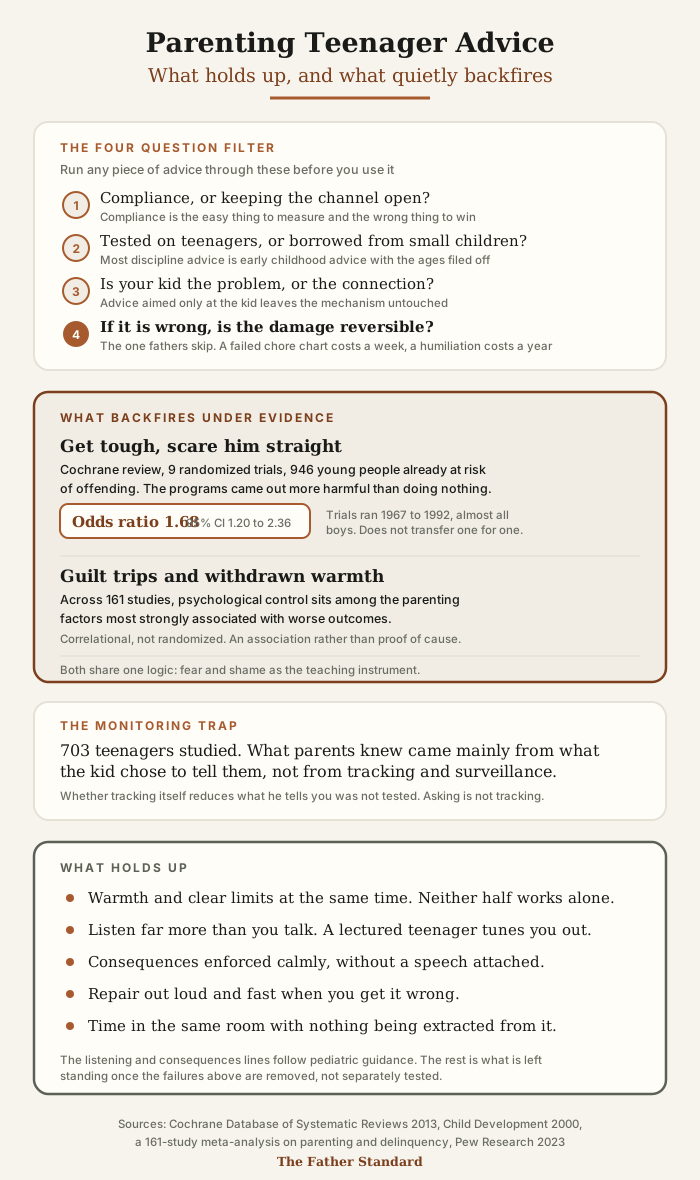
Before you take a piece of advice about your teenager, put it through these four.
It takes a few seconds to run, and it will disqualify a good share of what you hear, starting with the advice that sounds most obviously right.
Question four is the one fathers skip, and it is the one that matters most. Parenting advice is not risk free. A chore chart that fails costs you a week. A confrontation that humiliates your kid in front of people costs you a year of him telling you anything true.
The advice that backfires hardest: get tough and shock him out of it
No other piece of teenager advice has been tested this hard, and none has failed this badly.
Programs built on the get-tough logic, the organized prison visits where young people at risk are confronted with inmates and prison conditions to deter them from that path, were reviewed by Cochrane across nine randomized trials covering 946 young people. The meta-analysis of the seven trials with usable offending data found the intervention more harmful than doing nothing, with an odds ratio of 1.68 for later offending under the fixed-effect model, 95% confidence interval 1.20 to 2.36, and 1.72 under the random-effects model, 95% confidence interval 1.13 to 2.62. The result survived sensitivity analysis when the weaker studies were removed. The authors concluded plainly that these programs increase delinquency relative to doing nothing at all, and that they could not recommend the approach.
Sit with the shape of that result. Not that it failed to help. That the young people who got the intervention did worse than the ones nobody touched.
Now the limits, because they matter. That is a formal program rather than a father at a kitchen table, and the trials studied at-risk youth and offending rather than a normal teenager and a messy room. The samples were almost entirely boys, average ages 15 to 17, and the trials themselves ran between 1967 and 1992 in the US, which makes the underlying research both dated and narrower than the advice it gets used to knock down. The transfer is not one for one. What does transfer is the underlying logic, because it is the same logic: if he sees how bad it gets, he will straighten out. Fear as a teaching instrument. It is the most confidently delivered advice a worried father receives, usually from another man, and when someone actually ran the trials it came out on the wrong side of zero. The kind of confrontation that is meant to shame a teenager into changing tends to arrive as an attack, and a kid under attack defends himself rather than updates.
The softer household version follows a similar pattern, though the evidence behind it is a weaker kind. Pooling 161 studies of parenting and delinquency put guilt-driven, pressure-driven control, what psychologists file under psychological control, near the top of the parenting variables associated with poorer outcomes, ranking alongside a parent who has little idea what their kid is up to. That body of work is correlational rather than randomized, so it shows the association without proving the guilt trip causes the outcome, and some of it could run the other way, with a kid already in trouble drawing more pressure out of his parents. Guilt trips and withheld affection are still the kitchen-table cousin of the prison visit, and they deserve the same suspicion.
The second backfire: monitor him harder
The other advice a father hears constantly is to keep closer track. Check the phone. Know the passwords. Know where he is at all times. It sounds like diligence, and the researchers below open by acknowledging the same thing: well-monitored young people do turn up less involved in delinquency across a large body of work. That is the reason the advice refuses to die.
Then somebody checked where the monitoring actually comes from. In a study of 703 fourteen year olds and their parents, the researchers separated what parents knew from how they came to know it, something the earlier measures had never done. Parental knowledge came mainly from the kid choosing to tell them. That voluntary disclosure, rather than the parent's own tracking and surveillance, was the source of knowledge most closely tied to lower delinquency, and the pattern held for both sexes and regardless of whether the kid was already in trouble. The authors' conclusion was direct: tracking and surveillance is not the best prescription for parental behavior.
The practical translation for a father is uncomfortable and useful, and it needs one honest limit attached. The study measured where parents' knowledge came from. It did not test what happens to a kid's openness after a father starts checking his phone, so anyone telling you surveillance provably destroys disclosure is going further than this research goes. What it does show is narrower and still worth acting on: the tracking was not the part carrying the protective link. The disclosure was. Every unannounced phone check buys you one snapshot, and it is reasonable to suspect it costs something from the channel that was doing the real work, while noting that the trade-off itself has not been measured. Knowing where he is matters, and asking him is a different act from tracking him.
What actually holds up
The surviving advice is short and unglamorous. Nobody builds a seminar around it.
One honest note before the list, because this article has spent three sections telling you to ask whether a thing was actually tested. Two items below are tied to the pediatric guidance cited underneath them. The rest are not separately tested here. They are what is left standing once the failures are removed, and they follow the same logic already laid out: if the open channel is the thing doing the protective work, these are the moves that keep it open. Worth knowing which is which before you lean hard on any one of them.
Warmth and clear limits held at the same time, rather than traded against each other. This is the position left over after the eliminations. Fear on its own made things worse, and guilt-driven pressure on its own made things worse, which leaves warmth paired with a real limit as the one still standing. The kid knows the line is real and knows you are on his side. Neither half works alone.
Listening far more than you talk. Pediatric guidance is consistent that a teenager who gets lectured tunes you out, and that doing more listening than talking is the move that keeps a conversation alive. A lot of fathers hold more of the airtime than they think they do.
Consequences that are enforced calmly rather than delivered hot, and that stay proportional. Discipline works as teaching rather than as punishment, and the version that teaches is the one that arrives without a speech attached.
Repair after you get it wrong, out loud and quickly. No study on this page tests that one. It follows the same logic carried a step further: if the channel is what protects him, the fastest way to reopen it after you have shut it is to name it plainly, something as ordinary as telling him you came in too hot and that was yours, not his.
Time in the same room with nothing being extracted from it. Presence rather than management, which is the whole difference between being present and merely providing.
One more piece of advice deserves a straight answer here, because a father with a quiet kid hears it constantly: he will come to you when he is ready. Waiting is not nothing, but it is not a plan either. The disclosure finding above points the other way, since what a teenager tells you depends on there being somewhere easy to tell it, and building that is your job rather than something to sit out. A standing low-pressure slot that does not depend on his mood does more than a scheduled conversation about the relationship ever will.
None of that is new and none of it is clever. It is the same foundation sitting under the way the job itself changes once your kid hits adolescence, and it is the yardstick any packaged method deserves to be measured against.
The advice table
The common advice, sorted.
The column on the right says what actually backs each verdict, so you can see which calls rest on a study and which are editorial judgment.
| The advice | Verdict | What backs the verdict |
|---|---|---|
| Get tough, show him where this ends, scare him straight | Drop | Nine randomized trials, at-risk youth: the confrontation model came out more harmful than doing nothing, and the review concluded it increases delinquency |
| Guilt him into it, withdraw warmth until he changes | Drop | A 161-study meta-analysis puts psychological control among the factors most strongly associated with worse outcomes. Correlational, not randomized |
| Check his phone, track him, know everything | Adapt | In the 703-teenager study, disclosure rather than tracking was the source carrying the protective link. Whether tracking itself reduces disclosure was not tested |
| Be consistent and firm | Keep, with a caveat | Editorial judgment by elimination: firm limits are not what failed in either study above, but firmness stripped of warmth is the half that backfires |
| Do more listening than talking | Keep | Pediatric guidance is explicit that lecturing gets tuned out |
| Give him choices instead of commands | Keep | Not tested in the studies above. Editorial judgment: a real choice inside a firm limit removes the fight without removing the limit |
| He will come to you when he is ready | Drop | Not tested directly. Editorial judgment, pointed the same way as the disclosure finding: waiting with no format and no opening is passive rather than patient |
| Treat him like an adult now | Adapt | Not tested in the studies above. Editorial judgment: more say yes, full autonomy on safety items no. Judgment arrives later than independence does |
| Just spend time together, no agenda | Keep | Not tested on its own. It is the plainest form of the presence the disclosure research points toward |
Where advice stops and your kid starts
Every study on this page is an average. Averages tell you which direction to lean, and they cannot tell you about the specific fifteen year old in your house, who has a temperament, a history, and a set of things going on that no researcher measured.
So run the evidence as a filter on the obviously bad advice, which is what it is genuinely good for, then treat the rest as an experiment with one participant. Try a thing. Watch whether the channel opens or closes over a few weeks rather than a few hours. Teenagers respond on a delay, and judging a change by tonight's reaction will point you the wrong way almost every time.
Be especially skeptical of advice that arrives with certainty about a kid the adviser has never met. The confidence in parenting advice tends to run inversely to the evidence behind it, and a father who has run one child through adolescence has a sample size of one, same as you.
If the advice you are looking for is really about a door that is already shut, that is a different problem than a discipline problem, and the way back with a teenage son runs through format and shared activity rather than technique. If you are weighing one specific packaged method, the honest sort of what Love and Logic keeps and drops for a teenager is worked through separately. If the method you are weighing comes wrapped in a set of beliefs rather than a brand, what Christian parenting advice for a teenager keeps and what it borrows from the general evidence is sorted the same way.
Everything above is general information written for fathers. It is not clinical guidance and it is not a crisis resource. Where a teenager is at risk of harm, or has said anything about not wanting to be alive, the 988 Suicide and Crisis Lifeline takes calls and texts around the clock in the US, 911 covers immediate danger, and a licensed professional needs to be involved. No article can assess a young person it has never met, and that includes this one.
The whole filter in one picture
The whole filter on one page: the four questions, the advice that backfires under evidence, and the short list that holds up.
Test yourself
Five situations to sort: separating a compliance win from a relationship win, catching the get-tough logic when it shows up wearing friendlier clothes, and judging the point at which knowing where your son is turns into surveillance. Each answer lays out the reasoning behind it, which makes a wrong guess the more useful outcome.
Key takeaways
Last reviewed on August 14, 2026 by The Father Standard Editorial Team. How we select sources, and how we use AI, is documented in full on our editorial standards page.
FAQ
What is the best parenting advice for a teenager?
The short list that survives evidence is unglamorous: hold warmth and clear limits at the same time rather than trading one for the other, listen considerably more than you talk, enforce consequences calmly and proportionally instead of delivering them hot, repair out loud and fast when you get it wrong, and spend time in the same room without extracting anything from it. Everything else is a technique layered on top of those, and a technique without them underneath does not hold.
Does tough love work with teenagers?
The formal version of it has been tested and came out worse than doing nothing. A Cochrane review of nine randomized trials covering 946 young people, almost all boys already at risk of offending, found that get-tough prison visit programs were more harmful than no intervention, with the authors concluding the approach increases delinquency rather than deterring it. Those trials ran on at-risk youth between 1967 and 1992, not on an average teenager, so the finding does not transfer one for one. What does carry over is the logic underneath it, fear as the teaching instrument, which is the same thing a worried father reaches for at home. The household version, guilt trips and withdrawn warmth, shows up in a separate 161-study meta-analysis among the parenting factors most strongly associated with worse outcomes, though that evidence is correlational rather than randomized. Firm limits are not the problem and they hold up well. Fear and shame as the teaching instrument are the problem.
Should I check my teenager's phone?
Knowing what is going on in your kid's life is protective, but the research on where that knowledge comes from complicates the obvious answer. In a study of 703 fourteen year olds, what parents knew came mainly from what their kids voluntarily told them, and it was that disclosure, rather than the parents' own tracking and surveillance, that carried the link to lower delinquency. The authors concluded surveillance is not the best prescription for parents. One limit worth stating: the study did not test whether checking a phone reduces how much a kid tells you, only that tracking was not the source doing the protective work. So treat covert phone checking with caution rather than as a proven mistake. It buys one snapshot, and plausibly costs something from the openness that mattered more, which is a trade nobody has actually measured. Clear, stated expectations about devices are a different thing from secret monitoring.
Why does most parenting advice not work for teenagers?
Three reasons. Most of it was designed for younger children and carried upward without being re-tested on adolescents, which matters because a teenager pushing against your control is doing developmental work rather than malfunctioning. Most of it targets compliance, which is easy to measure and sell, while the thing that predicts the outcome is whether the channel between you stays open. And a lot of what feels like instinct is inherited rather than chosen, with 47% of fathers saying they are raising their kids similarly to how they were raised.
How do I know if a piece of parenting advice is any good?
Run it through four questions. Does it aim at compliance or at keeping the channel open. Was it tested on teenagers or borrowed from younger children. Does it treat your kid as the problem or the connection between you. And what happens if it is wrong, meaning is the damage reversible. Advice that fails the fourth question deserves the most caution, because a failed chore system costs a week and a humiliated teenager costs considerably longer.
My teenager will not talk to me. What advice actually helps?
That is a connection problem rather than a discipline problem, and discipline advice applied to it usually makes it worse. Silence from a teenager is developmental far more often than it is personal. What reopens the line is low-pressure format, shoulder to shoulder activity, and a recurring slot that does not depend on him being in the mood, rather than a big conversation about the relationship. Judge whether it is working over weeks, not over one evening, because teenagers disclose on a delay.
Is it too late to change how I parent my teenager?
No. What tells a kid the relationship is durable is that you named the mistake and came back, not that you never made one. That claim does not come with a citation the way the earlier findings do. It follows the same channel-over-compliance logic running through the rest of this article. Changing course in the middle of adolescence and saying so out loud is one of the more direct moves available to a father, and it models the thing you are asking him to learn. Expect the response to lag the change by weeks.
Sources
- 47% of fathers say they are doing it in a similar way to how they were raised, against 40% saying differently, while mothers split the other way at 48% differently and 40% similar (pewresearch.org)
- Cochrane across nine randomized trials covering 946 young people (pubmed.ncbi.nlm.nih.gov)
- 161 studies of parenting and delinquency (pubmed.ncbi.nlm.nih.gov)
- 703 fourteen year olds and their parents (pubmed.ncbi.nlm.nih.gov)
- a teenager who gets lectured tunes you out (healthychildren.org)
- Discipline works as teaching rather than as punishment (healthychildren.org)