Parenting a Teenager With ADD: The Quiet Presentation Is Not the Mild One
If you are parenting a teenager with ADD, the most useful fact on this page is that the assumption buried inside the word is wrong. ADD stopped being a diagnostic term in 1994. What survived is the idea underneath it, that a child who is not bouncing off the walls has the gentler version of the same condition. A study of 5,059 children found the opposite pattern on the one trait fathers assume the quiet presentation lacks.
The word matters because of how it gets used at home. A father says his son or his daughter has ADD and means something specific by it: not disruptive, not in trouble, just somewhere else. The teacher says dreamy. The report card says not applying themselves. Nobody is alarmed, and the lack of alarm is the part worth looking at.
What follows is where the term came from, what the current criteria actually contain, the finding that reverses the assumption, and the part of this that changes what a father does on a Tuesday evening.
Where to start
Stop using the word as a severity rating. If you have been saying ADD to mean the mild kind, replace it in your own head with the question the clinical criteria actually ask, which is not how loud your teenager is but how much the inattention costs them across more than one setting. Then look at the one thing this article says you are probably not looking at, which is impulse control in a kid nobody has ever called impulsive.
Calibrate the rest of what follows honestly. The central study here measured children who were 9 and 10 at baseline, not fifteen-year-olds, and it is an association study rather than an experiment. Treat it as a reason to watch more closely, not as grounds to diagnose your own child from the kitchen table.
The word was retired in 1994, and the history explains your teenager
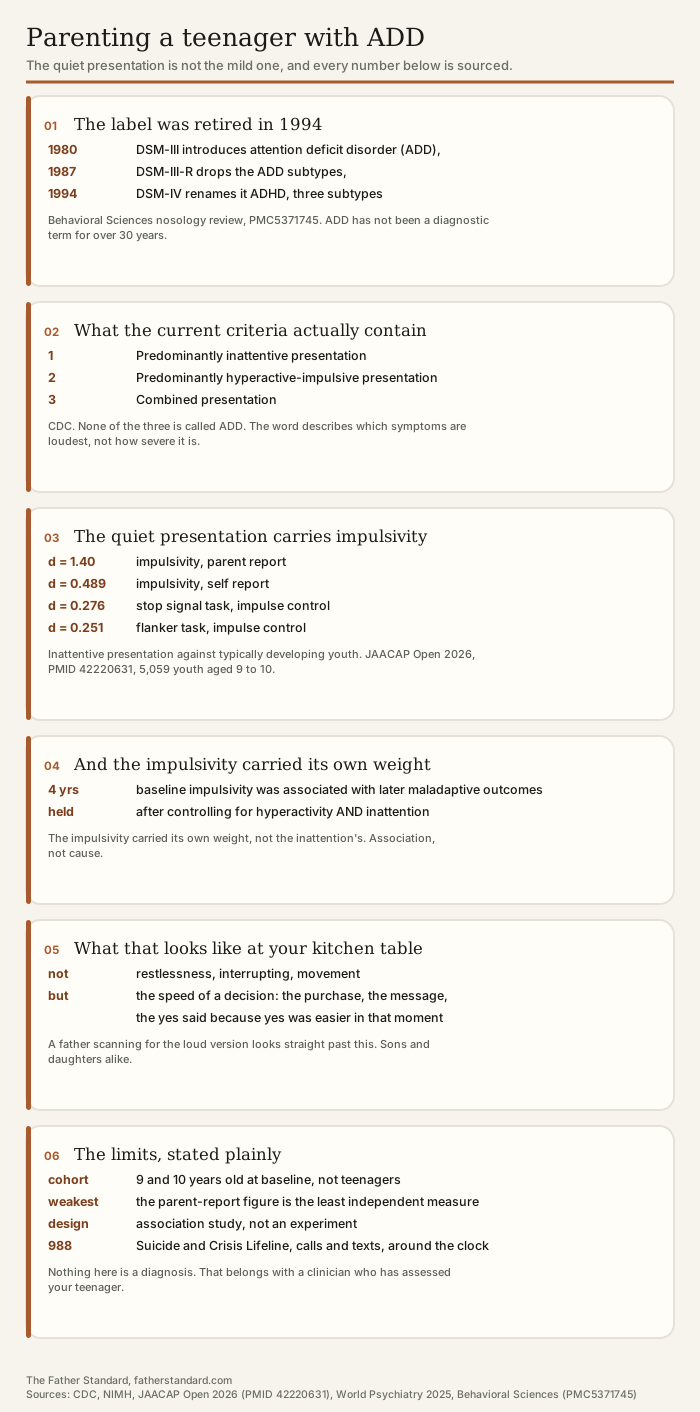
The term entered clinical use in 1980. A review of diagnostic nomenclature in the journal Behavioral Sciences, indexed as PMC5371745, records that "the term attention deficit disorder (ADD) with or without hyperactivity was introduced in the third version of the DSM," with an age-of-onset requirement before age seven.
Seven years later the picture changed. The same review records that the revision of that edition, the DSM-III-R, "dropped the subtypes of ADD due to lack of empirical evidence for the subtypes." Then in 1994 the fourth edition made the change that still stands: "DSM III's ADD was renamed attention-deficit/hyperactivity disorder (ADHD) and was divided into inattentive, hyperactive, and combined subtypes."
So the word a father uses in 2026 is the 1980 label for a category that was reorganised twice before most of today's teenagers were born. The Centers for Disease Control and Prevention describes ADHD in three current presentations. ADD is not among them:
| What the current criteria call it | What it looks like from across the kitchen | What a father usually calls it |
|---|---|---|
| Predominantly inattentive presentation | Drifting, losing things, unfinished tasks, quiet | ADD, or lazy |
| Predominantly hyperactive-impulsive presentation | Restless, interrupting, cannot sit through dinner | Proper ADHD |
| Combined presentation | Both patterns together | ADHD |
Look at the middle column. The word ADD carries a claim about severity that the criteria never made: it described which symptoms were loudest, and a father hears it as how bad the condition is.
The quiet presentation carries impulsivity too
A 2026 study in JAACAP Open, indexed as PMID 42220631, examined impulsivity across all ADHD subtypes using 5,059 young people from the Adolescent Brain Cognitive Development study, all with complete diagnostic and symptom data, all aged 9 to 10 at baseline, with outcomes tracked over four years.
The authors set out to fill a specific gap, which they state plainly: "relatively little is known about how impulsivity manifests among children with the ADHD primarily inattentive presentation." Their result runs against the assumption in the word ADD.
Youth with the inattentive presentation showed elevated impulsivity compared with typically developing youth, on every measure the study used:
| Measure | Effect size | 95 percent confidence interval |
|---|---|---|
| Impulsivity, self-report | d = 0.489 | 0.40 to 0.58 |
| Impulsivity, parent report | d = 1.40 | 1.31 to 1.50 |
| Flanker task, impulse control | d = -0.251 | -0.35 to -0.16 |
| Stop signal task, impulse control | d = -0.276 | -0.38 to -0.17 |
Read the chart honestly, because the two colours are not equivalent evidence. The largest number on it, the parent-report gap, is the one a father should trust least on its own, since the same parent who reports the impulsivity also lives with the inattention and cannot be blind to it. The two task-based measures are smaller and more independent. They still point the same direction.
The authors' own conclusion is the sentence to keep: "Impulsivity symptoms among youth with the inattentive ADHD presentation are higher than traditionally conceived."
There is a second half to their finding that matters more for a father than the effect sizes do. Among the youth with the inattentive presentation, impulsivity measured at baseline was associated with increased risk of maladaptive outcomes over the following four years, and that association held after the researchers controlled for both hyperactivity and inattentive symptoms. The impulsivity was carrying its own predictive weight instead of trailing behind the inattention.
What that actually means at your kitchen table
It does not mean your quiet teenager is secretly hyperactive. Impulsivity and hyperactivity are separate things that got bundled together by decades of naming, and the study's recommendation is precisely that they be classified independently.
Impulsivity in a teenager nobody has ever called impulsive tends to look like decisions instead of movement. The purchase made in the ninety seconds before the thought finished. The message sent and regretted. The commitment agreed to because saying yes was easier in that moment. A yes to a lift home from someone who should not be driving. None of that reads as a behaviour problem, because there is no noise attached to it, and a father scanning for the loud version will look straight past it.
That is the practical cost of the word ADD. It tells a father which risks to watch, and the list it hands him is short by one item.
The National Institute of Mental Health puts the teenage years on the risk list
The developmental point is not controversial. The National Institute of Mental Health states that ADHD symptoms "begin in childhood and usually continue into the teen years and adulthood," and adds a sentence a father should sit with: "Teens and adults with ADHD are more likely to engage in risky behaviors, such as substance use and unsafe sexual activity."
Neither of those risks requires hyperactivity, and both turn on how fast a decision gets made.
Persistence is real too, and the ceiling is higher than most fathers expect. A 2025 review in World Psychiatry, indexed as PMID 40948064, reports worldwide adult ADHD prevalence at around 2.5 percent, and states that "up to 70% of individuals with childhood-onset ADHD continue to experience impairing symptoms as adults, even if they no longer meet the criteria for a formal diagnosis." That last clause is the one to notice. Losing the diagnosis and losing the difficulty are not the same event.
What a father actually does with this
Four things you can start this week, before any appointment.
Retire the word in your own house. Not because the term offends anyone, but because it is doing hidden work. Every time you say ADD you are quietly telling yourself this is the manageable one. Say the presentation instead, or say nothing, and see whether your attention moves.
Watch the decisions, not the volume. For two weeks, notice the speed at which your teenager commits to things. Not what they choose, the gap between the offer and the yes. That gap is the thing the study measured, and it is invisible if you are watching for restlessness.
Ask whether the assessment ever looked. If your teenager was evaluated as a young child, that evaluation answered the question the referral asked, and quiet children are usually referred for schoolwork. It is a fair question for their clinician: was impulse control assessed, or was inattention assessed. Raise it as a question, not as an answer you already have.
Then treat the management as ADHD management, because it is. Everything about how the plan changes at twelve, what the clinical system requires of your teenager once they can consent, and which parts of a working plan reliably decay by six months, is in our longer piece on parenting an ADHD teenager. That article covers driving, medication and comorbidity in full, and the quiet presentation changes none of it. This page covers what the label gets wrong. The other one covers what to do once you have dropped it.
Two more pieces are worth reading alongside it. Our guide to parenting a teenager covers the structure question that sits underneath all of this, and parenting teenager advice covers how to judge whether guidance you have been handed is any good, which is a live problem in this particular subject.
The gap between diagnosis rates and reality
One figure gets quoted often, so it is worth stating what it does and does not show. Federal data indicates boys are diagnosed with ADHD at 13 percent against 7 percent for girls, in CDC data collected in 2022 and 2023.
That is a diagnosis rate. It counts how often the system arrives at a label, and it is the product of who gets noticed, who gets referred, and who gets assessed, alongside whatever the true difference in the condition may be. A gap in diagnosis rates cannot by itself tell you how much of the gap is the condition and how much is the noticing. Any page that hands you that number as proof of missed girls is going further than the number goes.
What the same dataset does show plainly is undertreatment. About 30 percent of children with ADHD received neither medication nor behaviour treatment in 2022, up from 23 percent in 2016. That is a measured increase in children carrying a diagnosis with nothing attached to it.
Where this stops being parenting
If your teenager is talking about harming themselves, if the substance use has stopped being occasional, or if their mood has changed in a way that does not lift, that is not a parenting question and this article is the wrong tool. The 988 Suicide and Crisis Lifeline takes calls and texts around the clock in the United States. Talk to their doctor. A diagnosis, and any change to a treatment plan, belongs with a licensed clinician who has actually assessed them, not with a website and not with a father's reading.
Nothing on this page is a diagnosis or a substitute for one.
Test yourself
Key takeaways
FAQ
Is ADD the same as ADHD?
They refer to the same condition at different points in its naming history. Attention deficit disorder was the DSM-III term introduced in 1980. The DSM-IV renamed it attention-deficit/hyperactivity disorder in 1994 and divided it into inattentive, hyperactive and combined subtypes. What people usually mean by ADD today maps onto what the current criteria call the predominantly inattentive presentation. The condition is the same one clinicians described in 1980. Only its name and its subdivisions changed.
Is ADD a milder form of ADHD?
The word carries that implication and the evidence does not support it. A 2026 study of 5,059 youth found that those with the inattentive presentation showed elevated impulsivity compared with typically developing youth on both rated and task-based measures, and that the impulsivity predicted poorer outcomes over four years even after hyperactivity and inattention were controlled for. Quieter describes which symptoms are visible, not how much the condition costs.
My teenager is not hyperactive at all. Can they still have ADHD?
Yes. The predominantly inattentive presentation is one of the three the Centers for Disease Control and Prevention describes, and hyperactivity is not required for it. This is exactly the case the term ADD was originally coined to name.
What does impulsivity look like in a teenager who is not hyperactive?
It shows up in the speed of decisions rather than in physical restlessness: the purchase made before the thought finished, the message sent and regretted, the commitment agreed to because saying yes was easier in the moment, the lift accepted from someone who should not be driving. The research measured impulsivity separately from hyperactivity for this reason, and recommends they be classified independently.
Does ADHD go away when they turn eighteen?
Often not. A 2025 review in World Psychiatry reports that up to 70 percent of people with childhood-onset ADHD continue to experience impairing symptoms as adults, even when they no longer meet the criteria for a formal diagnosis. Adult prevalence worldwide is estimated at around 2.5 percent. A formal diagnosis can lapse while the difficulty stays.
Are girls with ADD being missed?
Federal data shows boys are diagnosed at 13 percent and girls at 7 percent. That is a diagnosis rate, and it reflects who gets noticed and referred as well as any true difference in the condition, so it cannot on its own tell you how much of the gap is missed diagnosis. It is a reasonable question to raise with a clinician about your own daughter. It is not a settled finding, and pages that present it as one are overreading the number.
Should I ask for a reassessment?
Bring it to their clinician rather than settling it from an article. A specific and useful question to ask is whether impulse control was assessed or only inattention, since quiet children are usually referred for schoolwork and the referral question shapes what gets measured. Bring what you have observed about the speed of their decisions.
How many children have ADHD?
An estimated 7 million United States children aged 3 to 17, or 11.7 percent, have a current ADHD diagnosis according to data collected in 2024. The same source records that about 30 percent of children with ADHD received neither medication nor behaviour treatment in 2022, up from 23 percent in 2016.
Last reviewed by The Father Standard Editorial Team on September 4, 2026. Our sourcing and AI-use rules are public on the editorial standards page.
Sources
- PMC5371745 (pmc.ncbi.nlm.nih.gov)
- describes ADHD (cdc.gov)
- PMID 42220631 (pmc.ncbi.nlm.nih.gov)
- National Institute of Mental Health (nimh.nih.gov)
- PMID 40948064 (pmc.ncbi.nlm.nih.gov)
- CDC data (cdc.gov)