Parenting an ADHD Teenager: What Changes at Twelve, and What Actually Holds Up
Parenting an ADHD teenager means running two changes at once. Adolescence hands your kid more freedom while his ability to manage it is still arriving late, and at the same time the clinical system stops treating you as the person who decides and starts requiring his agreement. Both of those are documented, and neither is usually explained to a father.
That combination is why the plan that worked at nine stops working at fourteen, and why fathers so often read the failure as attitude. The most useful research finding on this page is not about your son at all. It is about which parts of a good plan survive six months, and which parts quietly stop being done.
What follows is the wording that changed at his twelfth birthday, the three year delay that is an actual measurement rather than a kindness, the part of a working plan that reliably falls apart by six months, and the one decision on this page where a father moves the risk himself.
What actually changed when he turned twelve
The American Academy of Pediatrics guideline splits its treatment recommendation at the twelfth birthday, and the wording of the split is the part worth reading.
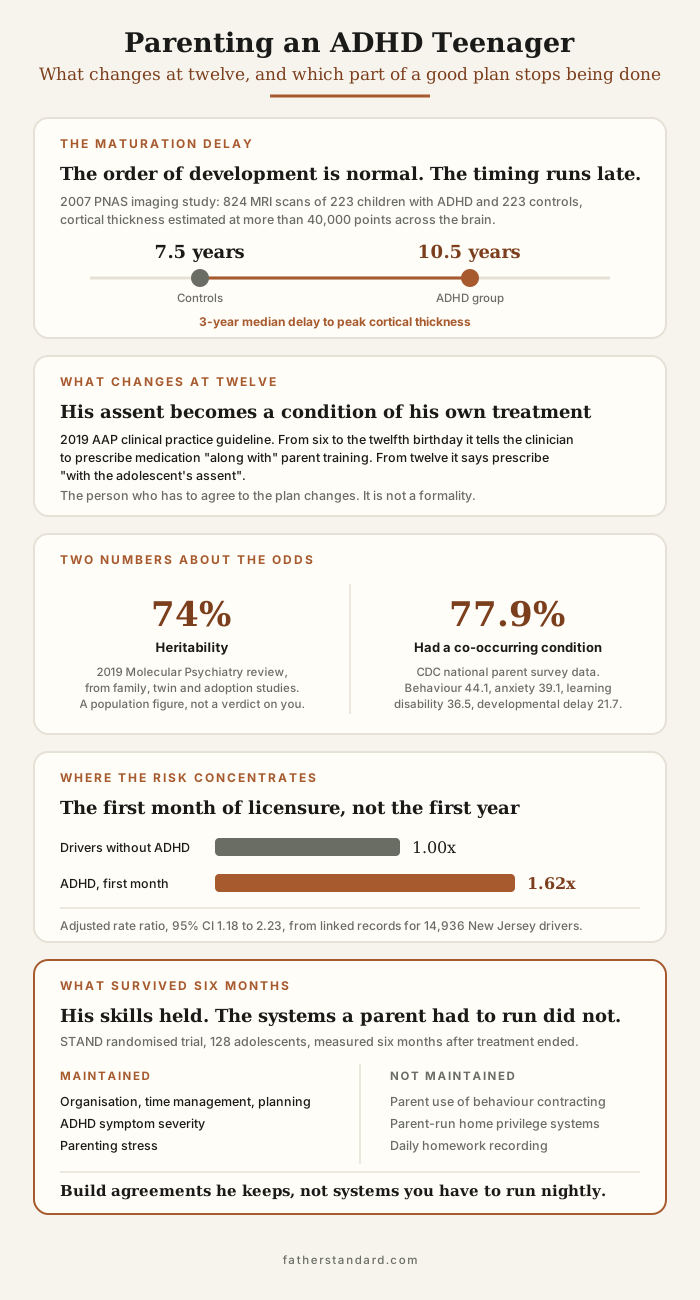
For children from six to the twelfth birthday, the 2019 AAP clinical practice guideline tells the clinician to prescribe approved medication "along with" parent training in behavior management and behavioral classroom intervention, preferably both. For adolescents from twelve to the eighteenth birthday, it says the clinician "should prescribe FDA-approved medications for ADHD with the adolescent's assent" and is "encouraged to prescribe evidence-based training interventions and/or behavioral interventions as treatment of ADHD, if available."
Read those two side by side. Two things move at once. Your son becomes a required party to his own treatment, and the behavioural half of the plan drops from an instruction to an encouragement.
Neither change is arbitrary. Both reflect a thinner evidence base for behavioural work with adolescents than with younger children, and the plain reality that a fifteen year old who does not agree with a plan will not run it. But the effect on a father is real and rarely named. You have been demoted from the person who installs the system to the person who has to sell it. That is the same shift we describe more broadly in what the teenage years actually ask of a father, arriving early and with more force.
The delay is literal, and it is not a figure of speech
The phrase "he is just behind" gets used as encouragement. In this case it is a measurement.
A 2007 study in the Proceedings of the National Academy of Sciences estimated cortical thickness at more than 40,000 points across the brain from 824 MRI scans of 223 children with ADHD and 223 typically developing controls, then tracked when each point reached its peak thickness. The order of maturation was the same in both groups. The timing was not. The median age at which half the cortical points had peaked was 10.5 years in the ADHD group against 7.5 years in controls. The delay was most pronounced in prefrontal regions the authors describe as important for control of cognitive processes including attention and motor planning.
Three years, concentrated in exactly the machinery you are asking him to use when you say plan ahead.
Hold that finding at its actual size. It is a group median across a research sample, not a schedule for your son, and it does not promise that a specific capability arrives on a specific birthday. What it does establish is a direction: the pattern looked like delayed maturation rather than a different kind of development. When you set an expectation for a fourteen year old with ADHD, you are addressing prefrontal equipment that the imaging says is running behind, not a boy who has decided not to bother.
The finding that should decide how you build
Here is the result that changed how we would advise a father, and it comes from a program that worked.
Supporting Teens' Autonomy Daily, or STAND, is a parent and teen skills therapy for adolescent ADHD. A randomised trial published in the Journal of Consulting and Clinical Psychology tested it against treatment as usual with 128 adolescents and their parents. Engagement was strong, with 85 percent of families completing. Immediately after treatment it produced significant gains across a wide front: ADHD symptoms, organisation and time management and planning skills, homework behaviour, parent and teen contracting, home privileges, parenting stress, and daily homework recording.
Then the researchers came back six months later, and the results separated cleanly.
What held: ADHD symptom severity, the teenager's organisation and time management and planning skills, and parenting stress. What did not hold: the parents' use of contracting and privilege implementation, and the teen's daily homework recording and homework behaviour gains.
Look at the shape of that. What the teenager internalised stayed. What required an adult to keep doing something every single day did not.
That is not a criticism of the parents in that trial, and it should not be read as one. It is a design constraint. A plan for an ADHD teenager that depends on you personally administering it nightly is running on the one resource the evidence says depletes. This is the practical argument for building the structure into the week rather than into your willpower, which is the same case we make about routines doing the heavy lifting for fathers generally, and it matters more here, not less.
Two consequences follow. Put your effort into things he can carry without you, since those are what survived. And where a system genuinely does need an adult, make it small enough and boring enough that a tired father still does it in month seven.
Most of the time, you are not only parenting ADHD
The single most useful correction to how ADHD gets discussed is that it usually does not arrive alone.
In the national parent survey data compiled by the CDC, nearly 78 percent of children with ADHD had at least one other co-occurring condition. The specific ones are worth knowing, because a father who is only watching for distraction will read several of these as character.
| Condition occurring alongside ADHD | Share of children with ADHD | What a father may misread it as |
|---|---|---|
| Any co-occurring condition in the survey | 77.9 percent | A single problem that treatment should have fixed by now |
| Behavioural or conduct problems | 44.1 percent | Defiance chosen on purpose |
| Anxiety | 39.1 percent | Avoidance, stalling, refusing to start |
| Learning disability | 36.5 percent | Not trying at school |
| Developmental delay | 21.7 percent | Immaturity for his age |
| Depression | 18.9 percent | Laziness, flatness, no motivation |
Two numbers from the same source sharpen the point. About 30 percent of children with ADHD received neither medication nor behaviour treatment in 2022, up from 23 percent in 2016. Among 12 to 17 year olds, 53.4 percent were currently taking ADHD medication. Whatever is happening in your house, a large share of families are managing this with no formal treatment at all, and the direction of travel over those six years was away from treatment rather than toward it.
The practical instruction is narrow and it is not for you to act on alone. If the picture at home looks like more than attention, say that to the clinician in those words and ask what else has been assessed. Nearly four in five is not an edge case.
The odds are decent that you have it too
ADHD is among the more heritable psychiatric conditions. A 2019 review in Molecular Psychiatry of the genetics of ADHD puts its heritability at 74 percent, drawing on family, twin and adoption studies.
That is a population figure and it tells you nothing certain about yourself. What makes it worth raising is a second study that treated it as a variable rather than a footnote. A trial in the Journal of Clinical Child and Adolescent Psychology compared two delivery formats of the same STAND program across 123 adolescents: a group format for parents and teens, and a one to one dyadic format for the family. Overall the two produced equivalent results, and the group version cost less than a third as much.
But the dyadic format was superior in three specific situations: when parents had elevated ADHD symptoms, when parents had elevated depression symptoms, and when there was high conflict between parent and teen. Attendance was also lower where parental depression was higher.
For a father, that turns a vague suspicion into a question with a consequence. If organisation and follow through have always been hard for you as well, or if the house is currently in open conflict, the cheaper group format is the one the evidence says fits you least well. Naming your own state to a clinician is not a confession. In that trial it was a matching variable that changed which treatment worked.
The car, which is the highest stakes item on this page
This is the part fathers are least often warned about, and it is the one where a father's decision has the most direct effect.
Researchers linked the electronic health records of 14,936 young drivers from a large paediatric practice network to New Jersey's licensing, crash and violation databases, and published the comparison in Pediatrics. Drivers with ADHD had higher crash rates regardless of the age at which they were licensed, and the gap was sharpest at the very start: an adjusted rate ratio of 1.62 during the first month of licensure, with a confidence interval of 1.18 to 2.23.
The pattern in the specific numbers is the useful part. Over four years, the alcohol related crash rate for drivers with ADHD was 2.1 times that of drivers without. In the first year of driving, the rate of alcohol or drug violations was 3.6 times higher. They also had higher rates of moving violations for speeding, seat belt nonuse and electronic equipment use, and higher rates of licence suspension. The authors conclude that preventable risky driving behaviour may be contributing, and that approaches going beyond current recommendations are needed.
Take the honest limits with it. This is one linked cohort in one state, drawn from one health system's patients, and it describes a group rather than predicting your son. It also cannot tell you that any particular father's intervention lowers that risk, because it did not test one.
What it is consistent with is treating the licence as a staged privilege rather than a birthday, keeping supervised hours going well past the legal minimum, and having the alcohol and phone conversations before the licence rather than after it. The elevated risk concentrated in the first month means the window where slowing down matters most is short and identifiable.
What a father should actually do with all of this
Five things follow from the studies above, and not one of them from the confident advice built on top of those studies.
Build what he can carry, not what you have to carry. In the one trial that measured it at six months, the teenager's own organisation and planning skills held and the parent administered contracts and privilege systems did not. Design accordingly. A system that dies when you have a bad week was never the right system.
Convert instructions into agreements. The guideline now requires his assent for medication. That is not a formality to be worked around, it is the actual condition of the treatment. A plan he has agreed to is the only kind that runs when you are not in the room.
Ask what else is there. Nearly 78 percent of children with ADHD carry at least one co-occurring condition, and the most common ones present to a father as attitude. Anxiety looks like stalling. Depression looks like laziness.
Get honest about yourself. Heritability sits at 74 percent, and parental ADHD, parental depression and parent teen conflict were the three things that changed which treatment format worked. This is also where fathers tend to spend energy badly, since guilt reports on your standards rather than on his experience and does none of the work.
Slow the car down. The crash rate gap is widest in the first month of licensure. That is the single highest stakes decision in this article and it is entirely yours to pace.
None of this is a substitute for the filter every piece of parenting advice should pass, which we set out in how to tell teenager advice that works from advice that backfires. Confident advice about ADHD is abundant. Tested advice is not.
Where this stops being parenting
Every finding above describes groups of children in studies. None of it is a diagnosis, none of it can assess your son, and none of it replaces a licensed clinician who can do both.
ADHD in adolescence sits alongside depression in about 19 percent of cases and anxiety in about 39 percent, and those are conditions that need professional assessment rather than a father's best reading. If your son has said anything about not wanting to be alive, or you are frightened for him, the 988 Suicide and Crisis Lifeline takes calls and texts around the clock in the US, 911 covers immediate danger, and a licensed professional needs to be involved rather than an article. If drinking or drug use has entered the picture, that belongs in front of his clinician too, given what the driving data shows about how those risks combine.
Parenting an ADHD teenager in one picture
The two shifts at twelve, the delay that is actually measured, and the part of a plan that reliably falls apart.
Test yourself
Five checks on what the studies above actually establish, and on where the familiar claims about ADHD teenagers outrun them.
Key takeaways
Last reviewed by The Father Standard Editorial Team on August 20, 2026. Our sourcing and AI-use rules are public on the editorial standards page.
FAQ
How do you discipline a teenager with ADHD?
Build agreements rather than administered systems, and expect the administered part to be what fails. In the randomised trial that followed families for six months after a working program ended, the teenagers' own organisation and planning skills were still there, while the parents' use of behaviour contracts and home privilege systems was not. That points away from elaborate consequence structures a father has to run nightly and toward a small number of rules he can still enforce in month seven. The AAP guideline reinforces the same direction by making the adolescent's assent a condition of his own treatment from age twelve.
Is my ADHD teenager lazy or is it the ADHD?
The imaging evidence gives a father a reason to be slow with that judgement. A study of 824 MRI scans found that children with ADHD reached peak cortical thickness at a median age of 10.5 years against 7.5 in controls, a delay most pronounced in prefrontal regions involved in attention and motor planning. The order of development was normal, the timing ran late. That is a group finding rather than a statement about your son, but it means the equipment you are asking a fourteen year old to use is measurably behind schedule.
Does ADHD in teenagers usually come with other conditions?
Usually, yes, and that is the safer default to hold. In the national parent survey data compiled by the CDC, nearly 78 percent of children with ADHD had at least one other co-occurring condition: behavioural or conduct problems at 44.1 percent, anxiety at 39.1 percent, a learning disability at 36.5 percent, developmental delay at 21.7 percent and depression at 18.9 percent. A father watching only for distraction reads several of those as character rather than condition, as defiance chosen on purpose, stalling, not trying at school, or flatness. If the picture at home looks like more than attention, say that to the clinician in those words and ask what else has been assessed.
At what age does ADHD get better in teenagers?
No honest number can be given for an individual. The maturation study measured a median three year lag in reaching peak cortical thickness rather than an age at which symptoms resolve, and reaching a peak in thickness is not the same as a capability switching on. What the evidence does support is that the delay is a delay rather than a permanently different developmental path, so the right expectation is later arrival, not absence.
Does my teenager with ADHD still need behaviour therapy, or is medication enough?
The AAP guideline treats them differently after twelve. For adolescents it says the clinician should prescribe approved medication with the adolescent's assent and is encouraged to prescribe training or behavioural interventions if available, a softer wording than the one used for six to eleven year olds where behavioural work sits alongside medication as an instruction. That softening reflects a thinner evidence base for adolescents rather than a finding that the behavioural work is useless. The STAND trials found real acute gains from parent and teen skills therapy, with the durability question still open.
Should I let my ADHD teenager drive?
The decision is yours and a clinician's, but the risk is concentrated in a place you can act on. In a linked cohort of 14,936 New Jersey drivers, those with ADHD had an adjusted crash rate 1.62 times higher during the first month of licensure, an alcohol related crash rate 2.1 times higher over four years, and a rate of alcohol or drug violations 3.6 times higher in the first year of driving. Because the gap is sharpest at the very beginning, extending supervised driving well past the legal minimum and settling the alcohol and phone rules before the licence rather than after it are the levers most clearly aimed at the period of highest risk.
I think I might have ADHD myself. Does that change anything?
It changes which help is likely to work for your family, which is a more useful answer than a diagnosis. ADHD's heritability is estimated at 74 percent, so fathers of diagnosed teenagers are not a low-probability group. In the trial comparing group and one to one delivery of the same program, the two formats performed equivalently overall, but the one to one format was superior specifically when parents had elevated ADHD symptoms, elevated depression symptoms, or high conflict with the teen. That is information a clinician can act on when choosing a format, not an admission that you are failing him.
Sources
- 2019 AAP clinical practice guideline (pubmed.ncbi.nlm.nih.gov)
- cortical thickness at more than 40,000 points across the brain (pubmed.ncbi.nlm.nih.gov)
- 128 adolescents and their parents (pubmed.ncbi.nlm.nih.gov)
- the CDC (cdc.gov)
- the genetics of ADHD (pubmed.ncbi.nlm.nih.gov)
- two delivery formats of the same STAND program (pubmed.ncbi.nlm.nih.gov)
- Pediatrics (pubmed.ncbi.nlm.nih.gov)