Effects of an Emotionally Distant Father on a Daughter: What Is Measured, What Is Folklore, and What Reverses
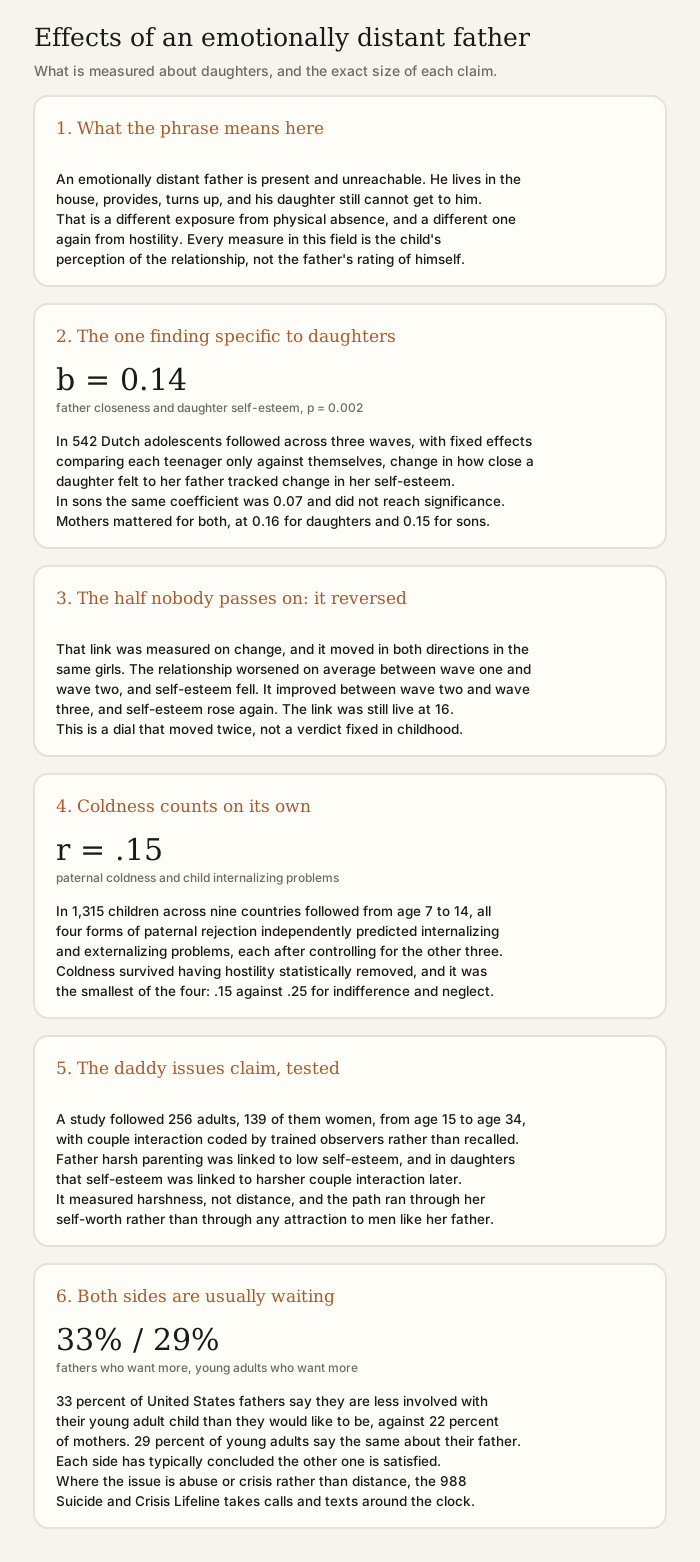
The best-measured effect of an emotionally distant father on a daughter is on her self-esteem, and it is the one outcome where fathers separate from mothers in the evidence. In a Dutch study that followed 542 adolescents across three waves and compared each teenager only against themselves, changes in how close a daughter felt to her father tracked changes in her self-esteem. In sons, the same link did not reach significance. That is the honest headline, and it is narrower than what most pages on this search will tell you.
The half of that finding almost nobody passes on is that it ran in both directions in the same girls. When the relationship got worse across a wave, their self-esteem went down with it. When it got better, their self-esteem went back up. This is not a study about permanent damage. It is a study about a dial that moved twice.
If what you are reading about is abuse rather than distance, or if you are in crisis right now, stop here and use 988lifeline.org, which takes calls and texts around the clock in the United States. A licensed clinician is the right instrument for that, and this page is not.
What "emotionally distant" means here, and the three things it is not
Most of the confusion on this topic comes from four different fathers being discussed under one phrase. The research treats them separately, so this page does too.
An emotionally distant father is present and unreachable. He lives in the house, he pays for things, he turns up, and his daughter cannot get to him. That is the subject of this article and of our longer piece on the emotionally absent father.
Physical absence is a separate exposure, with its own literature and its own set of outcomes, covered in the effect of an absent father on daughters. Findings do not carry across from one to the other.
Hostility is a separate pattern again. Criticism, contempt and unpredictable warmth belong in the unhealthy father-daughter relationship. That line matters more than it sounds, because the single most useful finding below is that distance counts on its own once hostility is statistically removed.
Reserve is not distance either. Reserve is a temperament. Distance is a daughter reporting she cannot reach you. Only the second shows up in the data, because almost every measure in this field is the child's perception rather than the father's self-rating.
The finding that is genuinely specific to daughters
Renske Keizer, Katrien Helmerhorst and Loes van Rijn-van Gelderen published Perceived Quality of the Mother-Adolescent and Father-Adolescent Attachment Relationship and Adolescents' Self-Esteem in the Journal of Youth and Adolescence in 2019. It used all three waves of the Dutch cohort study Social Development of Adolescents: 542 teenagers, 51 percent female, mean age 13.6 at the first wave.
The method is why it is worth your time. It used fixed effects on within-person variation only, which means every adolescent acts as their own control. Anything stable about a family, its income, its culture, the daughter's baseline temperament, is held out of the comparison. What is left is the change.
| Change in perceived relationship quality | Link to daughters' self-esteem | Link to sons' self-esteem |
|---|---|---|
| With father | b = 0.14, p = 0.002 | b = 0.07, p = 0.099 |
| With mother | b = 0.16, p = 0.001 | b = 0.15, p = 0.003 |
| Between the two parents | significant | significant |
| Number of close friends | not significant | not significant |
| Having a romantic partner | not significant | not significant |
The father column is the daughter-specific result. Mothers mattered for both sons and daughters at roughly the same strength. Fathers reached significance only for daughters. That is a real asymmetry, and it is the closest thing this field has to evidence for the popular claim that a father's warmth carries particular weight for a girl.
The peer rows are the surprise. These were 13 to 16 year olds, the exact stage at which the story says friends replace parents. Changes in friendships and in having a partner showed no significant link to self-esteem at all. The parents did.
And the last honest point about that table is the size. A b of 0.14 is a real association and a modest one. It is not a mechanism that decides a life.
Coldness counts on its own, with everything else held out
The obvious objection to any of this is that cold fathers are usually also harsh fathers, so what looks like an effect of distance is really an effect of something louder happening in the same house.
That objection has been tested directly. In 2021 W. Andrew Rothenberg and colleagues published Effects of Parental Acceptance-Rejection on Children's Internalizing and Externalizing Behaviors in the Journal of Child and Family Studies, following 1,315 children from twelve ethnocultural groups across nine countries from age 7 to age 14. Children rated their mother and their father separately on four distinct forms of rejection.
All four paternal forms, including coldness and lack of affection, were independently associated with children's internalizing problems, meaning anxiety, withdrawal and low mood, and with their externalizing problems, meaning acting out and aggression, after controlling for child gender, paternal education, and each of the other three forms of rejection. Coldness survived having hostility statistically removed from underneath it.
| Form of paternal behaviour | What the child is reporting | Correlation with child internalizing problems |
|---|---|---|
| Coldness, lack of affection | No warmth reaches me | .15 |
| Hostility, aggression | He is angry at me | .22 |
| Indifference, neglect | He does not attend to me | .25 |
| Undifferentiated rejection | He does not love me | .24 |
Two things in that table are worth saying out loud. The coldness row is the smallest of the four, so if you arrived here braced for the worst, the specific pattern you are worried about is the mildest of the four measured forms. And these are simple correlations, all of them small: an r of .15 is a nudge across a population, not a diagnosis of a person. The study's contribution is not the size of that number but the fact that it survived having the other three forms controlled.
One more figure from the same paper is worth knowing, and it is about the field rather than about your daughter. That study recruited 1,275 mothers and 1,032 fathers. Even in a well-funded nine-country design, there is less father data than mother data. Our piece on father-daughter relationship psychology walks through how thin the daughter-specific evidence is once you look closely.
The "daddy issues" claim, actually tested
The loudest version of this topic online is that a distant father determines the men his daughter will choose. There is a study that tests the shape of that claim, and reading it carefully is more useful than either believing it or dismissing it.
Alison White, Olivia Diggs and Tricia Neppl published Father and Mother Harsh Parenting and Adult Romantic Relationships over Time in the Journal of Family Psychology in 2024. It followed 256 adults, 139 of them women, from ages 15 and 16 into their thirties, and it did not rely on people remembering their childhoods. That figure is the analytic sample its model was actually run on; the paper's abstract prints a different one, which does not reconcile with its own total. Couple interaction in adulthood was videotaped and coded by trained observers at ages 29, 31 and 34.
Father harsh parenting in adolescence was associated with low self-esteem for both daughters and sons. For daughters only, that lower self-esteem at 18 was in turn associated with harsher couple interaction at 29 and 31, and the pattern held through 34. A separate path ran through mothers rather than fathers: maternal harsh parenting predicted academic difficulty at 18, and in daughters that difficulty carried its own forward link to the same outcome. Once every pathway was specified, the direct association between father harsh parenting and adult couple interaction was no longer significant, which is precisely what makes this a mediated finding rather than a straight line.
Every qualification on it cuts against the folk version.
It measured harshness, not distance. Harsh parenting is not the same exposure as emotional distance, and this study does not license carrying its results across to a cold-but-not-harsh father. It is the closest tested analogue, not an answer.
The path ran through her, not through her taste in men. The link was mediated by self-esteem and academic difficulty. Nothing in it describes a daughter drawn toward men who resemble her father. It describes a young woman entering adulthood with less self-worth and, on average, rougher interactions as a result.
A mediated association across fifteen years is a weak causal claim. These are real people followed for a long time, which is the strongest design available here, and it is still an observational study of 256 people.
Both of you are describing the same gap
The part of this that gets least attention is that the distance is usually not one-sided, and the father is usually not comfortable in it.
Pew Research Center surveyed parents of young adults and young adults themselves in 2023 and reported the comparison in a March 2024 analysis. Thirty-three percent of fathers said they were less involved in their young adult child's life than they would like to be, against 22 percent of mothers. Forty-four percent of fathers said they communicate with that child less often than they would like, against 30 percent of mothers.
From the other side, 29 percent of young adults said their father is less involved in their day-to-day life than they would like, and 37 percent said they communicate with him less often than they would like. For mothers those figures were 17 and 20 percent.
Roughly a third of fathers want more contact than they have, and roughly a third of young adults want more contact with their father than they have. Both sides are waiting, and each has concluded the other one is satisfied.
One detail in that release deserves a flag, and its scope needs stating precisely. On the single question of whether their child leans on them for emotional support, fathers answered the same whether the child was a son or a daughter, while mothers did not: mothers were likelier to say they provide that support to daughters. Pew did not report the involvement and communication gaps above broken out by the child's gender at all, so read the result narrowly. It covers one survey item, and it is not a finding about everything else on this page.
What actually reverses it
The strongest practical claim available here comes from the shape of the Keizer result rather than from any advice. That dial moved twice, in the same girls, and it was still live at 16.
Three implications follow, and we would rather label them as our reading than dress them up as findings.
Her perception is the measured variable, not your intent. Every result on this page rests on the child's rating of the relationship. A father can be genuinely trying and still produce a low score, because the score is hers. That does not mean the effort was wasted. It means the effort has not reached her yet, which is a different problem from not trying, and a more tractable one.
Frequency of contact is not the same variable as reachability. Pew measured texts, calls and visits. The studies with outcomes measured warmth and reachability. Adding a weekly phone call to a relationship she experiences as unreachable is likely to move the first and leave the second where it was. No study we found has tested that comparison directly, so that is our read rather than a result.
If you want to know which of the two you are short on, the direct route is to ask her, and not with "do we talk enough". Ask whether she feels she can reach you. That question needs no study behind it, because reachability as she perceives it is the exact variable every result above is built on.
The measured effects are modest, which cuts in the encouraging direction too. If a cold father is a nudge rather than a verdict, then a warmer one is also a nudge rather than a rescue. Expect a dial, not a switch. Our piece on the distant father sets out the mechanism of the drift itself, which is the thing you would actually be reversing.
When this stops being an article
None of the above applies to abuse, and the perception-gap framing should never be used to talk a daughter out of her own read of what happened to her. Where there was neglect that met a legal threshold, sexual or physical harm, or a pattern of coercive control, the correct next step is a licensed clinician rather than a parenting page. In the United States, the 988 Suicide and Crisis Lifeline takes calls and texts around the clock, and it is the right first call in a crisis for a father or a daughter.
Test yourself
Key takeaways
Last reviewed by The Father Standard Editorial Team on September 5, 2026. Our sourcing and AI-use rules are public on the editorial standards page.
FAQ
What are the effects of an emotionally distant father on a daughter?
The best-evidenced one is on self-esteem. In a Dutch study of 542 adolescents that compared each teenager only against themselves across three waves, changes in a daughter's perceived closeness to her father tracked changes in her self-esteem at b equals 0.14, p equals 0.002, while the equivalent coefficient in sons was 0.07 and did not reach significance. Separately, in 1,315 children across nine countries, paternal coldness and lack of affection independently predicted internalizing and externalizing problems from age 7 to 14 even after hostility and neglect were controlled. Both effects are real and both are modest.
Does an emotionally distant father affect a daughter more than a son?
On the one study designed to separate them, yes, and only on self-esteem. Keizer and colleagues found the father link significant for daughters and not for sons, while the mother link was significant for both at similar strength. That is a single finding in a single Dutch cohort, so treat it as the best available answer rather than a settled one. In the nine-country study of parental rejection, the paternal effects held after controlling for child gender, which means they applied to both.
Is an emotionally distant father the same as an absent father?
No, and the distinction changes which research applies. An emotionally distant father is physically present and emotionally unreachable. An absent father is physically gone. They have different literatures and different measured outcomes, and findings from one should not be read onto the other. We cover physical absence separately in the effect of an absent father on daughters.
Do daddy issues from an emotionally distant father affect her relationships later?
The claim as usually stated is not what the research found. The closest test followed 256 adults, 139 of them women, from age 15 to age 34 with couple interaction coded by trained observers, and it linked harsh paternal parenting to low self-esteem, and, in daughters, low self-esteem in turn to harsher couple interaction in adulthood. It measured harshness rather than distance, and the pathway ran through her self-worth rather than through any attraction to men resembling her father.
Can the effects of an emotionally distant father on a daughter be reversed?
The evidence is more encouraging than most pages on this topic suggest. The father and daughter self-esteem link in the Keizer study was measured on change and moved in both directions inside the same three waves, dropping when the relationship worsened and rising when it improved. That is a population pattern rather than a promise about one family, and it rules out the assumption that the effect is fixed by adolescence.
Does my daughter see me as emotionally distant even if I do not feel distant?
Possibly, and it is her rating that carries the measured association. Every study on this page used the child's perception of the relationship, not the father's self-report. Pew Research Center found 33 percent of fathers saying they are less involved with their young adult child than they would like, against 29 percent of young adults saying the same about their father, which suggests both sides frequently misread how the other feels about the distance.
How much contact does it take to stop being an emotionally distant father?
No study we found answers that in hours. What the research measures is warmth and reachability as the child perceives them, which is a different variable from frequency. Pew measured contact and found 63 percent of fathers texting their young adult child at least a few times a week against 81 percent of mothers, but contact counts are not what predicted the outcomes above. That is our read rather than a tested claim: track reachability and frequency as two separate things.
Sources
- 988lifeline.org (988lifeline.org)
- Perceived Quality of the Mother-Adolescent and Father-Adolescent Attachment Relationship and Adolescents' Self-Esteem (pmc.ncbi.nlm.nih.gov)
- Effects of Parental Acceptance-Rejection on Children's Internalizing and Externalizing Behaviors (pmc.ncbi.nlm.nih.gov)
- Father and Mother Harsh Parenting and Adult Romantic Relationships over Time (pmc.ncbi.nlm.nih.gov)
- a March 2024 analysis (pewresearch.org)