The Unhealthy Father-Daughter Relationship: Signs, Effects, and How It Changes
An unhealthy father-daughter relationship is one where closeness carries a cost: love that arrives with control, warmth that turns to contempt without warning, approval a daughter has to keep earning, or a father so guarded she learns to stop reaching. It is not always loud, and it is rarely simple cruelty. The most common shape is a father who is present and even affectionate, yet whose presence teaches a daughter that being close to a man means bracing for the next mood. What researchers keep finding is that this pattern is linked to how she handles anxiety and self-worth, and can shape how she reads closeness later, and that the pattern can change when the father does.
A father reading this is probably not hunting for a label to feel guilty under. He wants to know whether what he does lands the way he means it, and how to fix it if it does not. A daughter reading it can take the same signs and read them from her own side, naming what happened without either excusing it or shouldering blame that was never hers. One honest caveat first: most of the research below measures patterns across large groups, not a verdict on any single home, and a strained relationship is not the same as an abusive one. Where it crosses into abuse or crisis, this article says so and points you to real help.
What makes a father-daughter relationship unhealthy
A father-daughter relationship turns unhealthy when the connection between them starts to cost the daughter something she should never have to pay: her sense of safety, her right to her own feelings, or her ability to say no. The healthiest version of the bond is described in our father and daughter relationship guide: warmth that is steady, respect that does not depend on obedience, and a father whose mood is his own to manage. Unhealthy is the mirror of that. The warmth is conditional, the respect is one-directional, and the daughter becomes the manager of the father's moods.
Psychologists have a precise name for one of the most damaging versions of this. In a landmark paper, Brian Barber described parental psychological control as a distinct and neglected kind of control, separate from ordinary rules and discipline. Where healthy control shapes behavior ("you are home by ten"), psychological control invades the inner life: guilt trips, love that gets withdrawn when the child disappoints, constant invalidation of what the child feels, and a refusal to let the child develop a self of her own. A father who sets a curfew is doing his job. A father who makes his daughter feel that her sadness is a personal insult to him has crossed into something else entirely.
That distinction matters because the second kind is what the research ties to harm. A 2025 meta-analysis pooling 37 studies of more than 27,000 young people found that higher parental psychological control was linked to more internalizing symptoms, meaning anxiety and depression, with an effect that was modest in size but consistent across very different cultures. A 2026 set of meta-analytic reviews looked at intrusive parenting and both internalizing and externalizing symptoms in adolescents, pointing the same way. No single child is doomed by this. What the numbers show is a father's behavior nudging the risk in one direction.
The signs, read honestly
Most unhealthy father-daughter relationships do not announce themselves. They feel normal to the people inside them, which is exactly why naming the signs is useful. The point is not to hang a diagnosis on an ordinary bad week. It is to notice a pattern that repeats.
The recurring signs of an unhealthy father-daughter relationship look like this. A daughter feels she has to earn approval, and it can be revoked. Her feelings are routinely argued with rather than heard. The father's temper sets the weather in the house, and she has learned to read it before she reads anything else. Affection runs hot and cold, so she can never fully relax into it. Criticism outnumbers warmth, often about her body, her choices, or her worth. She is asked, openly or not, to manage the father's emotional needs, comfort him, keep his secrets, or take a side in the parents' conflict. Or the father is simply unreachable behind a wall, which is the pattern we cover in the emotionally absent father and, in its quieter form, the distant father.
One sign deserves its own line because it is the most counterintuitive. Warmth is not automatically protective. When Dmitrieva and Espel followed at-risk adolescent girls, they found that a father who paired affection with hostility left a daughter worse off than a father who simply stayed remote. The lesson such a father teaches is that being close to him and being hurt by him are the same event. That is why "but he was so loving when he was in a good mood" is not the reassurance it sounds like. The good moods are part of what made the bad ones so confusing.
What an unhealthy relationship does to a daughter
The clearest measured effect is on a daughter's inner life. Across the psychological-control research, the outcome that shows up most is internalizing: anxiety, depression, low self-worth, and a harsh inner voice that sounds a lot like the father who raised it. The Dmitrieva and Espel study measured that toll at the time, in at-risk girls, rather than following them into later life. The reasonable reading of it is not a proven mechanism but a plausible one: a daughter who lived with warmth that turned to hostility can carry it forward as a template for what closeness with a man is supposed to feel like. A daughter who grew up bracing learns to brace, and she often keeps bracing in relationships that never asked her to.
That expectation can travel. A father is frequently a daughter's first model of male attention, and an unhealthy version of it can bias how she reads warmth, criticism, and safety for years. This is the same machinery, running in a present home, that we describe for absence in the effect of an absent father on daughters: the father does not have to be gone to shape her, he only has to be unsafe. Some daughters respond by chasing approval from men who withhold it, because withheld approval is the familiar shape of love. Others respond by shutting the door on closeness entirely. Neither one is a character flaw, both are learned responses.
It is worth holding two truths at once here. The effects are real and worth taking seriously, without deciding any one daughter's future. Most daughters of difficult fathers are not defined by it, and the presence of one dependable adult, a mother, a grandparent, a coach, or the same father after he changes, often takes the edge off it. A raised risk is a reason to act, never a sentence.
Healthy, strained, and harmful are three different things
The word "unhealthy" covers a lot of ground, and it helps to sort it. Not every hard father-daughter relationship is abusive, and treating an ordinary strained bond as abuse helps no one. This table maps the difference without flattening it.
| Pattern | What it looks like | What it teaches the daughter |
|---|---|---|
| Healthy | Warmth is steady, rules exist without contempt, her feelings are allowed even when the answer is still no | Closeness is safe, and she can be herself and still be loved |
| Strained | Real love buried under distance, awkwardness, or a season of conflict, but no pattern of control or fear | The bond is worth repairing, and both sides can reach across it |
| Psychologically controlling | Guilt, love withdrawal, invalidation, an inner life that is never left alone | Her feelings are a liability, and approval must be earned and can be lost |
| Warm but hostile | Affection that flips to temper or contempt without warning | Closeness and harm come together, so she braces even when things are good |
| Abusive or unsafe | Physical, sexual, or severe emotional abuse, or a child made to carry an adult's role | This is beyond parenting advice and needs a professional, not a blog |
The line between the middle rows and the last one is not always obvious from inside the home. If any part of that bottom row is familiar, the right next step is a licensed professional, not a self-help article. The American Psychological Association and pediatric guidance from the American Academy of Pediatrics both frame healthy parenting around warmth paired with consistent, non-hostile structure, which is a useful yardstick to hold your own home against.
What a father can actually change
The research points at a short list, and it is the same whether a father is trying to repair a bond with a teenager under his roof or with an adult daughter who keeps him at arm's length.
The first change is to separate control from love. Barber's whole point is that these are different systems. A father can keep every reasonable rule and still stop using guilt, silence, and withdrawn affection as tools. When a daughter disappoints him, the fix is to address the behavior and keep the warmth on, not to make the warmth the thing she loses. A daughter needs to know the connection itself is not on the table every time she falls short.
The second change is to make warmth reliable instead of intense. The damage in a warm-but-hostile home is not a shortage of good moments, it is that a daughter cannot trust the ones she gets. Dependable, even boring warmth beats a grand loving gesture she knows could flip by dinner. This is the same principle as being present rather than just providing: what matters is whether she can count on it, not how big the gesture is.
The third change is to let her have her own feelings, especially the ones about him. A father who can hear "that hurt me" without turning it into an attack on himself gives his daughter something most unhealthy relationships never allow: the right to her own experience. For an adult daughter, that often means listening to an account of the past that is hard to hear, resisting the urge to defend or explain, and letting her be right about her own life. Repair with an adult daughter is slow, measured in months, and it is built far more on changed behavior than on the perfect apology.
When it is heavier than this article
Some of what an unhealthy father-daughter relationship leaves behind sits deeper than parenting advice can reach. Severe emotional abuse, physical or sexual abuse, and being pressed to carry an adult's emotional or practical role are forms of childhood adversity that the Centers for Disease Control and Prevention studies as adverse childhood experiences, and they are tied to lasting effects on health and well-being. That sits in clinical territory and calls for a trained professional. Nothing here is medical or crisis advice.
When a daughter is carrying lasting depression, self-harm, an eating disorder, or thoughts of suicide, the right help comes from a licensed clinician, and urgent help is a phone away at any hour. In the United States, calling or texting 988 reaches the Suicide and Crisis Lifeline. A therapist trained in family-of-origin wounds can help her separate what her father put on her from what is genuinely hers, and that sorting is usually where the real change starts. A father calm enough to back that work without needing it to center on him is already repairing something.
An unhealthy father-daughter relationship is best understood as a pattern, not a single bad day: closeness that costs too much, warmth she cannot trust, or control dressed up as love. The research is honest about the size of the harm, real and modest and never the whole story of one girl, and just as honest about the way out. A father cannot unmake the years that shaped his daughter. What remains in his hands is to grow into the calm, dependable father she needed the first time, and to hold it long enough that she believes it.
The unhealthy father-daughter relationship in one picture
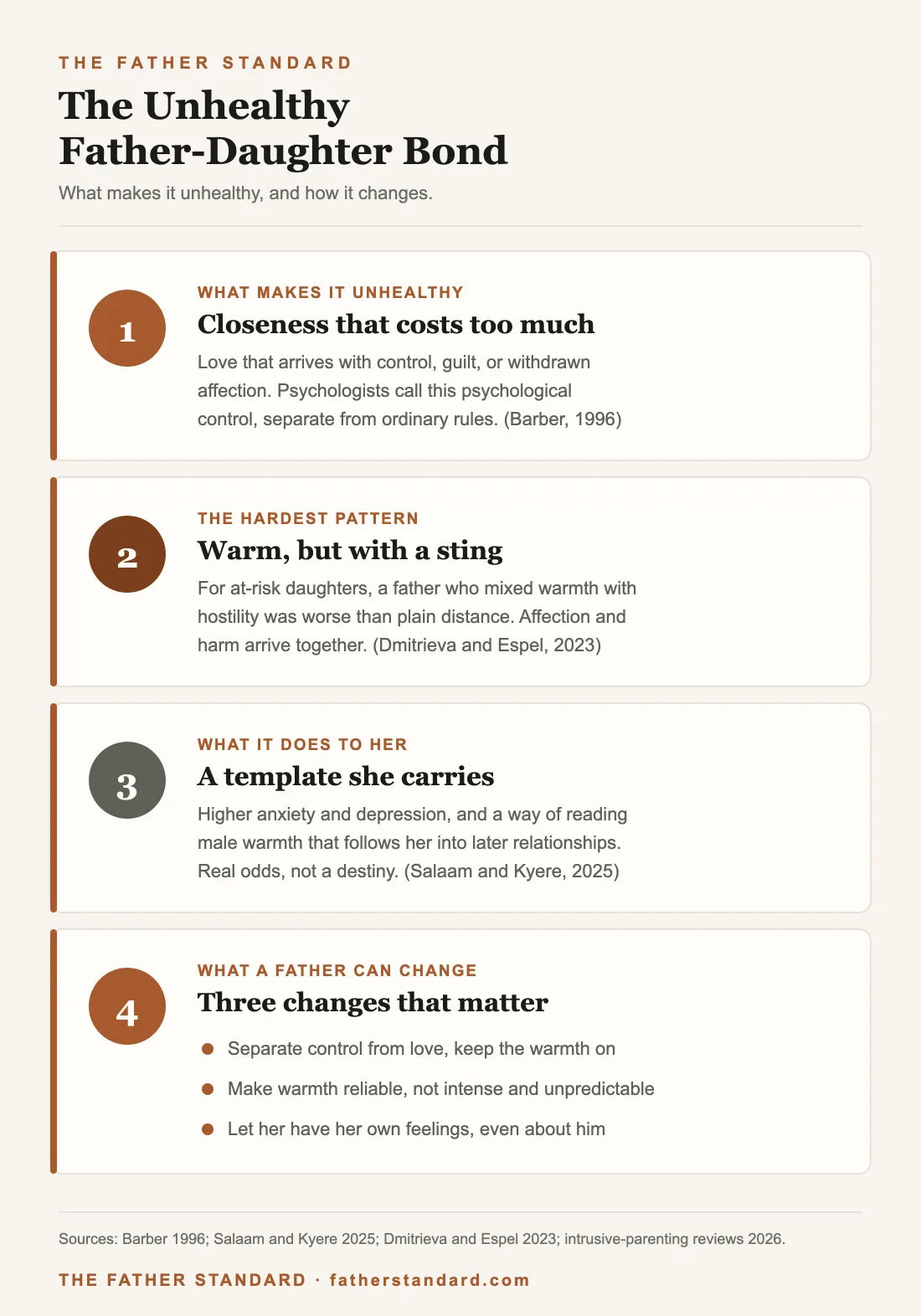
The whole piece compressed into a single image: what makes the bond unhealthy, the signs that keep repeating, its mark on a daughter, and the three changes that count most.
Test yourself
Five questions on the core of this piece: what truly makes the bond unhealthy, why the warm-but-hostile pattern hits harder, and how to treat a raised risk as odds rather than a sentence. Each answer explains itself, so even a wrong guess teaches you something.
Key takeaways
Last reviewed by The Father Standard Editorial Team on August 12, 2026. How we source our work and use AI is documented on our editorial standards page.
FAQ
What are the signs of an unhealthy father-daughter bond?
The recurring signs are a pattern, not a single bad day: a daughter feels she has to earn approval that can be taken away, her feelings are argued with instead of heard, the father's temper sets the mood of the house, affection runs hot and cold so she can never relax into it, criticism outweighs warmth, or she is asked to manage the father's emotional needs. One counterintuitive sign is warmth that flips to contempt without warning. That warm-but-hostile pattern is often more confusing and more harmful than plain distance, because the good moods are part of what makes the bad ones land so hard.
Is a distant father worse than a harsh one?
Not usually. In a study of at-risk adolescent girls, a father who mixed affection with hostility predicted worse depression and anxiety than one who was simply remote. A daughter raised on that mix learns to expect that affection may turn on her, so she braces even during the good stretches. Distance leaves a gap; unpredictable warmth teaches an active lesson that love is dangerous. Both are worth addressing, but the warm-but-hostile pattern is the one the research flags as especially damaging, which is why "he was loving when he was in a good mood" is not the reassurance it sounds like.
How does an unhealthy relationship with her father affect a daughter later in life?
The most consistent effect is on her inner life: higher rates of anxiety, depression, and low self-worth, and a harsh inner voice that often echoes the father who raised it. Because a father is frequently a daughter's first model of male attention, an unhealthy version can bias how she reads warmth, criticism, and safety for years, and she may carry that template into adult relationships. Some daughters chase approval from men who withhold it because that is the familiar shape of love; others shut down closeness entirely. These are learned responses and odds, not destiny, and a single steady relationship reliably softens them.
Is a toxic father-daughter relationship the same as an unhealthy one?
In everyday use, yes. "Toxic" is the word most people reach for to describe the same pattern this article calls unhealthy: a bond where closeness costs the daughter her sense of safety, her right to her own feelings, or her ability to say no. Changing the label does not change what is being described, and there is no separate category of relationship that is toxic rather than unhealthy. The distinction worth making is not toxic versus unhealthy but the one in the table above, which sorts a hard relationship into strained, psychologically controlling, warm but hostile, or abusive. Those four look different from inside the home and they call for different responses, which is why one strong word covering all of them is more confusing than useful. If the word feels accurate to your home, the useful next question is which row it actually sits in.
What is the difference between a strained and an abusive father-daughter relationship?
A strained relationship has real love buried under distance, awkwardness, or a season of conflict, with no pattern of control or fear, and both sides can usually reach across it to repair. An abusive or unsafe relationship involves physical, sexual, or severe emotional abuse, or a child forced to carry an adult's role, and it is beyond parenting advice. Psychological control, guilt, love withdrawal, and constant invalidation sit in between and still cause measurable harm. If any part of the abusive category is familiar, the right next step is a licensed professional rather than a self-help article, and immediate help is available by calling or texting 988.
Can an unhealthy father-daughter relationship be repaired?
Often, yes, though repair is slow, and it shows up in what he does differently rather than in how well he apologizes. The three changes that matter most are separating control from love, so a daughter never loses the connection itself when she disappoints him, making warmth reliable instead of intense, so she can finally trust it, and letting her have her own feelings about him without turning her honesty into an attack on himself. With an adult daughter that usually means listening to a hard account of the past without defending, and staying steady for months. A father cannot erase the years that shaped her, though he can grow into the safe, predictable father she needed and hold it long enough to be believed.
Sources
- parental psychological control (pubmed.ncbi.nlm.nih.gov)
- higher parental psychological control was linked to more internalizing symptoms (pubmed.ncbi.nlm.nih.gov)
- intrusive parenting and both internalizing and externalizing symptoms (pubmed.ncbi.nlm.nih.gov)
- a father who paired affection with hostility left a daughter worse off than a father who simply stayed remote (pubmed.ncbi.nlm.nih.gov)
- American Psychological Association (apa.org)
- American Academy of Pediatrics (healthychildren.org)
- Centers for Disease Control and Prevention studies as adverse childhood experiences (cdc.gov)
- Suicide and Crisis Lifeline (988lifeline.org)