The Effect of an Absent Father on Daughters: What the Research Really Shows
The effect of an absent father on daughters is best understood as a shift in odds, not a fixed fate. Across long-term studies, girls who grew up with less of their father present carried a higher risk of early sexual activity and teenage pregnancy, and a somewhat higher risk of trouble with mood and self-worth, than girls whose fathers were around. Those are population patterns, not a verdict on any one girl, and plenty of daughters of absent fathers turn out steady and well. What the research keeps showing is that a father's presence tilts the odds, and that a father who was gone, or is trying to come back, still has room to tilt them the other way.
If you are the father reading this, you are probably looking for the honest size of the damage, not a lecture. If you are a daughter reading it to make sense of your own life, the same findings hold, read from your side. One warning up front: most of this research measures who ended up where, not a clean cause and effect. Father absence travels with other hard things, less money, more stress, a home already under strain, and untangling the father's part from all of that is the whole difficulty of the field. The findings below are careful about that, and so are we.
What an absent father does, and does not do, to a daughter
An absent father is a dad who is physically gone or so rarely present that a child grows up without him as a daily figure. For a daughter, the most consistent measured effect of that absence is not academic and not general misbehavior. It is earlier sexual development and earlier risk in relationships. When Ellis and colleagues followed girls in the United States and New Zealand from early childhood to age 18, greater exposure to father absence was strongly tied to early sexual activity and adolescent pregnancy, and after accounting for other disadvantages, this link was stronger and more consistent than the link to any other behavioral, mental-health, or school outcome they measured. The measured pattern for a son is different in both kind and timing, and absent father effects on sons sets out the behavioral and schooling gap that opens between fifth and eighth grade rather than at the point a father leaves.
That link holds up under careful testing. It does not mean an absent father dooms a daughter to a broken life. The same study could not fully explain the effect away as simple disadvantage, but it also did not describe a girl with no other path. It described a raised probability inside a large group. Read the rest of this piece with that distinction held firmly: everything here is about odds across many daughters, never a prediction about one.
The most consistent finding: earlier dating and sexual development
Of everything researchers have looked at, the tie between a father's absence and a daughter's earlier sexual activity is the one that keeps showing up. In the Ellis work, girls with more father absence reached these milestones sooner and faced higher pregnancy risk as teenagers, and the pattern held across two very different countries, which is part of why it is taken seriously. The New Zealand sample suggested some of the effect ran through the harder circumstances that often come with an absent father, while the United States sample did not explain it away that cleanly. Either way, the direction was the same.
It helps to strip the shame out of this. A daughter who dates early or gets pregnant young is not proof of a girl gone wrong, and framing it that way is both cruel and inaccurate. The research treats it as a shift in timing and risk that a father's steady presence tends to slow. Researchers still debate why, and the Ellis team weighed several explanations, from life-course stress to social learning to inherited traits. One familiar idea is that a father gives a girl an early, safe model of male attention that asks nothing of her, so that when the model is missing, the pull toward finding it elsewhere, sooner, may be stronger for some girls. That is a reason for a father to show up, not a reason to blame a daughter who did the best she could with who was there.
Mood, self-worth, and how she reads closeness
Beyond timing, a father's absence leaves a quieter mark on how a daughter feels and how she reads closeness. The broadest, most careful review of the field, by McLanahan, Tach and Schneider, gathered the studies built to isolate cause rather than just correlation, and concluded that father absence does lower children's well-being, with the effects smaller than headline gaps imply and clearest for high school graduation, social and emotional adjustment, and adult mental health. That review is about children in general, not daughters alone, so read it as the solid floor under the daughter-specific work rather than a measurement of girls by itself.
Where the father-daughter bond seems to carry unusual weight is in how a girl learns to read male warmth. In a study of at-risk adolescent girls, Dmitrieva and Espel found that the father-daughter relationship explained more of a daughter's depression and anxiety than the mother-daughter relationship did, and that daughters appeared to model and internalize the relationship they had with their fathers. That sample was narrow, girls already in the juvenile system, so it is a signal about the father-daughter bond's outsized pull, not a population average. It also carried a hard warning: father warmth mixed with father hostility was worse for a daughter than plain distance, because a girl learns from a warm-but-hostile father that closeness and harm come as a package. A daughter can absorb that lesson from a father who is physically present but unreachable just as she can from one who left, which is why an emotionally absent father can shape her the same way a missing one does. The full picture of that bond, and how it forms and reopens, is the subject of our father and daughter guide.
It is a risk factor, not a destiny
This is the single most important thing to hold onto, so it gets its own heading. Every finding above describes a group, and inside every one of those groups most daughters did not have the bad outcome. A raised risk of early pregnancy is not a prediction that a given girl will get pregnant young. A higher average level of anxiety across a sample is not a sentence handed to your daughter. Averages hide enormous variety, and the variety is where real girls live.
What tilts a daughter back toward the good side of the odds is not mysterious. A steady, warm mother or grandmother, a coach or teacher or aunt who sticks around, a stable home, and a father who reappears and stays are the things that show up again and again as buffers against father absence. None of them erase it. All of them soften it. Put plainly, an absent father loads the dice a little, and a girl's whole world, including a father who decides to come back, keeps rolling them.
What the research supports, and what people assume
| Common assumption | What the research actually supports |
|---|---|
| An absent father ruins a daughter's life | It raises the odds of specific outcomes across a group, and most daughters do not have those outcomes |
| The biggest effect is on grades and school | The strongest, most consistent effect measured was on earlier sexual activity and teen pregnancy, not academics |
| It is all just poverty, not the father | Harder circumstances explain part of it, but careful studies still find a father-absence effect after accounting for them |
| A present father is automatically a good influence | Warmth mixed with hostility was worse for a daughter than distance; presence has to be safe to help |
| Nothing can be done once he was gone | A father who returns and stays steady is one of the buffers that shifts a daughter's odds |
What a father can do, present, part-time, or coming back
The research points at three moves, and they are the same whether a father never left, sees his daughter every other weekend, or is trying to reopen a door he shut years ago. The first is presence over provision. A daughter reads time and attention as love far more than she reads a paid bill, which is the whole argument in why being present is not the same as providing. The second is clean warmth. The Dmitrieva and Espel finding is a blunt instruction: affection that comes wrapped in temper, contempt, or unpredictability teaches a daughter that closeness is dangerous, so warmth has to arrive without the hostility riding along with it. The third is consistency over intensity. A father who shows up small and often, a real conversation, a kept promise, a steady weekly call, builds more than a father who stages a big emotional scene and then disappears.
For a father who was absent and wants back in, none of the odds above are closed. A returning father is one of the protective factors, not an outsider to them. The path is the ordinary, unglamorous one: low-pressure contact, no demand for instant forgiveness, patience measured in months, and warmth kept clean of the old temper. What a daughter needs to see is not a grand apology but a father who is simply, boringly, reliably there this time.
When it is heavier than parenting advice
Some of what an absent father leaves behind sits deeper than any of this can reach. If a daughter is struggling with lasting depression, self-harm, an eating disorder, or thoughts of suicide, that is medical territory, and it deserves a professional, not a blog. This article is not medical or crisis guidance. Anyone in the United States can reach a trained counselor at any hour by calling or texting 988, the Suicide and Crisis Lifeline. A licensed therapist who works with young women can help a daughter sort what belongs to her father's absence from what belongs to her, which is often the work that actually moves things. A father steady enough to support that, and humble enough not to make it about him, is doing real repair.
The effect of an absent father on a daughter is best held as a raised probability, most reliably around the timing of her early relationships, and more quietly around her mood and how she reads closeness. It is real, it is measurable, and it is modest, and it is never the whole story of a single girl. A father cannot undo an absence that already happened. What he can still do is become one of the reasons the odds bend back: present, warm without the sting, and reliably there.
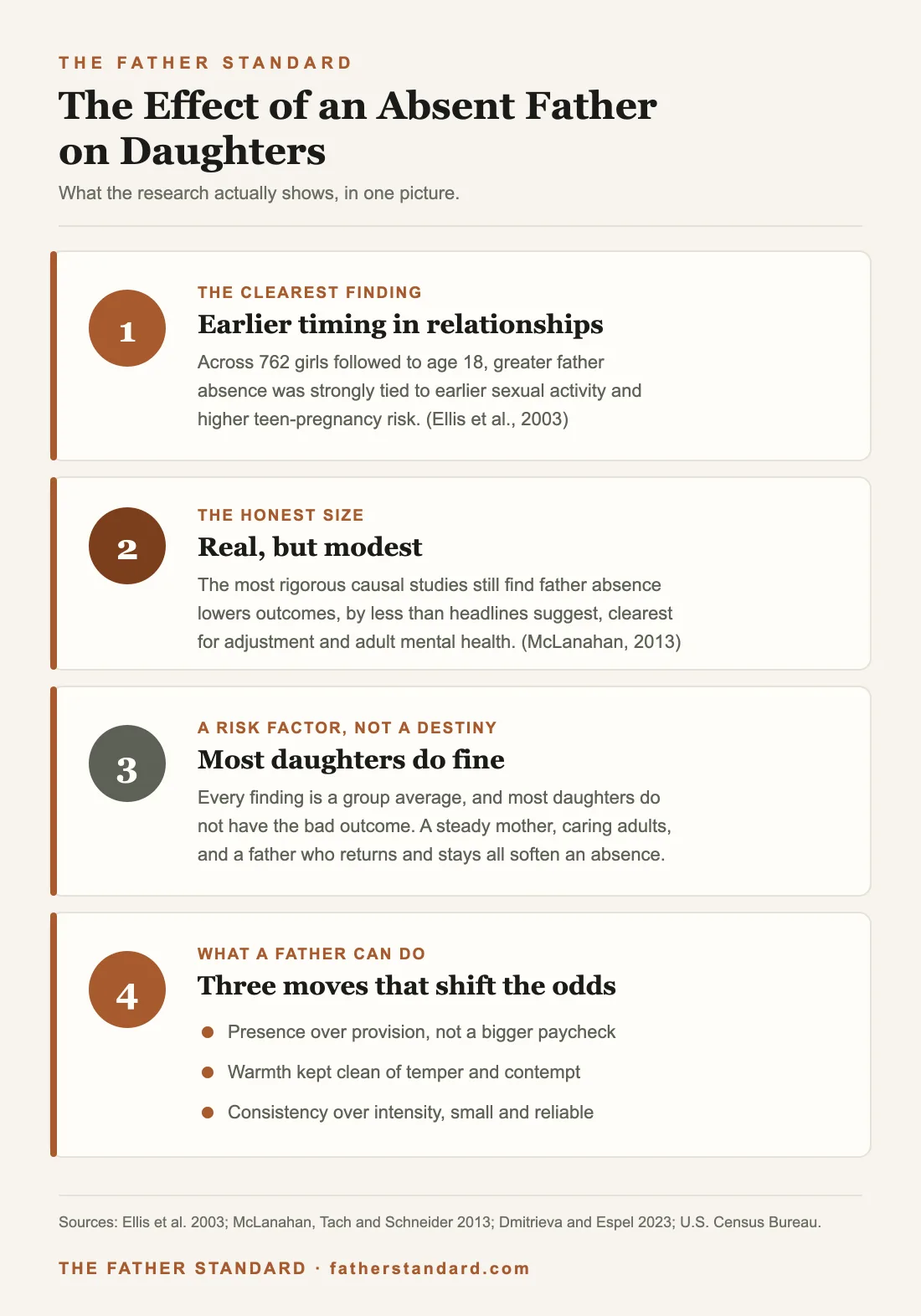
The effect of an absent father on daughters in one picture
Everything above, distilled into one image: the clearest effect, the honest limits, the buffers that soften an absence, and what a father can still do.
Test yourself
Five questions on the heart of this piece: what the research really found, where it is strongest, and how to read a risk factor without turning it into a prophecy. Every answer walks through the reasoning, so a wrong pick still leaves you better informed.
Key takeaways
Last reviewed by The Father Standard Editorial Team on August 11, 2026. How we source our work and use AI is documented on our editorial standards page.
FAQ
What is the main effect of an absent father on a daughter?
The most consistent measured effect is earlier sexual development and higher risk in relationships during adolescence. When Ellis and colleagues followed girls in the United States and New Zealand from age 5 to about 18, greater father absence was strongly linked to early sexual activity and teenage pregnancy, and that link was more consistent than any effect on schoolwork or general behavior. A father's absence also touches a daughter's mood and self-worth more quietly. All of it describes raised odds across a group, not a fixed outcome for one girl.
Does an absent father cause a daughter's problems, or is it just correlation?
It sits in between, and honesty matters here. Father absence usually comes bundled with other hard things like less money and more household stress, so a lot of the raw difference between father-present and father-absent daughters is really about those circumstances. But the careful review by McLanahan, Tach and Schneider, which gathered studies built to isolate cause, still found a real father-absence effect after accounting for those factors, just smaller than headline comparisons suggest. So it is partly causal and partly circumstance, and the effect is modest rather than overwhelming.
How does a father's absence affect a daughter specifically?
For a daughter, the clearest documented response to father absence is around the timing of her early relationships, reaching sexual milestones sooner and facing higher teen-pregnancy risk. The father-daughter bond also seems to carry unusual weight in how a girl learns to read male warmth. In one study of at-risk adolescent girls, the father-daughter relationship explained more of a daughter's depression and anxiety than the mother-daughter relationship did, and warmth mixed with hostility from a father was worse than plain distance. A daughter tends to internalize the relationship she had with her father and carry that template into later relationships.
Can a daughter grow up healthy without her father?
Yes, and most do. Every finding on father absence describes a group average, and inside those groups the majority of daughters do not have the negative outcome. Steady buffers make a large difference: a warm and reliable mother or grandmother, other caring adults like a coach or teacher, a stable home, and a father who returns and stays. None of these erase an absence, though each one takes the edge off it. A daughter without her father is at somewhat raised risk, not on a fixed track, and the rest of her world does most of the writing of her story.
Does a father coming back later still help a daughter?
It can, because a returning father is one of the protective factors, not an outsider to them. The odds a daughter carries are not sealed by an earlier absence. What helps is the unglamorous version of coming back: low-pressure and consistent contact, no demand for instant forgiveness, patience measured in months rather than days, and warmth kept clean of the old temper. A daughter does not need a grand apology so much as evidence that this time her father is simply, reliably present.
What is the difference between an absent father and an emotionally absent one for a daughter?
For a daughter's inner life, the difference is often smaller than it looks. A physically absent father is gone from the home; an emotionally absent father is in the house but unreachable. Both can leave a daughter without a safe, steady model of male attention, and both can shape how she reads closeness later. In some ways a warm-but-hostile father who is present teaches a harsher lesson than a clean absence, because a daughter learns that affection and harm arrive together. What matters most to her is not the father's location but whether his presence, when it exists, is safe and reliable.
Sources
- greater exposure to father absence was strongly tied to early sexual activity and adolescent pregnancy (pubmed.ncbi.nlm.nih.gov)
- father absence does lower children's well-being (pubmed.ncbi.nlm.nih.gov)
- the father-daughter relationship explained more of a daughter's depression and anxiety than the mother-daughter relationship did (pubmed.ncbi.nlm.nih.gov)
- Suicide and Crisis Lifeline (988lifeline.org)