Love and Logic Parenting for a Teenager: What Holds Up and What to Drop
Love and Logic is the parenting method that promises to end the fighting. No more yelling, no more lectures, no more standoffs at the kitchen table. You hand your teenager a couple of choices, you meet their mistakes with empathy instead of anger, and you let the consequences do the teaching while you stay calm. Parents have taken the classes for decades. Fathers, in particular, tend to love the promise, because it offers a way out of the two moves most of us default to and hate ourselves for: the blow-up and the caving.
Here is the part the seminar does not lead with. Love and Logic's core moves originated with younger children and classrooms, and even the teen-specific materials the institute sells carry that same DNA. Run those moves word for word on a fifteen year old and some of them work better than almost anything else you will try, and some of them read to your teenager as exactly what they are, a technique, a script, a dad who read a book. A teenager can smell a script from across the room.
So this is the honest sort: what to keep, what to adapt, and what to drop, with the evidence for why each call goes the way it does.
What Love and Logic actually is
Love and Logic came out of the work of Foster Cline, a psychiatrist, and Jim Fay, an educator, through the institute they founded in Colorado. Strip away the branding and the method rests on four ideas.
Build the kid's sense of self, so they see themselves as capable. Share control by offering choices inside limits you can live with, instead of issuing commands. Lead with empathy before any consequence lands, so the lesson attaches to the mistake rather than to your anger. And share the thinking, handing the problem back with a question rather than solving it for them.
On top of those four principles the method leans on a handful of signature techniques, chief among them the delayed consequence, the one where you buy time before you respond, and the calm catchphrase one-liner. The four principles are the foundation. The techniques are how the method tells you to deliver them.
Read all of that as a father of a teenager and something clicks. Every one of the four principles is a direct answer to a mistake fathers make with adolescents. We command when we should offer. We lecture when we should listen. We deliver consequences hot, wrapped in a speech, so the kid remembers the fight and forgets the point. Love and Logic is, at its best, a discipline for not doing those things. The question is whether each principle and each technique survives contact with a teenager, and the answer runs one at a time.
Shared control is the pillar that carries the weight
If you keep one thing from Love and Logic, keep this one. Sharing control means you stop issuing commands your teenager can only obey or defy, and you start offering choices you are genuinely fine with either way. Not "clean your room right now," which sets up a yes-or-no fight, but "you can get the room done before dinner or after, your call, and screens wait until it is." Both outcomes are acceptable to you. The teenager gets a real say. The power struggle has nowhere to plug in.
This is not a trick, and that is exactly why it works. Adolescence is the work of assembling a self that can stand apart from you, and a kid in the middle of that work pushes hardest against control that feels total. Offer a real choice and you hand them a piece of the autonomy they are wired to demand, without giving up the limit that actually matters to you. It also cuts against the direction most of us lean by default: put on the spot about their own tendencies, 45% of parents land on overprotective, and only 20% own up to allowing too much freedom. Shared control is a structured way to loosen a grip that runs tight on its own.
The evidence points the same direction, and it points hard at the failure mode. A meta-analysis of 161 studies on parenting and delinquency found that the guilt-tripping, pressure-based tactics psychologists file under psychological control sat among the parenting factors most strongly tied to delinquency, in the same tier as a parent's poor knowledge of what their kid was actually doing. That finding is the warning label on this whole method. Shared control is protective when the choices are real. The moment the "choice" is a rigged setup where one option is obviously unacceptable and the other is what you wanted all along, it stops being autonomy and becomes the manipulative control the data flags as harmful. Teenagers detect the rig instantly, and they file it under things dad does to manage me.
Pediatric guidance lands on the same posture from the other side: do far more listening than talking, and drop the lecture, since a teenager who gets lectured quietly tunes you out. Shared control is what listening looks like in the moment a decision has to get made.
Empathy before the consequence, and where it goes fake
The second keeper is the sequence. Love and Logic tells you to lead with genuine empathy before a consequence lands, so the teenager connects the fallout to their own choice rather than to your fury. Your kid bombs a test because the phone won all week. The Love and Logic move is not the speech. It is "oh, that is rough, I am sorry," said like you mean it, and then you let the grade, the lost weekend, the conversation with the teacher, be the teacher.
This holds up, and the reason it holds up is that it protects the warmth axis that the evidence keeps flagging. In the same delinquency meta-analysis, rejection and hostility, harsh criticism delivered in the heat of the moment, were among the parenting factors most strongly linked to delinquency. Empathy before the consequence is a discipline for not rejecting your kid at the exact moment they blew it. The consequence still lands. The pediatric guidance on discipline is blunt that you give the consequence and follow through rather than rescuing. What Love and Logic adds is the tone that keeps the kid from writing you off while it happens.
Here is where it goes fake, and where a teenager will torch you for it. If the empathy is a line you deliver because the book said to, in the same flat voice every time, your kid clocks it as a technique inside a week. "Oh, that is so sad" said with no actual sadness behind it is worse than saying nothing, because now you are performing care while running a play. The pillar is real empathy or nothing. A teenager can survive a father who is genuinely angry and honest about it. They cannot respect a father who fakes warmth to manage them.
The consequence you delay is the one that teaches
The third keeper is the one most fathers need most. Love and Logic tells you that when you are too angry to respond well, you delay. You say some version of "I am going to have to do something about this. I am not sure what yet. We will talk later," and you walk away.
This is not weakness and it is not letting it slide. It is the opposite of the hot consequence handed down in the doorway, which a teenager experiences as your temper, not their mistake. Delaying buys you the gap between the trigger and the response, and that gap is where the consequence turns from punishment into a lesson. It also models the exact skill you are trying to build in them, the pause between feeling something and acting on it. A father who can say "I need a night to think about this" in front of his teenager is teaching self-regulation by doing it, which lands far harder than any lecture about it.
The one caution: delay is not delay forever. If "we will talk later" becomes a way to avoid the hard conversation until everyone forgets, you have taught your kid that consequences evaporate if they wait you out. Delay to cool down, then follow through, exactly as the discipline guidance says.
Where Love and Logic breaks with a teenager
Now the honest debits. Love and Logic's signature moves were shaped around younger kids, and a few of them age badly.
The cheerful one-liners are the first to go. "I love you too much to argue," repeated in a bright singsong to a toddler, defuses. Aimed at a sixteen year old mid-conflict, the same line reads as smug, dismissive, and infuriating, because a teenager's grievance is often real and deserves an actual answer, not a rehearsed deflection. Keep the principle, refuse to argue, drop the singsong catchphrase. Say it in your own plain words.
The heavy reliance on choices can also thin out into gimmick if every single interaction becomes a staged two-option menu. Teenagers are old enough for straight conversation. Sometimes the honest move is not a choice at all but a direct "here is what I need from you and here is why," said adult to almost-adult. Over-scripting the method turns a relationship into a transaction, and a teenager will pull away from a dad who only speaks in techniques.
And the biggest limit, the one Love and Logic soft-pedals: natural consequences are for reversible mistakes only. Letting the grade drop, the money run out, the forgotten chore bite, that is cheap tuition. It has no business anywhere near a decision with lasting stakes. A drink behind the wheel, drug use, unprotected sex, self-harm, a weapon, none of those is a lesson you let land the hard way. Those stay flat, non-negotiable, parent-decides. Any method that makes you hesitate to intervene on a life-safety issue has been misapplied.
Keep, adapt, drop
The whole method sorted for a father of a teenager.
| Love and Logic move | Verdict | Why |
|---|---|---|
| Shared control through real choices inside a limit (principle) | Keep | Feeds the autonomy a teenager is wired to demand while your limit holds. The strongest principle. |
| Genuine empathy before the consequence (principle) | Keep | Protects the warmth the evidence flags as protective, so the lesson lands and the bond survives. |
| Share the thinking: hand the problem back with a question (principle) | Keep | "So what are you going to do about it?" builds the decision muscle and suits a teenager better than a younger child. |
| Build the kid's sense of themselves as capable (principle) | Keep | The foundation under the rest. A teenager who sees themselves as competent takes the choices and consequences seriously. |
| Delay the consequence when you are hot (technique) | Keep | Turns punishment into a lesson and models self-regulation by doing it in front of them. |
| Rigged choices where one option is unacceptable | Drop | Reads as manipulation, the psychological control the delinquency data links to worse outcomes. |
| Cheerful catchphrase one-liners | Adapt | Keep the refuse-to-argue principle, say it in your own plain words, lose the singsong script. |
| Everything routed through a two-option menu | Adapt | A teenager is old enough for straight talk. Reserve choices for real decisions, not every exchange. |
| Natural consequences for high-stakes risks | Drop | Reversible mistakes only. Safety items stay non-negotiable, parent-decides, no exceptions. |
Say it in your own words
The reason Love and Logic works when it works is not the scripts. It is the posture underneath them: a father who holds the line without heat, offers a real say inside that line, and lets reality do the teaching he used to try to do with a speech. No script survives if the kid does not feel you are actually there, and teenagers notice when you are not. Close to half of teens, 46%, catch a parent glancing at a phone at least some of the time while they are trying to talk. That posture is the same one the shift from managing a child to consulting a teenager is built on, and it is the same one that keeps a father present rather than merely providing once the kid is capable and pulling away.
If the method appeals to you because things at home have already gone quiet, understand that no technique reopens a closed door on its own. A teenage son who has stopped talking comes back through format and shared activity, not through a better script, which is its own repair and we walk through it in how to reconnect with your teenage son. And if the distance is older and wider than one adolescence, the slow drift of a good man into a stranger at home has its own mechanism, and it reverses the way it formed. If you would rather hear this argued out loud than read it, the parenting teenager podcasts worth the drive cover the same ground in the format most fathers actually have time for.
Take the three moves that end the daily standoffs, shared control, empathy before the consequence, and the pause when you are hot. Say them in your own voice. Skip the singsong. Keep the safety lines flat. That is Love and Logic with a teenager, honestly sorted.
This article is general information for fathers, not clinical or crisis advice. If your teenager is in danger or talking about not wanting to be here, call or text the 988 Suicide and Crisis Lifeline, available 24 hours a day in the US, or call 911, and involve a licensed professional.
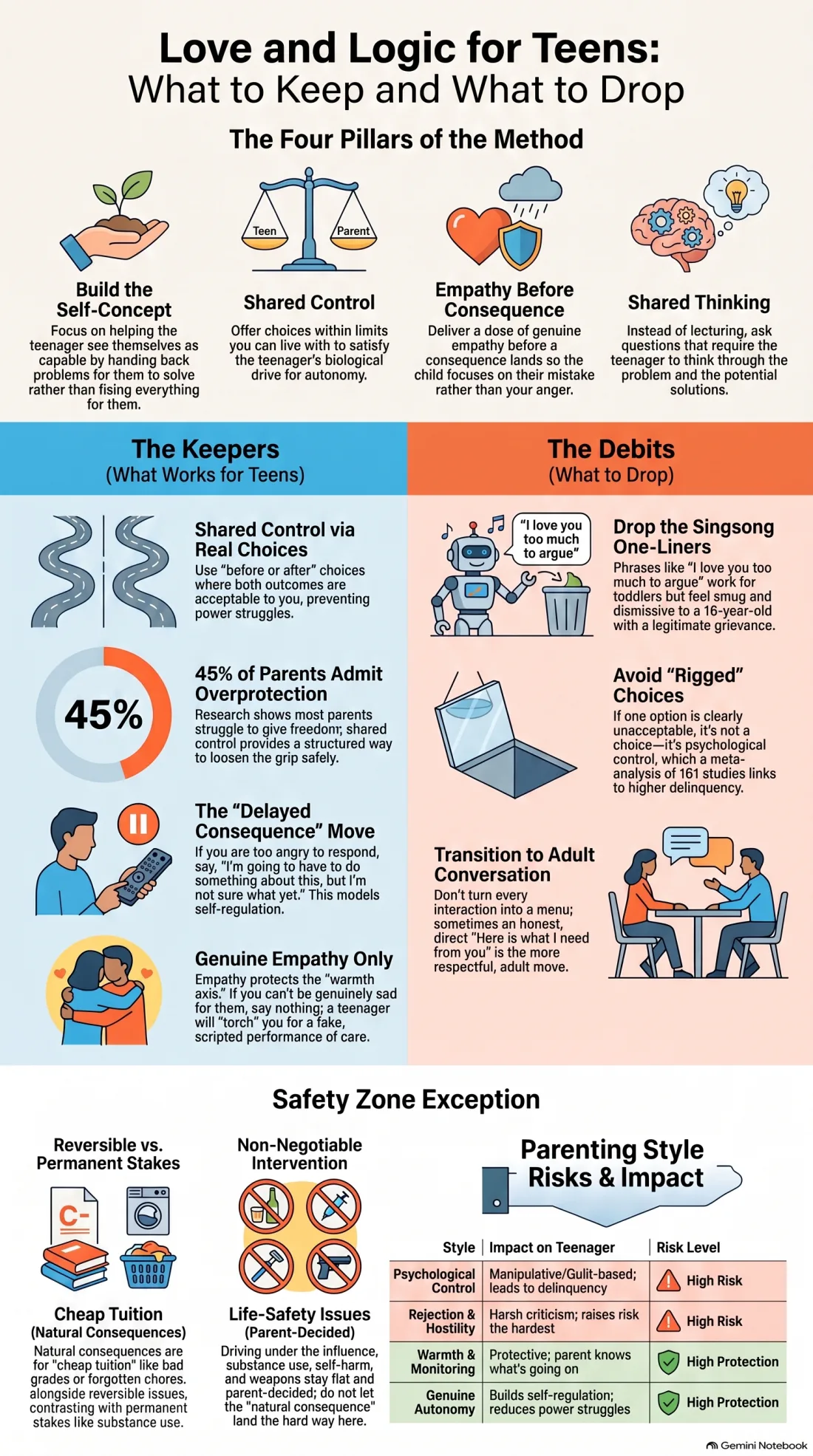
Love and Logic with a teenager in one picture
The whole method on one page: the four principles, its signature techniques, and a clear verdict on each for a father raising a teenager.
Test yourself
Five real situations to work through: a shared choice versus a rigged one, empathy ahead of the consequence, the pause when you are angry, and where the safety lines stay fixed. Every answer walks you through the why, so guessing wrong here teaches you more than guessing right.
Key takeaways
Last reviewed by The Father Standard Editorial Team on August 13, 2026. Our sourcing and AI-use rules are public on the editorial standards page.
FAQ
Does Love and Logic parenting work for teenagers?
Parts of it work better than almost anything else, and parts of it age badly. Its core moves were shaped around younger children and classrooms. The three that end the daily standoffs with a teenager are shared control through real choices, leading with genuine empathy before a consequence, and delaying a consequence when you are too angry to respond well, and the underlying principles of building the kid's sense of themselves and handing the thinking back hold up too. The parts to drop or rework are the cheerful catchphrase one-liners, which read as smug to a teenager, and any use of natural consequences on high-stakes safety issues, which stay non-negotiable. Say the keepers in your own plain words rather than as scripts, because a teenager detects a rehearsed technique fast.
What are the main principles of Love and Logic?
Foster Cline and Jim Fay built the method on four ideas: build the child's sense of themselves as capable, share control by offering choices inside limits you can live with, lead with empathy before any consequence so the lesson attaches to the mistake instead of your anger, and share the thinking by handing the problem back with a question rather than solving it. With a teenager, shared control and empathy-before-consequence are the load-bearing two.
Is giving my teenager choices just a way to manipulate them?
It becomes manipulation the moment the choice is rigged, meaning one option is obviously unacceptable and the other is what you wanted all along. A meta-analysis of 161 studies found that manipulative, guilt-based control carried a real risk to how teenagers turned out. The fix is to only offer choices where you are genuinely fine with either outcome. If you are not fine with one branch, it is not a choice, it is a command wearing a costume, and your teenager will see through it.
How do I discipline a teenager without constant fighting?
Stop issuing commands that can only be obeyed or defied, and start offering real choices inside a firm limit, so the power struggle has nothing to plug into. When a consequence is needed, lead with real empathy rather than a lecture, then let the consequence follow through instead of rescuing. If you are too angry to be fair, delay: say you need time to think and you will talk later, then actually follow up. Pediatric guidance is consistent that you listen more than you talk and give consequences you enforce calmly rather than in the heat of the moment.
When should I not use natural consequences with my teenager?
Never on anything with lasting consequences. Letting a bad grade, an empty wallet, or a forgotten chore bite is cheap and useful tuition. A drink behind the wheel, drug use, unprotected sex, self-harm, and weapons are not lessons you let land the hard way. Those stay flat and non-negotiable, and you intervene directly. Any version of a parenting method that makes you hesitate to step in on a life-safety issue has been misapplied.
My teenager has stopped talking to me. Will Love and Logic fix that?
No single technique reopens a closed door. Love and Logic can change how you handle conflict going forward, but a teenager who has gone quiet comes back through shared activity and low-pressure format, not through a better script, and trying to run a method on a kid who has already pulled away usually reads as one more thing dad is doing at them. Rebuild the connection first through presence and time, then the discipline framework has a relationship to sit inside.
Sources
- 45% of parents land on overprotective, and only 20% own up to allowing too much freedom (pewresearch.org)
- meta-analysis of 161 studies on parenting and delinquency (pubmed.ncbi.nlm.nih.gov)
- do far more listening than talking, and drop the lecture (healthychildren.org)
- give the consequence and follow through (healthychildren.org)
- 46%, catch a parent glancing at a phone at least some of the time (pewresearch.org)