Parenting Teenager Podcasts: Which Ones Are Still Running, and How to Make One Change Something
The parenting teenager podcasts still publishing as of 26 August 2026 are Ask Lisa, Feeding The Mouth That Bites You, Parenting Teens with Dr. Cam, Raising Good Humans and The Dad Edge. A sixth, Speaking of Psychology, is also publishing, but it is not a parenting show at all. It is researchers explaining their own work, and it is the one to reach for when you want to check a claim you heard somewhere else. Two shows that sit near the top of almost every recommendation list you will find, Talking To Teens and ON BOYS, have not released a new episode in ten months or more.
We know that because we checked the feeds ourselves on 26 August 2026 rather than copying somebody else's list. That is the first thing worth saying about this category. Most of the "best parenting teenager podcast" pages ranking today were written once and never re-checked, so they keep sending fathers to shows that stopped.
The second thing is less comfortable. A podcast is a very good way to stop feeling alone at 7am on a motorway, and a very poor way to change what happens in your kitchen on Thursday. Those are different jobs, and the drive home is where most of what you hear quietly dies.
So this page does two things. It tells you which feeds are alive and what each one is for, and then it deals with the part almost nobody covers, which is how to stop an episode evaporating between the car park and the front door.
The list, checked against the live feed on 26 August 2026
Every row below was verified against the podcast's own feed on 26 August 2026. Episode counts and last publish dates are what the feed reported that day, not what a directory listing claims.
| Podcast | Who hosts it | Episodes | Last published | What it is actually for |
|---|---|---|---|---|
| Ask Lisa: Untangling Family Life | Dr. Lisa Damour, clinical psychologist, with Reena Ninan | 290 | 25 Aug 2026 | One listener question per episode, answered from developmental psychology. The closest thing here to a second opinion on a specific situation. Now published under the title above, having run for years as Ask Lisa: The Psychology of Raising Tweens and Teens, so search the current name. |
| Feeding The Mouth That Bites You | Dr. Kenneth Wilgus, psychologist, with Cynthia Yanof | 265 | 25 Aug 2026 | Handing control over in planned stages rather than fighting for it. Useful if your teenager is 15 or older and the arguments are about autonomy. |
| Parenting Teens with Dr. Cam | Dr. Cam, adolescent psychologist and coach | 294 | 11 Aug 2026 | Short, practical, conflict-focused. Good for the specific week where every conversation is turning into a row. |
| Raising Good Humans | Dr. Aliza Pressman, developmental psychologist | 399 | 21 Aug 2026 | Broad age range, so you will filter. Strongest on the parent's own regulation, which is often the actual variable. |
| Speaking of Psychology | American Psychological Association | 443 | 19 Aug 2026 | Not a parenting show. It is researchers explaining their own work, so it is the one to reach for when you want to check a claim you heard somewhere else. |
| The Dad Edge Podcast | Larry Hagner, not a clinician | 1,529 | 26 Aug 2026 | Fathers talking to fathers, marriage and self-management as much as parenting. Company rather than clinical guidance, and worth knowing which one you are getting. |
| Talking To Teens | talkingtoteens.com, author interviews | 669 | 13 Jul 2025 | Dormant for over a year. The back catalogue is still the deepest interview archive in this niche and remains worth mining by topic. |
| ON BOYS Podcast | Janet Allison and Jennifer LW Fink | 371 | 16 Oct 2025 | Dormant for ten months. Still the most focused archive specifically on raising boys, which most general parenting shows treat only in passing. |
| Parenting Great Kids | Dr. Meg Meeker, paediatrician | 311 | 15 Jun 2026 | Publishing, but slowly. Written from a paediatric practice, with a father-daughter emphasis running through much of it. |
A dormant feed is not a bad feed. Talking To Teens has 669 episodes sitting there, most of them interviews with the author of a specific book, and if you are looking for one narrow subject that archive will usually beat a live show's latest release. The distinction that matters is between a show you subscribe to and a library you search.
Which of these feeds is still moving
What the evidence does and does not support
Here is where most articles in this category would tell you that podcasts make you a better father. We cannot tell you that, because nobody has tested it.
What has been tested, extensively, is structured parenting programmes. A systematic review and meta-analysis of the Triple P system in Clinical Psychology Review pooled 101 studies covering 16,099 families across a 33-year period. It found significant short-term effects on children's social, emotional and behavioural outcomes, on parenting practices, and on parental adjustment. It also found that the level of the programme was one of the things that changed how well it worked, still significant once the other factors were accounted for. Triple P is built as a graded ladder. A separate review of the Stepping Stones version describes five levels of increasing intensity, running from low-intensity media-based parenting information at level one, through brief interventions in the middle, to intensive parent training and family therapy at levels four and five. Where a family sat on that ladder was not incidental to the result.
That finding belongs to a different intervention altogether, one built on a designed curriculum, homework and feedback. It is not a finding about podcasts. What it establishes is narrower and more useful: in the one delivery format that has been measured properly, intensity was one of the things that moved the outcome. Passive information sat at the bottom of that ladder.
So our position, and we label it as ours rather than the literature's, is this. Listening is not the intervention. It is the thing that occasionally produces one. An episode earns its 45 minutes when it leaves you doing one thing differently, and it earns nothing when it leaves you better informed and identical.
Podcast listening itself is no longer a niche habit, which is why the quality of what gets recommended matters. Pew Research Center found that 54% of US adults had listened to a podcast in the past 12 months in its 2025 survey, up from 49% when the question was first asked in 2022, with listening concentrated among younger adults at 67% of those aged 18 to 29 against 33% of those 65 and over.
The reason to bother at all is the thing that has been measured. Steiner and colleagues, using two waves of the National Longitudinal Study of Adolescent to Adult Health, examined family and school connectedness in adolescence against health outcomes in adulthood across 14,800 people. Compared with people who scored low on both, those with high levels of both family and school connectedness had 48% to 66% lower odds of a range of health risk behaviours and experiences in adulthood, depending on the outcome. This is an observational cohort, so it shows association and not cause, and the authors are careful about that. But what it points at has nothing to do with information transfer. What matters is whether your teenager experiences you as someone they are connected to. No episode delivers that. Only the next fortnight of your behaviour does.
The one-change rule
The practical version is short enough to remember on a motorway.
One episode, one change, one week. When an episode ends, name the single smallest thing you will do differently, out loud, before you park. Then do that one thing for a week before you listen to anything else on the subject.
Most fathers we would expect to find this uncomfortable, because the ratio feels wrong. Forty-five minutes of expert material reduced to one small behaviour looks like waste. It is the opposite. Three good ideas held loosely produce nothing. One small behaviour held for seven days produces evidence, and evidence is what tells you whether the idea was any good in your house with your kid.
What counts as small enough:
- Ask one open question at dinner and then say nothing for the rest of the answer.
- Drive him somewhere he was going to get to on his own anyway.
- Do not comment on the first thing you would normally comment on.
- Say the thing you noticed, without attaching what he should do about it.
Those are the size. If your change requires a family meeting, it is too big and it will not survive Tuesday. The same logic runs underneath how to reconnect with your teenage son, where the finding is consistently that the small repeated move beats the planned conversation.
How to vet a parenting podcast in ninety seconds
Four checks, in order. Any show that fails the first two is entertainment, which is a legitimate thing to want, but you should know which one you have picked up.
| Check | What you are looking for | What it tells you |
|---|---|---|
| Last publish date | An episode inside the last 3 months | Whether the show is alive. Two of the nine we checked were not, and a third, Parenting Great Kids, is close to the line. |
| Who is talking | A stated clinical or research credential, or an honest absence of one | Hosts who state plainly that they are a parent and not a clinician are more trustworthy than hosts who blur it. |
| What happens at a claim | The study named, or the claim marked as opinion | "The research says" with nothing attached is the single most common failure in this category. |
| What the episode sells | Where the call to action points | A course at the end is not disqualifying. A course that is the answer to every question is. |
A show can pass all four and still be wrong for your house. Credentials establish that someone is worth listening to. They do not establish that the advice fits a fifteen-year-old who has been quiet since March. That judgement stays yours, and it is covered at more length in how to tell what works from what backfires.
Listening with him in the car
The move almost nobody mentions is to stop listening about your teenager and start listening alongside him.
Not a parenting podcast. He does not want to hear a psychologist discuss the management of someone like him, and putting one on in a shared car is a small act of surveillance whatever your intentions. Something he is interested in, that you know nothing about, with him controlling the queue.
What this does is invert the roles for 30 minutes. He is the one who knows the material. You are the one asking. That is an unusual arrangement in a father and teenager relationship and it tends to produce more real conversation than any episode about communication ever will. It also costs nothing and requires no new skill, which puts it inside the category of structure that quietly does the heavy lifting.
The car helps for a reason that has nothing to do with audio. You are side by side rather than face to face, there is a fixed end point, and nobody has to decide when the conversation is over. Those three properties do more work than the content.
When a podcast is the wrong tool
There is a point where reaching for another episode is a way of not doing the harder thing.
If your teenager has stopped eating or sleeping normally, has withdrawn from everything they used to care about, is hurting themselves, or has said anything about not wanting to be here, that is not a listening problem and no episode is the right response. If there is any risk to their safety right now, the 988 Suicide and Crisis Lifeline in the United States takes calls and texts around the clock, and it is for worried parents as well as for people in crisis. Outside the US, your local crisis line covers the same ground. After that, a paediatrician or a licensed adolescent clinician, not a podcast queue.
The same applies more quietly to the ordinary version. If you have listened to eleven episodes this month and changed nothing, the podcast has stopped being a resource and started being a way to feel active while remaining still. That is worth catching in yourself, because it feels like effort. It is a pattern we have written about directly in what dad guilt is actually measuring.
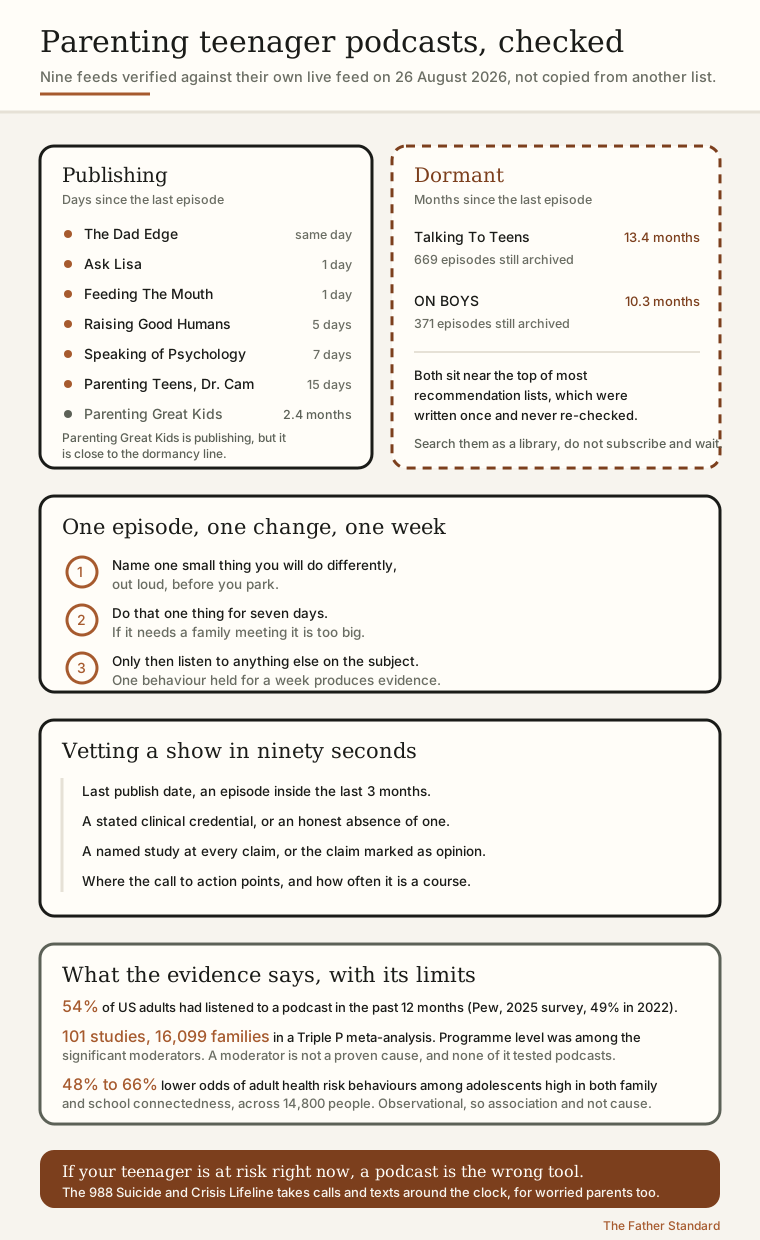
Parenting teenager podcasts, in one picture
Test yourself
Key takeaways
Last reviewed by The Father Standard Editorial Team on August 26, 2026. Podcast episode counts and last publish dates were verified against each show's live feed on that date. Our sourcing and AI-use rules are public on the editorial standards page.
FAQ
What is the best podcast for parents of teenagers?
For most fathers, Ask Lisa. It is hosted by a clinical psychologist, it answers one specific listener situation per episode rather than covering a topic in general, and it published as recently as 25 August 2026 with 290 episodes behind it. If your friction is specifically about autonomy and control with an older teenager, Feeding The Mouth That Bites You is the better first pick. If you want a father's register rather than a clinical one, The Dad Edge, with the caveat that its host is not a clinician and does not claim to be.
Are parenting podcasts actually useful?
They are useful for two things and unreliable for a third. They are good at reducing the sense that your house is uniquely broken, and good at giving you vocabulary for something you had noticed but could not name. They are unreliable at changing behaviour, because nothing about listening requires you to do anything. No study has tested podcasts specifically. The nearest evidence, from structured parenting programmes, found that how intensively a programme was delivered was among the factors that moved the outcome, and passive information sits at the bottom of that range. Treat an episode as a prompt rather than a treatment.
How can you tell if a parenting podcast is giving good advice?
Four checks, about ninety seconds. Check the last publish date, because a show with no episode inside three months may be dead. Check who is talking, and prefer a host who states a credential, or says plainly they are a parent and not a clinician, over one who blurs the two. Check what happens at a claim, because "the research says" with nothing attached is the commonest failure here. Then check where the call to action points, since a course at the end is not disqualifying but a course that answers every question is. A show can pass all four and still be wrong for your house, and that judgement stays yours.
Is Talking To Teens still active?
No. As of 26 August 2026 its most recent episode was published on 13 July 2025, which is more than thirteen months of silence. The archive of 669 episodes is still available and still useful, because most of those episodes are interviews built around one book on one narrow subject. Search it by topic rather than subscribing to it and waiting.
Should I listen to a parenting podcast with my teenager in the car?
No. A podcast about managing teenagers, played in a car containing a teenager, reads as surveillance no matter how it is meant. The version that works is the reverse: let him pick something he is interested in and you know nothing about, and ask questions. Being side by side, with a fixed end point and no obligation to decide when talking is over, does more for the relationship than any episode about communication.
How long should a parenting podcast episode be?
There is no tested ideal length, so that is the wrong question to ask of an episode. What matters is whether it ends with one instruction you can act on. Use the one-change rule above as the actual measure. If you cannot say in one sentence what you are going to do differently this week, the episode failed regardless of its running time.
Are there parenting teenager podcasts made specifically for fathers?
Few that are both father-focused and teenager-focused. The Dad Edge is the largest active show written for fathers, though it covers marriage and self-management as much as parenting and its host is not a clinician. ON BOYS is the deepest archive specifically on raising boys, but it has not published since 16 October 2025. The practical answer for most fathers is to use a clinician-hosted general show for the substance and accept that the register will not be a father's.
When should I stop listening and get help instead?
When your teenager has stopped eating or sleeping normally, has withdrawn from things they used to care about, is hurting themselves, or has said anything about not wanting to be alive. That is a clinical situation and no episode addresses it. If there is any immediate risk, contact the 988 Suicide and Crisis Lifeline in the United States or your local crisis line, then a paediatrician or a licensed adolescent clinician. The quieter signal to watch in yourself is listening a lot and changing nothing, which feels like effort but is closer to avoidance.
Sources
- Ask Lisa: Untangling Family Life (podcasts.apple.com)
- Feeding The Mouth That Bites You (podcasts.apple.com)
- Parenting Teens with Dr. Cam (podcasts.apple.com)
- Raising Good Humans (podcasts.apple.com)
- Speaking of Psychology (podcasts.apple.com)
- The Dad Edge Podcast (podcasts.apple.com)
- Talking To Teens (podcasts.apple.com)
- ON BOYS Podcast (podcasts.apple.com)
- Parenting Great Kids (podcasts.apple.com)
- 101 studies covering 16,099 families (pubmed.ncbi.nlm.nih.gov)
- five levels of increasing intensity (pubmed.ncbi.nlm.nih.gov)
- 54% of US adults had listened to a podcast in the past 12 months (pewresearch.org)
- family and school connectedness in adolescence against health outcomes in adulthood (pubmed.ncbi.nlm.nih.gov)
- 988 Suicide and Crisis Lifeline (988lifeline.org)