How Can I Be a Better Father to My Daughter? The Measured Answer Is Three Things, and You Have Probably Already Done the Easiest One
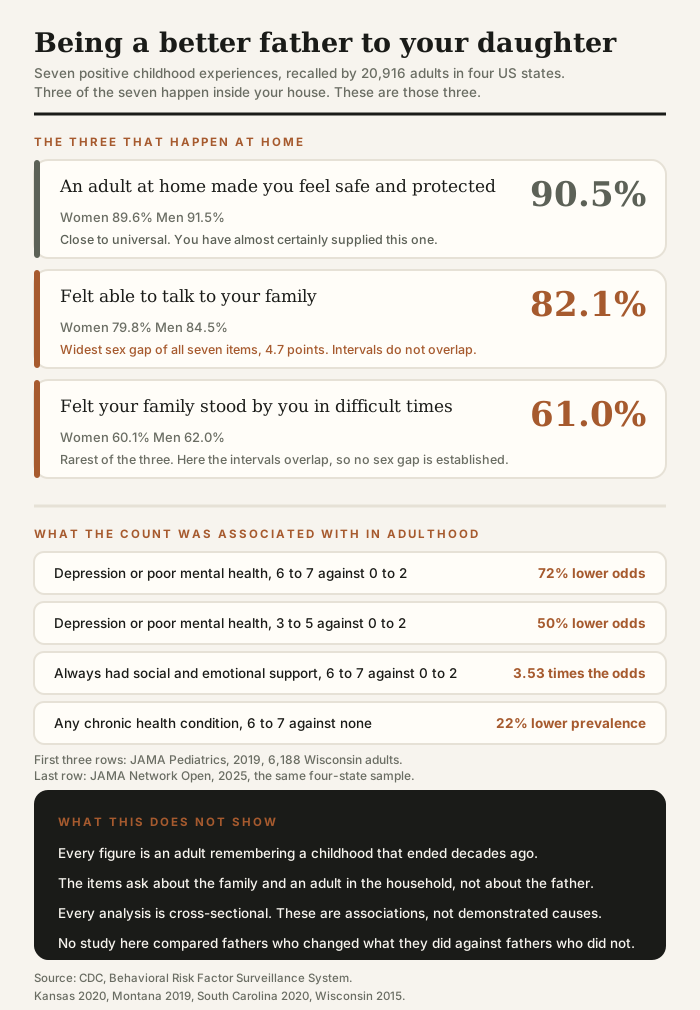
The closest thing to a measured answer is three things that happen inside your house: an adult at home who makes her feel safe and protected, a family she feels able to talk to, and a family that stands by her when things go wrong. Adults were asked years later whether each had been true of their own childhood, and the count was then scored against their adult health. You have almost certainly done the first one. In a CDC survey of 20,916 adults across four states, 90.5 percent recalled it. Only 61.0 percent recalled the third. And on the middle one, women recalled it at 79.8 percent against 84.5 percent for men, with confidence intervals that do not overlap.
So the answer is narrower than the question sounds. Safety is close to universal and you have supplied it. What is left is being the kind of house she can talk in, and what you do on the day she tells you something hard. Neither is what a father is usually told to work on, and one of them is measurably thinner for daughters than for sons.
Where the seven come from, and what they are
Researchers took seven positive childhood experiences and asked adults, years later, whether each one had been true of their own childhood. The Centers for Disease Control and Prevention published the prevalence of all seven in 2024, using Behavioral Risk Factor Surveillance System data from Kansas in 2020, Montana in 2019, South Carolina in 2020, and Wisconsin in 2015. The sample was 20,916 people, 11,357 of them women.
The seven split into three that happen at home and four that happen outside it. The household three are that an adult in the home made you feel safe and protected, that you felt able to talk to your family about your feelings, and that your family stood by you during difficult times. The other four are enjoying community traditions, a sense of belonging in high school, feeling supported by friends, and having at least two nonparent adults who took a genuine interest in you.
That split is the first practical thing on this page. Four of the seven are not yours to supply directly, though the last of them, two adults outside the family who take a real interest in her, is something a father can quietly arrange over years. The three that are yours are the three below.
The one you have almost certainly done
Of all seven experiences, the household safety item had the highest recall in the country: 90.5 percent, with a confidence interval of 89.9 to 91.1. For women specifically it was 89.6 percent, against 91.5 percent for men.
This is worth saying plainly to a father who arrived here worried. The thing most men picture when they picture fathering, a house where a child is physically safe and protected by an adult, is the thing nine in ten adults report having had. If you are supplying it, you are not failing at the job. You are at the point where the remaining gains sit somewhere else.
The two that are not covered, and the daughter-specific part
Here are the three household items side by side, by the respondent's sex.
| Recalled from childhood | Women | Men | All |
|---|---|---|---|
| Safe and protected by an adult at home | 89.6% | 91.5% | 90.5% |
| Able to talk to your family | 79.8% | 84.5% | 82.1% |
| Family stood by you in hard times | 60.1% | 62.0% | 61.0% |
Two things in that table deserve different levels of confidence, and it matters that they are not treated the same.
The talking gap is the solid one. Women recalled it at 79.8 percent, confidence interval 78.6 to 81.0. Men recalled it at 84.5 percent, confidence interval 83.4 to 85.6. Those intervals do not touch, which is a conservative way of saying the difference is unlikely to be noise. It is the largest sex gap of any of the seven items, at 4.7 percentage points.
Confidence runs the other way on the third item. Women recalled standing-by at 60.1 percent with an interval of 58.7 to 61.5, men at 62.0 percent with an interval of 60.4 to 63.4, and those two intervals overlap. Anyone telling you daughters are less likely to feel their family stood by them is reading more into this table than it holds.
What the count is associated with in adulthood
The prevalence numbers alone would be a curiosity. What makes them worth a father's attention is that the count of these experiences has been scored against adult outcomes twice, in two separate papers.
| Experiences recalled | What it was associated with |
|---|---|
| 6 to 7, against 0 to 2 | 72% lower adjusted odds of depression or poor mental health |
| 3 to 5, against 0 to 2 | 50% lower adjusted odds of depression or poor mental health |
| 6 to 7, against 0 to 2 | 3.53 times the odds of always having support |
| 6 to 7, against none | 22% lower prevalence of any chronic health condition |
| 6 to 7, against none | 36% lower prevalence of current smoking |
The first three rows come from the 2019 JAMA Pediatrics analysis of 6,188 Wisconsin adults. In raw terms, 12.6 percent of adults with six or seven of these experiences reported depression or poor mental health, against 48.2 percent of adults with two or fewer. The last two rows come from a 2025 JAMA Network Open analysis of the same four-state sample of 20,916 people.
Every one of these is cross-sectional and every one of them is an association. The 2019 authors write that the experiences show dose-response associations after accounting for exposure to adverse childhood experiences. They do not report that supplying the experiences caused the outcome, and nothing in either paper tests a father who changed his behaviour.
The channel is narrowing nationally, not only in your house
There is a second, present-tense measure worth putting beside the recall data, because it runs in the wrong direction.
The federal Healthy People 2030 programme tracks an objective on children communicating positively with their parents, drawn from the National Survey of Children's Health run by HRSA and its Maternal and Child Health Bureau. Its baseline statement reads that 68.6 percent of children and adolescents aged 6 to 17 years had parents who reported that they and their child can share ideas or talk about things that matter in 2016-17. The target for 2030 is 73.1 percent. The most recent figure, for 2022 to 2023, is 61.9 percent.
That is a fall of 6.7 percentage points against a target that required a rise. The federal status on the objective is that it is getting worse. This is parent-reported rather than child-reported, so it measures what fathers and mothers believe about the channel rather than what their children would say, and the two are not the same number. Taken for what it is, it says the thing with the widest daughter gap in the recall data is also the thing the country is losing. That is a national trend and not a grade on your house.
The honest limits, and they are not small
Four of them, and each one narrows what you should take from this page.
These are adults remembering childhoods that ended decades ago, and memory of a childhood is shaped by the adult life that followed it. Nothing here followed a child forward in time.
The item says family, not father. A woman who recalls being able to talk to her family may be recalling her mother, a grandmother, or a sibling. No analysis on this page isolates the father's contribution, and it would be dishonest to read these numbers as a scorecard for you specifically.
The four states are Kansas, Montana, South Carolina and Wisconsin, and the 2019 sample was 84.9 percent white. The national picture may not look like this.
And the design cannot answer the question a father is actually asking. It compares adults who recall different childhoods. It does not compare fathers who changed what they did against fathers who did not. The direction of the arrow is assumed rather than tested.
What to change this week
Given the limits above, the useful move is not to chase the outcome. It is to supply the input that is measurably thinnest and let the evidence be what it is: a reason to bother rather than a promise.
The talking item is about her being able to, not about the two of you having talked. The measure asked whether she felt able to. That is a property of the room rather than a property of the conversation, and it is built out of what happens on the ordinary evenings when nothing is wrong. In practice it means a recurring low-pressure slot that does not depend on her being in the mood, and putting your phone face down when she starts talking, because what she brings arrives on her schedule and almost always at a bad moment. The research on why it arrives that way is set out in parenting teenager advice.
Standing by her is decided on one bad day rather than banked in advance. It gets settled the afternoon she tells you something you find hard to hear, and the score she gives it decades later is set by what you did in the first ten minutes. The instruction for those ten minutes is short enough to keep in your head: understand the thing before you react to it, and say you are glad she told you before you say anything at all about the thing itself. It is the lowest-prevalence household item in the country, at 61.0 percent, and it is the one that nobody thinks to work on because there is nothing to do about it until the day there is.
The fourth community item, at least two nonparent adults who took a genuine interest, was recalled by 71.8 percent of adults and is the one most open to a father's quiet arranging. A coach who sticks, an aunt she can call, a teacher who stays in touch. You are not competing with those people. You are supplying them.
And if your first instinct is to read all of this as evidence that you have already failed, that instinct has its own body of research, which we take apart in dad guilt. A father worried enough to read a page like this is not the father the low numbers are describing.
If your daughter is in crisis, call 911 or reach the 988 Suicide and Crisis Lifeline by call or text at any hour. Everything here is published research, summarized. It is not clinical advice and it replaces no licensed professional.
Being a better father to your daughter, in one picture
Test yourself
Key takeaways
Last reviewed by The Father Standard Editorial Team on September 12, 2026. How we source our work and use AI is documented on our editorial standards page.
FAQ
How can I be a better father to my daughter?
Three household experiences have been scored against adult outcomes, and they are covered at very different rates nationally: safety at home by 90.5 percent of adults, being able to talk to your family by 82.1 percent, and a family that stood by you in difficult times by 61.0 percent. The room to improve is in the last two. Which of those two carries a real daughter gap, and which does not, is set out under the household table above. All of this is adult recall and association, not proof of cause.
What is the one thing daughters are least likely to have had?
Of the three household items, the least common by a wide margin is feeling that your family stood by you during difficult times, recalled by 60.1 percent of women and 61.0 percent of adults overall. Feeling safe at home was recalled by 89.6 percent of women. The gap between those two numbers is roughly thirty points and it sits inside the same houses.
Is there really a difference between fathering a daughter and fathering a son?
On this evidence, one difference is measured and it is narrow. Women recalled feeling able to talk to their family at 79.8 percent against 84.5 percent for men, and the confidence intervals do not overlap. On the other two household items the intervals overlap or the gap is under two points, so no reliable difference is established. The broader case that daughters need a categorically different kind of father is not something this dataset supports, and we test that claim against a controlled trial in raising a daughter.
Does giving my daughter these experiences guarantee she will be fine?
No. Every finding on this page is cross-sectional, drawn from adults recalling their own childhoods, and no analysis followed a child forward or compared fathers who changed their behaviour against fathers who did not. The 2019 paper reports 72 percent lower adjusted odds of depression or poor mental health for adults with six or seven of the experiences against zero to two. Lower odds in a population is not a prediction about one person.
My daughter does not talk to me. Does that mean I have failed?
Not on this evidence. The survey item measures whether she felt able to talk, which is a question about the conditions rather than about the frequency of conversations, and a teenager who says little may still score it positively. Nationally the parent-reported version of this measure has fallen from 68.6 percent to 61.9 percent between 2016-17 and 2022-23, so a narrowing channel is the common case rather than a private failure.
Does any of this measure fathers specifically?
No, and that is the most important limit on the page, set out in full under the honest limits above. The items ask about the family and about an adult in the household, so no number here scores you individually. What the evidence supports is that these three experiences are worth supplying, not that only a father can supply them.
What about the four experiences that happen outside the home?
They are enjoying community traditions, a sense of belonging in high school, feeling supported by friends, and having at least two nonparent adults who took a genuine interest, recalled by 59.5, 71.8, 80.3 and 71.8 percent of adults respectively. A father does not control these directly. The last one is the most open to being quietly arranged over years, and it counts the same as the household items in the score.
Is more time with my daughter the answer?
Time is the input most fathers reach for first, and the evidence on how it is actually spent complicates that instinct, which we set out in how to be a better father and in being present, not just providing. Nothing in the positive childhood experiences work measures hours. It measures whether three things were true of the household, and a house can contain a lot of shared hours without any of the three being true.
Sources
- CDC survey of 20,916 adults across four states (cdc.gov)
- 2019 JAMA Pediatrics analysis (europepmc.org)
- 2025 JAMA Network Open analysis (europepmc.org)
- baseline statement (odphp.health.gov)