How Can I Be a Better Father to My Son? Three Things to Change, and Why "He Seems Fine" Is Your Weakest Evidence
Put less weight on what your son tells you about himself. In the population data a father can actually check, that is the difference this page focuses on between fathering a son and fathering a daughter, and it points somewhere less satisfying and more useful than the list most answers hand a father: throw a ball, take him camping, have the conversation.
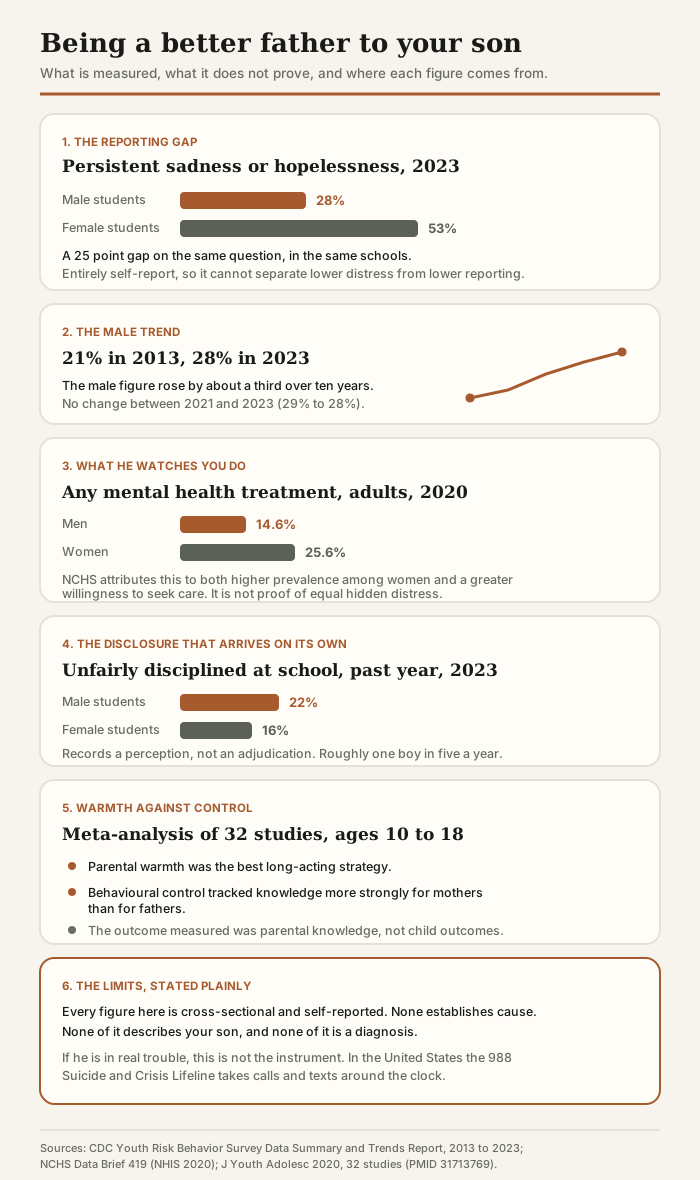
On the 2023 national high school survey, 28 percent of male students reported persistent feelings of sadness or hopelessness. Among female students the figure was 53 percent. That is a gap of 25 percentage points on the same question, in the same schools, in the same year. What a father does with that gap decides most of the rest.
One note before any of the data. If his low mood or withdrawal has already lasted more than two weeks, or he has mentioned harming himself, that is not what this page is for. Call or text 988 in the United States, or reach a licensed professional. Everything below is about the ordinary week, not the urgent one.
The short answer
Three things, none of them an activity. The first and third are drawn from measured population data. The second is our own editorial position, labelled as such where it appears.
Stop treating his own account as your primary instrument. Be a man he has watched handle difficulty out loud, because that is where he learns what a man does with it. And take his side of a story seriously on the one occasion he reliably volunteers one.
The rest of this page is why those three and not the usual list, and where each of them stops being supported.
The 25 point gap, and the two readings of it that a father has to hold at once
The Centers for Disease Control and Prevention runs the Youth Risk Behavior Survey every two years across a nationally representative sample of students in grades 9 through 12. Its Data Summary and Trends Report for 2013 to 2023 puts persistent feelings of sadness or hopelessness at 40 percent of all high school students in 2023, and splits that by sex: 53 percent of female students, 28 percent of male students.
There are exactly two ways to read a gap that size, and the honest position is that this survey cannot pick between them.
The first reading is that adolescent boys are, on average, genuinely less likely to be in that state. That is a real possibility and the National Institute of Mental Health says something close to it in plain terms on its men and mental health page: the prevalence of several mental disorders is lower in men than in women. Taken alone, the 28 percent is good news about your son's odds.
The second reading is that the survey asks a fifteen year old boy to describe his inner state in writing and then counts what he writes down. Every figure in that report is self-report. The instrument and the boy are the same person.
What tips this from an academic question into a practical one is the male trend line in the same report. The male figure did not sit still. It rose from 21 percent in 2013 to 28 percent in 2023, an increase of a third over ten years, while the two year change from 2021 to 2023 showed no movement at all. Whatever the 28 percent is measuring, more boys are now saying it than were saying it a decade ago.
A father does not get to resolve this. What he gets is a rule that works under either reading: with a son, "he seems fine" and "he says he is fine" are the same sentence, and neither is a measurement. Build something that does not depend on him volunteering.
The thing he is learning by watching you
The one place a father has real purchase on this is not what he asks his son. It is what his son has seen him do.
The National Center for Health Statistics reported that in 2020, 25.6 percent of women had received any mental health treatment in the past 12 months, against 14.6 percent of men. Medication ran 21.2 percent against 11.5 percent. Counselling or therapy ran 12.1 percent against 7.9 percent.
The honest caveat comes from the report itself rather than from us. NCHS attributes the difference to two things at once: the higher prevalence of common conditions such as anxiety and depression among women, and what it calls an increased willingness to seek out mental health care. So this is not clean evidence that men are silently suffering at the same rate. Some of that gap is real prevalence. The report does not say how much.
But the part that is not prevalence is the part your son is watching. He is forming a working model of what a man does when something is wrong, and almost all of his data on that subject comes from one man. This is narrower than the general case that a son picks up emotional vocabulary from his father, which we cover in raising a son. It is specifically about whether he has ever seen a man ask for help. This is the lever with the shortest distance between a father and an effect, and it costs nothing: say the true thing out loud once. That the week was hard. That you asked someone for help with it. That you are seeing someone about your back, or your sleep, or your head.
This is the one recommendation on this page that has no effect size attached to it, and we are labelling it as such: it is an editorial working position, not a measured result. The measured part is only that the adult male and female treatment rates differ by roughly eleven percentage points and that CDC reads willingness as part of the reason.
The one story a son reliably volunteers
If the channel problem is that boys disclose less, the practical question is where they still do. The same 2023 survey contains an answer that is easy to miss, because it sits in a section about schools rather than about feelings.
Nineteen percent of high school students reported being unfairly disciplined at school during the past year. Split by sex, it runs 22 percent of male students against 16 percent of female students. It is one of the few items on the whole instrument where boys score higher than girls.
Note carefully what that measures. It records the student's report that the discipline was unfair. It does not establish that it was. A father who reads it as proof that schools mistreat boys has gone past the data, and so has a father who reads it as proof that boys behave worse.
What it does establish is frequency. Roughly one boy in five arrives home each year with a grievance about an adult in authority, already formed, already worth telling. That is a disclosure that walks in the door under its own power, in a household where most of them do not. How a father receives it is the whole thing: whether the account gets heard before it gets adjudicated, or whether the first sentence out of the father's mouth is a question about what the boy did to deserve it. The general case for protecting that channel rather than tightening surveillance is set out in our piece on which teenager advice survives contact with evidence. This is the specific, recurring, son-skewed instance of it.
Warmth, and a pooled result that names fathers specifically
There is one finding worth adding because it is about fathers rather than about parents in general.
A meta-analysis of 32 studies published in the Journal of Youth and Adolescence in 2020 asked which parental strategies actually predict a parent knowing what is going on in a 10 to 18 year old's life. Two of its results matter here. Parental warmth was the best long-acting strategy. Two other strategies the authors tested, parental solicitation and the child's own disclosure, showed significantly lower effect sizes in longitudinal designs than in one-time ones. And the association between behavioural control and parental knowledge was stronger for mothers than for fathers, which the authors read as behavioural control being better executed by mothers.
Be precise about what that is. It is a pooled correlation about where parental knowledge comes from, not a trial, and not a claim about how the son turns out. It does not license the sentence "fathers should stop setting rules."
What it supports is narrower and still worth having. If a father has one thing to spend effort on, the durable one in this pooled evidence is warmth, and the one where his effort appears to convert less efficiently than a mother's is control. In our reading, most advice aimed at fathers of sons recommends the reverse mix.
| Common advice to a father of a son | What is actually measured |
|---|---|
| Get him talking about his feelings | Boys report less distress (28% vs 53%). The gap is measured; its cause is not |
| Keep closer track of him | In pooled data, control predicts knowledge less well for fathers than for mothers |
| Be warmer | Warmth was the best long-acting predictor of parental knowledge across 32 studies |
| Toughen him up | Not measured here. No finding on this page supports it |
| Wait for him to come to you | One boy in five reports unfair discipline yearly. That one does arrive |
What to change this week
Pick one. All five are small on purpose.
- Retire "how was your day." It asks him to summarise and grade himself, the exact thing the survey data says he is least reliable at.
- Say one true hard thing about your own week, out loud, without a moral attached.
- The next time he reports an unfairness, hear the whole account before you rule on it. You can still rule on it.
- Ask a factual question instead of an emotional one. Who was there. What happened next. Facts are cheap for him to hand over.
- Notice whether most of what you say to him is instruction rather than warmth. That is the mix the pooled evidence says pays off less when it comes from a father than from a mother. The tally is ours; the finding behind it is the meta-analysis.
Tactics for reopening a line that has already gone quiet are a separate job, covered in how to reconnect with your teenage son. The broader question of whether effort is your problem at all is handled in how to be a better father, and the default settings fathers bring to sons specifically are in raising a son.
The honest limits
Each figure above carries the caveat given where it appeared: cross-sectional self-report, a correlation about parental knowledge rather than child outcomes, or a perception rather than an adjudication. Two things are worth repeating once. None of it describes your son, and none of it is a diagnosis. A 25 point gap on a questionnaire tells you first how boys and girls answer questionnaires, and only second how they feel.
And the same question asked about a daughter produces a different answer from different data, which is set out in how can I be a better father to my daughter. If a page ever tells you the two questions have the same answer, it is not reading the same surveys.
If your son is in real trouble, none of this is the instrument. Low mood lasting more than two weeks, hopelessness, withdrawal from things he used to want, or any mention of self-harm calls for a licensed professional and not a change of parenting style. In the United States the 988 Suicide and Crisis Lifeline takes calls and texts around the clock at 988lifeline.org. Getting help is not a father failing to handle it himself. NIMH also notes that men are more likely to die by suicide than women, which is the reason a father of a son should act early rather than wait for a clearer signal.
Being a better father to your son, in one picture
Test yourself
Key takeaways
Last reviewed by The Father Standard Editorial Team on September 28, 2026. Our sourcing and AI-use rules are public on the editorial standards page.
FAQ
How can I be a better father to my son?
Three things, and they are not activities. First, stop treating his own account as your main instrument: on the 2023 national survey male students reported persistent sadness at 28 percent against 53 percent for female students, and the survey cannot tell you whether boys feel less or say less. Second, let him see you handle difficulty out loud, which is our editorial position rather than a measured finding. Third, when he does volunteer a grievance, and roughly one boy in five a year brings home an unfair-discipline story, hear the whole account before you rule on it. What the evidence does not support is the usual prescription, which is more activities and a bigger conversation.
Why does my son say he is fine when he is not?
The survey data cannot answer that about your son. What it shows is that boys as a group report distress at roughly half the rate girls do, and that the male figure rose from 21 percent in 2013 to 28 percent in 2023. Whether that gap is lower distress or lower reporting is unresolved. Treat his self-report as weak evidence either way.
Should I track my son's phone or monitor him more closely?
The pooled evidence across 32 studies found that behavioural control predicted parental knowledge less strongly for fathers than for mothers, and that parental warmth was the best long-acting strategy. That is an argument about efficiency, not a rule against boundaries. Rules still belong to you. What the pooled numbers question is the assumption that tightening them is where a father's effort pays best.
Does my own behaviour actually affect my son's willingness to talk?
Not something this page can prove. What is measured is that 14.6 percent of men received any mental health treatment in the past 12 months against 25.6 percent of women, and that CDC attributes part of that gap to willingness to seek care rather than to prevalence alone. Our position that a son learns this from watching his father is an editorial working position, not a measured result.
My son says his teacher punished him unfairly. Is he making it up?
The survey cannot tell you. It records that 22 percent of male students and 16 percent of female students reported being unfairly disciplined at school during the past year, which is a report rather than a finding. The useful part is how common it is. That grievance is one of the few things a teenage boy reliably brings home, so what happens in the first minute of telling it matters more than who turns out to be right.
Is fathering a son really different from fathering a daughter?
On these particular measures the numbers differ by sex, which is not the same as the parenting needing to differ. Boys report less distress, less parental monitoring and more unfair discipline than girls do on the same instrument. What that changes is which evidence a father should trust, not which values he should hold.
He is already an adult. Is any of this still relevant?
The survey material is about high school students and does not extend to adult sons. The one item that plausibly does is the modelling point, since an adult son is still watching what his father does with difficulty. For a relationship that has already gone quiet, see the signs worth checking.
How long before I see any change?
No study on this page measured that, and anyone giving you a number is inventing it. What the pooled evidence does say is that warmth was the strategy that held up best over time, and that longitudinal effects ran smaller than one-time correlations. Expect slow rather than none.
Sources
- Data Summary and Trends Report for 2013 to 2023 (cdc.gov)
- men and mental health (nimh.nih.gov)
- National Center for Health Statistics (cdc.gov)
- meta-analysis of 32 studies (pubmed.ncbi.nlm.nih.gov)
- 988lifeline.org (988lifeline.org)